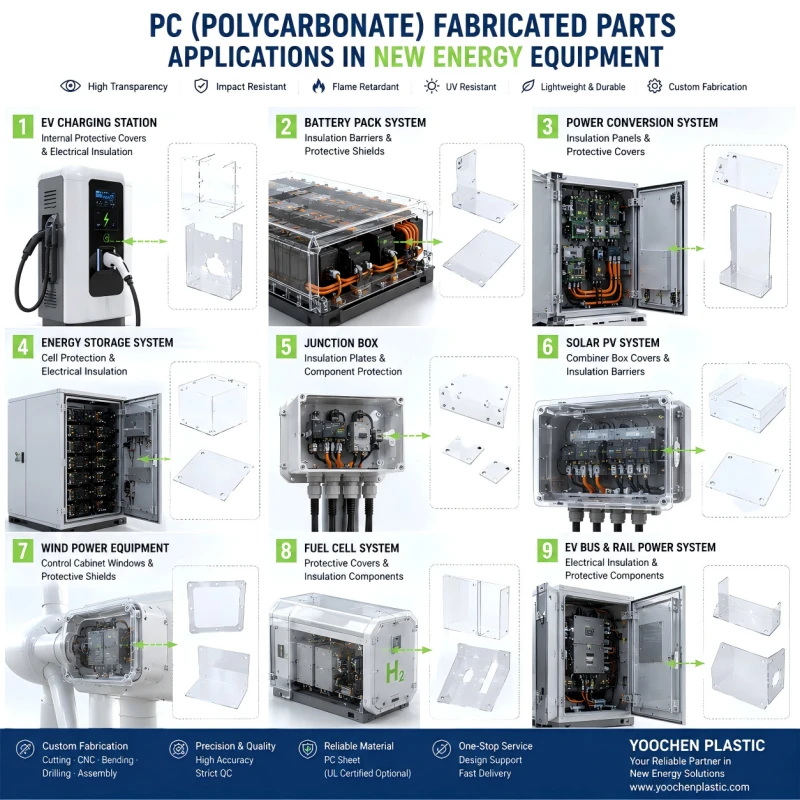





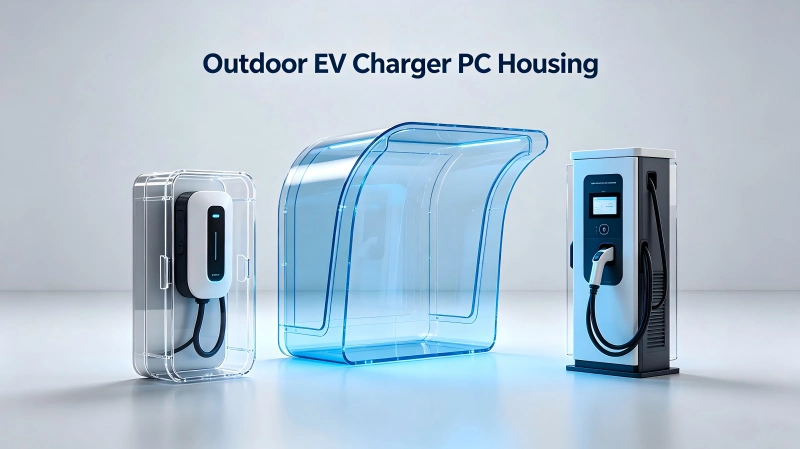
1. Why Outdoor EV Charger Protective Housing Needs Professional Polycarbonate Material
With the rapid popularization of new energy electric vehicles, outdoor EV charging stations have been widely installed in residential communities, commercial parking lots, highway service stations, scenic spots and industrial parks. Different from indoor electrical equipment, outdoor charging equipment is exposed to all-weather, harsh environments all year round, which puts forward extremely high requirements for the protective shell material.
Many new energy equipment purchasers used to choose metal shell, ordinary plastic shell, or acrylic shell in the early stage, but they all encountered various practical problems: metal shell rusts and corrodes in rainy and salt spray environments, acrylic shell becomes brittle and cracked after sun exposure, ordinary ABS shell fades and deforms in high temperatures, and cannot meet long-term outdoor safe operation standards.
At present, ألواح البولي كربونات (PC) has become the most widely recognized and used material for polycarbonate protective housings for outdoor EV chargers in the global new energy industry. It perfectly balances impact resistance, UV aging resistance, flame-retardant safety, electrical insulation, and waterproof and dustproof performance, and addresses almost all outdoor durability pain points for the charging station shell.
Different from ordinary indoor polycarbonate panels, outdoor charger special polycarbonate enclosure materials that need customized functional modification and standardized processing technology. Ordinary civilian polycarbonate sheets will also turn yellow, fog and age quickly if used for charging station shells. This article will fully explain the whole process from material selection standards, parameter matching, processing technology, to defect prevention, helping global buyers avoid material selection mistakes and processing quality risks.
2. Harsh Outdoor Working Conditions for EV Charging Station Equipment
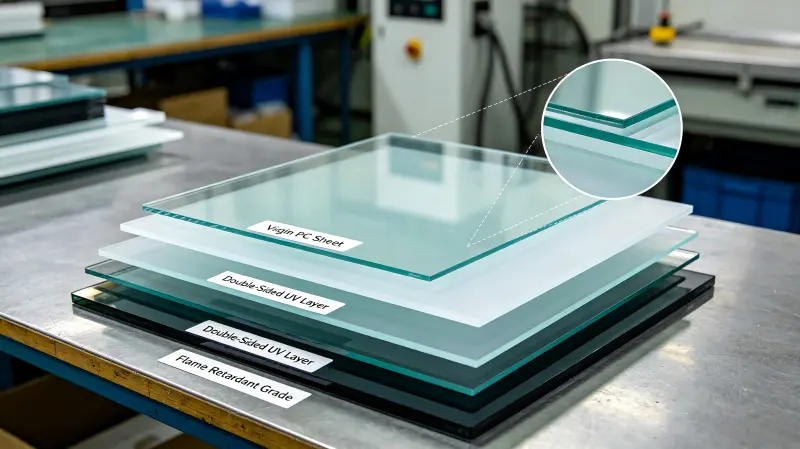
To understand why professional UV-resistant flame-retardant polycarbonate sheet must be selected for charging station shells, we first need to clarify the six major outdoor environmental tests that charging equipment needs to bear for a long time:
2.1. Long-term ultraviolet sun exposure
Outdoor charging stations have no sunshade protection all year round. Strong UV rays will destroy the molecular structure of ordinary plastic materials, causing shell yellowing, fogging, surface cracking and toughness attenuation, which seriously affects the appearance and structural safety.
2.2. Extremely high and low temperature alternating impact
In summer, the surface temperature of outdoor equipment can reach 70℃–80℃; in winter, the low temperature in northern areas can drop to -30℃– -40℃. Frequent temperature alternation will cause thermal expansion and contraction stress of the shell. Unqualified materials will warp, deform and crack after one or two years of use.
2.3. Rainwater erosion and high humidity mildew
Long-term rain washing, dew condensation and high-humidity air will test the waterproof sealing performance and material corrosion resistance of the shell. Ordinary materials are easy to absorb water and deform, resulting in internal water seepage and a short circuit risk of electrical components.
2.4. Salt spray corrosion in coastal areas
Coastal cities have high salt content in the air, which has a strong corrosiveness to metal and ordinary plastic shells. The shell is easy to peel, powder and rust, greatly shortening the service life of charging equipment.
2.5. External collision and impact damage
Parking lot vehicles scratch, pedestrian collision, stone impact and hail weather will test the impact resistance of the shell. Brittle materials are easy to break and lose their protective effect on internal electrical components.
2.6. Electrical fire safety hazard
Charging stations have high-power current operation. Short circuit and overload may cause local high temperatures. The shell must have excellent flame-retardant self-extinguishing performance to prevent fire spread and ensure equipment and public safety.
3. PC Sheet VS ABS VS Metal VS Acrylic: Charger Housing Material Comparison
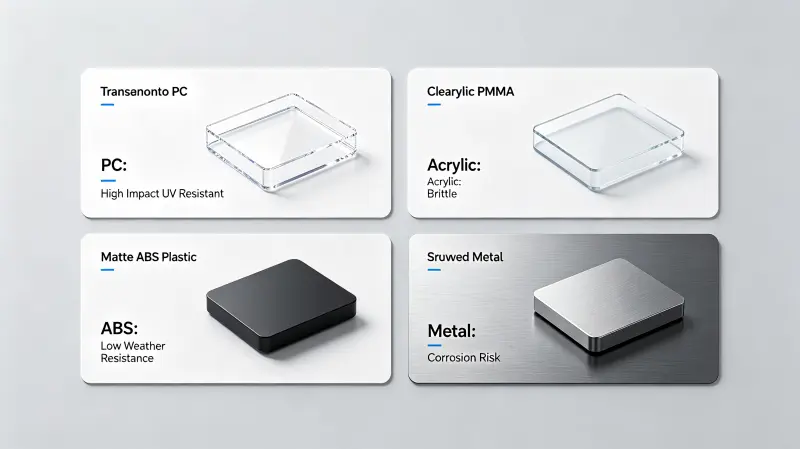
We make a comprehensive and practical comparison of four mainstream charging station shell materials on the market, clearly analyzing the advantages and disadvantages, helping you quickly lock the most suitable outdoor EV charger housing material:
3.1 Metal Shell (Stainless Steel / Galvanized Sheet)
المزايا: High surface hardness, strong structural rigidity, not easy to deform, low initial cost.
Disadvantages: Easy to rust and corrode in humid and salt spray environments; poor insulation performance, needs additional insulation protection; heavy weight, high installation load; single appearance, unable to make transparent and light-transmitting decorative effect; poor weather resistance, easy paint peeling.
Applicable scenario: Only suitable for simple indoor charging equipment; not recommended for high-standard outdoor new energy projects.
3.2 Ordinary ABS Plastic Shell
المزايا: Low cost, easy injection molding, good flexibility, rich molding shapes.
Disadvantages: Extremely poor UV resistance, obvious fading and pulverization within 1 year outdoors; low temperature brittleness, easy cracking in winter; poor flame retardant grade; low impact resistance, easy permanent deformation after collision.
Applicable scenario: Indoor low-power charging equipment, completely not suitable for long-term outdoor use.
3.3 Acrylic (PMMA) Shell
المزايا: High light transmittance, beautiful appearance, smooth surface, good printing performance.
Disadvantages: Very brittle, easy to crack and break under slight impact; poor low-temperature resistance, easy to crack in cold weather; poor toughness, unable to resist hail and external impact; no flame retardant performance.
Applicable scenario: Indoor display transparent cover, absolutely not suitable for outdoor charging station safety protection shell.
3.4 Polycarbonate (PC) Protective Cover
Core Advantages (Industry Exclusive)
1. Super impact resistance: polycarbonate material is known as “unbreakable plastic”, 200 times stronger than acrylic, will not break and produce sharp fragments after collision and hail impact, ensuring equipment and pedestrian safety.
2. Long-term UV anti-aging performance: Double-sided co-extruded UV-resistant polycarbonate sheet can resist outdoor sun exposure for 10–15 years, with no yellowing, no fogging, and no cracking.
3. Ultra-wide temperature resistance: Stable performance from -40℃ low temperature to 120℃ high temperature, with no deformation and brittleness in extreme weather.
4. Excellent flame retardant safety: Professional modified polycarbonate sheet reaches UL94 V0 flame retardant grade, self-extinguishing within seconds after leaving the fire, with no molten droplet spreading fire.
5. Reliable electrical insulation: High insulation resistance, effectively isolating current leakage risk, fully compliant with new energy electrical safety standards.
6. Corrosion and salt spray resistance: Resist rainwater, dew, acid-base gas and coastal salt spray erosion, no rust and corrosion.
7. Flexible processing performance: Support vacuum forming, bending, CNC cutting, drilling, silk screen printing, and can realize various curved and personalized shell shapes.
Applicable scenario: All outdoor wallbox chargers, DC fast charging stations, and commercial new energy charging equipment are the only long-term stable and safe outdoor charging station shell materials.
4. Core Performance Standards for Qualified Outdoor Charger Polycarbonate Enclosure
Not all polycarbonate sheets can be used for outdoor EV charger polycarbonate enclosure production. Ordinary civilian polycarbonate sheets lack functional modification and cannot pass new energy industry safety tests. We summarize the five mandatory core standards for qualified charging station special polycarbonate materials, which are also the key basis for buyers to inspect suppliers:
4.1. Double-sided UV co-extrusion anti-aging layer (mandatory)
The surface of the polycarbonate sheet must have a unified thickness UV protective layer formed by the co-extrusion process, not manual spraying coating. The co-extruded UV layer is integrated with the substrate, not easy to peel off, and can effectively block ultraviolet radiation, delaying material aging and yellowing. Ordinary single-sided UV or non-UV polycarbonate sheets will turn yellow and fog within 1–2 years outdoors.
4.2. UL94 V0 high flame retardant grade
Outdoor charging equipment belongs to public electrical facilities, and the shell must meet the V0 flame retardant standard. After ignition, it self-extinguishes quickly, with no open flame combustion and no molten droplet dripping, avoiding fire diffusion caused by circuit failure. Ordinary V2-grade polycarbonate is only suitable for indoor use and cannot pass outdoor engineering acceptance.
4.3. High-low temperature cycle resistance
After 1000 times of -40℃ to 80℃ temperature cycle test, the polycarbonate enclosure has no warping, cracking, shrinkage and deformation, and the structural size remains stable, adapting to seasonal temperature changes in all regions of the world.
4.4. Salt spray and corrosion resistance
Pass 168-hour continuous salt spray test, the surface has no pulverization, peeling and corrosion, the internal molecular structure is stable, specially adapted for coastal high humidity and high salt environment.
4.5. High transparency and surface hardness
High-quality charging station polycarbonate enclosure has a light transmittance of more than 88%, clear display of internal indicator lights and display screens; surface hardness reaches 3H, resisting daily scratches and friction, maintaining a long-term smooth and beautiful appearance.
5. How to Select the Right Polycarbonate Sheet Grade for Different Charger Types
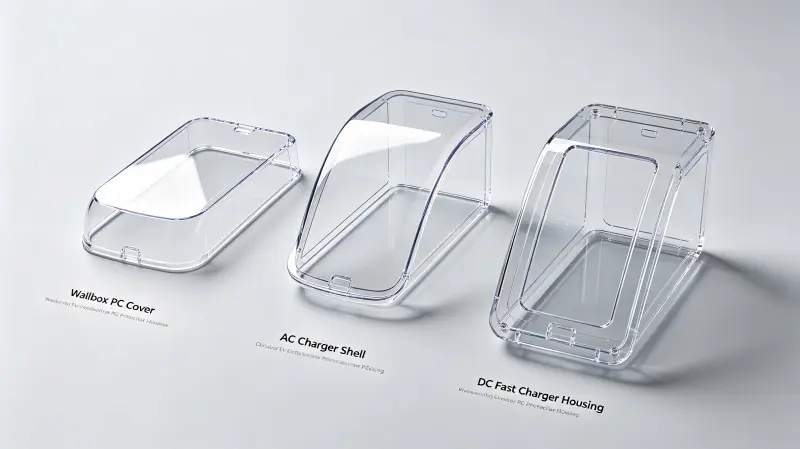
Different types of outdoor charging stations have different power, installation environment and safety levels, and cannot use the same polycarbonate sheet grade. We classify and match the most suitable custom polycarbonate enclosure materials for mainstream charging equipment:
5.1 Household Wallbox EV Charger (Low Power 7kW–11kW)
Environment characteristics: Installed in a residential parking lot, low collision risk, general weather resistance demand, no extreme harsh environment.
Recommended polycarbonate grade: Standard double-sided UV-resistant + UL94 V2 flame-retardant polycarbonate sheet
Reason: Balanced cost performance, stable outdoor anti-yellowing performance, meeting household electrical safety standards, sufficient toughness to resist daily minor scratches and collision.
5.2 Commercial AC Charging محطة (22kW–44kW)
Environment characteristics: Public commercial area, large pedestrian flow, high collision risk, long-term open-air exposure, high safety requirements.
Recommended بولي كربونات grade: Enhanced UV anti-aging + UL94 V0 flame retardant بولي كربونات ورقة
Reason: V0 high flame retardant ensures public fire safety, enhanced UV layer prolongs outdoor service life, and high impact toughness resists accidental collision damage.
5.3 High-Power DC Fast Charging محطة (60kW–180kW+)
Environment characteristics: Highway station, large parking lot, heavy equipment operation, high internal heat generation, strict electrical safety and fire protection standards.
Recommended polycarbonate grade: Industrial-grade weather-resistant flame-retardant polycarbonate / PC-ABS alloy sheet
Reason: PC-ABS alloy material combines PC’s high toughness and ABS’s excellent molding performance, more stable high-temperature resistance, better structural rigidity, no deformation under long-term high-power heat radiation, suitable for high-standard commercial fast charging equipment.
5.4 Coastal & High-Altitude Cold Area Charging Equipment
Environment characteristics: Coastal salt spray corrosion, high-altitude strong ultraviolet radiation, northern extreme low temperature frost and snow weather.
Recommended polycarbonate grade: Super weather-resistant, low-temperature-resistant, flame-retardant polycarbonate sheet
Reason: Special low-temperature resistant formula, no brittleness at -40℃; enhanced anti-corrosion formula, resisting salt spray erosion; thickened UV co-extruded layer, strong anti-aging ability.
6. Standard Polycarbonate Sheet Thickness Selection for Wallbox & DC Fast Charger
Sheet thickness directly determines the structural firmness, impact resistance and service life of outdoor polycarbonate charger housing. Too thin will cause a weak structure and easy deformation; too thick will increase cost and installation burden. We provide the most practical thickness matching standard summarized from mass engineering projects:
6.1. Household wallbox charger transparent cover: 2.0mm–2.5mm polycarbonate sheet
Sufficient toughness and hardness, light weight, beautiful appearance, meeting daily wind and rain protection and scratch resistance requirements, and cost-effective.
6.2. Commercial AC charging station outer protective shell: 3.0mm–4.0mm polycarbonate sheet
Public equipment needs higher structural strength, resisting pedestrian collision and vehicle scratches, a stable structure and not easy to deform after long-term use.
6.3. DC fast charging station large curved housing: 4.0mm–6.0mm polycarbonate sheet
A large-sized curved polycarbonate enclosure has a large stretching range during processing; a thickened sheet avoids local thinning and strength attenuation after vacuum forming, ensuring overall structural safety.
6.4. Vulnerable impact parts (corner, protruding protective cover): 6.0mm–8.0mm thickened polycarbonate sheet
Key stress-bearing and impact-prone positions are thickened in a targeted manner to avoid local damage caused by external force impact and improve the overall anti-collision level of the equipment.
7. Complete Processing Technology of Outdoor Polycarbonate Charger Protective Cover
High-quality raw materials need standardized processing technology to exert performance advantages. Many high-grade polycarbonate sheets have performance attenuation and quality problems after processing, all caused by non-standard operation. Our factory summarizes the full set of industrial standard processing flow for polycarbonate enclosure in charging stations suitable for outdoor new energy equipment:
Step 1: Raw material selection and incoming inspection
Select 100% virgin raw material outdoor special UV flame retardant polycarbonate sheet, reject recycled material and ordinary indoor polycarbonate sheet. Inspect surface transparency, UV layer uniformity, flame retardant grade and sheet thickness tolerance to ensure raw materials meet outdoor engineering standards.
Step 2: Professional pre-drying treatment
Polycarbonate sheet has strong hygroscopicity. Before forming and processing, it must be dried at a constant temperature of 120℃–130℃ according to thickness to remove internal moisture, completely avoid bubble defects on the shell surface after heating processing, and ensure a transparent and smooth appearance.
Step 3: Precision cutting and blanking
According to the shell 3D drawing, use CNC precision cutting equipment to blank, reserve processing margin and assembly tolerance, ensure a neat cutting edge without burrs, and lay the foundation for subsequent molding.
Step 4: Vacuum forming / hot bending shaping
For curved and special-shaped charger shells, adopt the standard polycarbonate vacuum forming process; for flat and simple bent shells, adopt the precise hot bending process. Strictly control heating temperature, heating time and cooling speed to avoid internal residual stress and post-processing deformation.
Step 5: CNC finishing and hole processing
Complete precise trimming, assembly hole drilling, display window grooving and sinking processing to ensure accurate assembly size, no gap, and no jitter after installation.
Step 6: Edge polishing and surface fine treatment
Polish all cutting edges to mirror smoothness, eliminate sharp burrs, clean the surface, remove processing dust and oil stains, and ensure high transparency and a clean appearance of the shell.
Step 7: Waterproof and dustproof structural processing
Process sealing groove, glue groove and assembly clamping position, match waterproof rubber strip installation, and improve the overall IP protection level of the charging station shell.
Step 8: Surface UV screen printing and logo processing
Adopt outdoor weather-resistant UV ink to print the brand logo, parameter text, and warning signs; the printing layer is firm and does not fade for 8–10 years outdoors.
Step 9: Stress relief annealing treatment
For thick polycarbonate forming shells and high-precision assembly parts, professional annealing treatment is carried out to eliminate internal processing residual stress, completely solving the problem of later shell cracking and warping deformation.
Step 10: Finished product quality inspection and packaging
Inspect surface transparency, flatness, dimensional tolerance, waterproof structure, flame-retardant appearance; carry out dust-proof and scratch-proof packaging, adopt shockproof export packaging to avoid transportation damage.
8. Key Vacuum Forming & CNC Processing Details for Polycarbonate Charger Housing
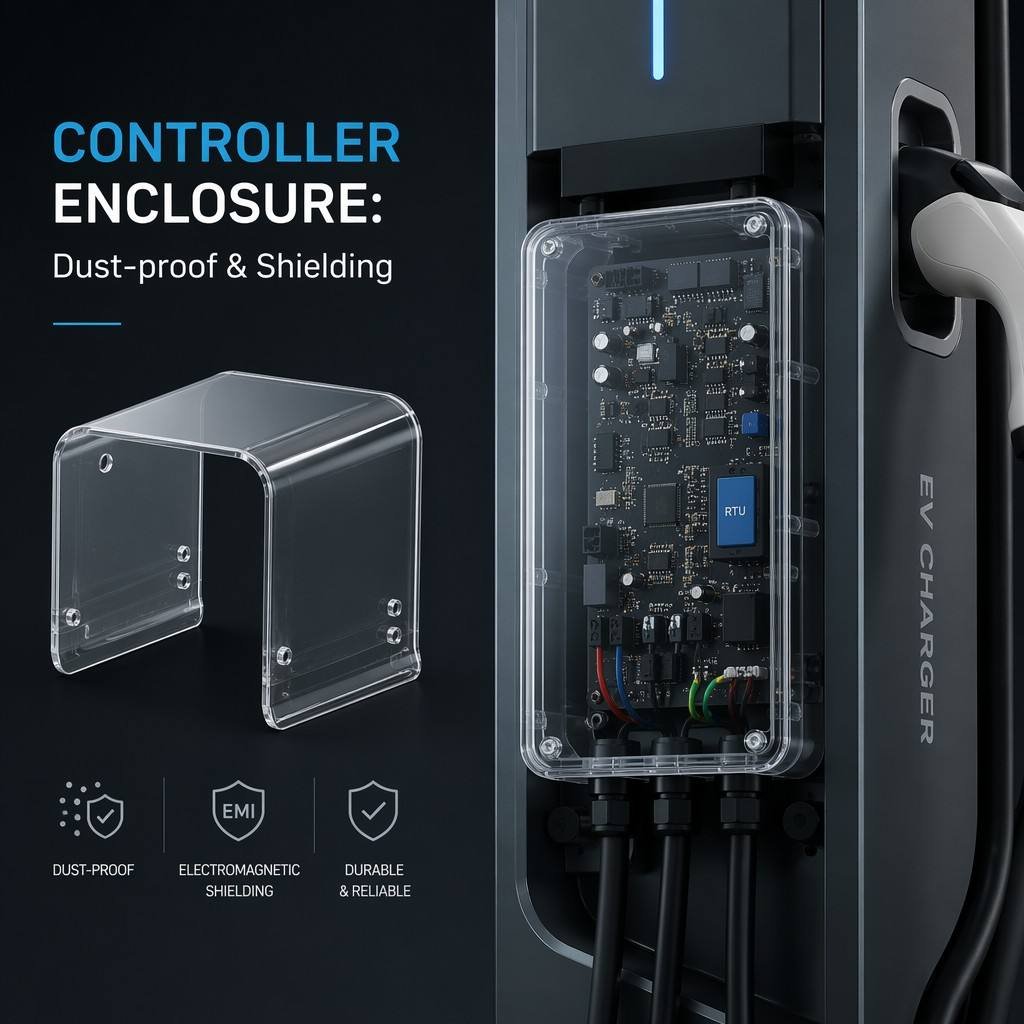
Polycarbonate vacuum forming is the core processing technology for special-shaped, curved charging station shells. Different from ordinary plastic forming, polycarbonate material has strict parameter requirements, and small parameter errors will lead to defective products in batches:
8.1. Strict double-sided uniform heating
The charger shell forming must adopt upper and lower double-sided infrared balanced heating to avoid single-sided heating causing outer overheating and inner under-softening, resulting in uneven shell thickness and poor surface flatness.
8.2. Control reasonable forming sag and tension
Stable heating sag range ensures uniform material stretching, avoids local over-thinning of curved corners, ensures consistent overall impact resistance of the shell, and prevents corner cracking after long-term use.
8.3. Standard mold draft angle and fillet design
All shell corner positions must be rounded, with no sharp right angles, effectively dispersing stretching tension; reserve a standard draft angle to ensure smooth demolding without scratching and deforming the UV protective layer.
8.4. Slow cooling and sufficient pressure holding
After forming, keep vacuum pressure holding and slow cooling, prohibit early pressure release, avoid shell rebound deformation and size deviation, and ensure finished product assembly accuracy.
8.5. CNC high-precision secondary trimming
After forming, manual trimming is prohibited; full CNC automatic trimming is adopted, and the tolerance is controlled within ±0.2mm, ensuring perfect matching with the charging station internal components and assembly frame.
9. Waterproof, Dustproof & Insulation Structure Processing Standards
The core function of outdoor polycarbonate charger housing is protection, so waterproof, dustproof and insulation performance are the key indices of processing quality:
9.1. IP65 waterproof and dustproof structural processing
Process the closed glue groove and pressing groove at the shell assembly gap, match a high-elastic weather-resistant silicone sealing strip, fully block rainwater and dust infiltration, meet the outdoor IP65 protection level standard, and adapt to rainstorm and dusty weather.
9.2. Electrical insulation enhancement treatment
The inner wall of the shell is polished smoothly without burrs and sharp edges, avoiding scratching internal wiring and causing electric leakage; the overall insulation performance of the polycarbonate material is used to isolate external humid air and improve electrical safety.
9.3. Heat dissipation and ventilation structure optimization
Reasonably reserve heat dissipation holes and ventilation gaps according to charging station power, ensure internal hot air circulation and heat dissipation, avoid high temperature accumulation inside the equipment, and prolong the service life of electrical components.
9.4. Anti-loosening assembly structure
Reserve positioning holes and fixing grooves, adopt embedded assembly design, and avoid shell loosening and gap enlargement caused by long-term wind vibration and equipment operation vibration.
10. 8 Common Defects of Polycarbonate Charger Housing & Practical Solutions
Based on years of experience supporting new energy equipment, we summarize the 8 most common quality problems of outdoor polycarbonate enclosure, with clear causes and targeted solutions to help buyers avoid batch quality risks:
Defect 1: Shell surface yellowing and fogging after outdoor use
Cause: Using non-UV or single-sided UV ordinary polycarbonate sheet; insufficient UV coating thickness; recycled material raw material.
Solution: Must adopt double-sided co-extruded UV outdoor special polycarbonate sheet, 100% virgin raw material, reject recycled material mixing.
Defect 2: Small bubbles inside the shell after forming
Cause: polycarbonate sheet not fully pre-dried; residual moisture turns into steam during heating.
Solution: Strictly implement a thickness-matched constant-temperature drying process and prohibit direct forming of undried sheets.
Defect 3: Curved corner thinning and local cracking
Cause: Mold right-angle design, excessive stretching depth, uneven heating.
Solution: All corners are rounded, optimize forming parameters, balance material stretching flow.
Defect 4: Shell warping and deformation after installation
Cause: Large residual internal stress after forming, no annealing treatment, rapid cooling.
Solution: Add post-forming annealing stress relief process, slow cooling and natural shaping.
Defect 5: Poor waterproof performance and water seepage at gaps
Cause: Unsmooth assembly gap, unqualified sealing strip, unreasonable glue groove design.
Solution: Precision CNC trimming, standard sealing groove processing, match high-quality weather-resistant sealing strip.
Defect 6: Surface scratch and low hardness
Cause: Ordinary low-hardness polycarbonate sheet, no surface hardening treatment, rough processing and packaging.
Solution: Select high-hardness outdoor polycarbonate sheet, add surface anti-scratch coating, adopt dust-free processing and anti-scratch packaging.
Defect 7: Fading and peeling of surface printing
Cause: Ordinary indoor ink, no UV weather resistance, unqualified printing process.
Solution: Special outdoor UV weather-resistant ink, professional screen printing process, firm and non-fading for years.
Defect 8: Poor flame retardant effect and easy combustion
Cause: Shoddy material, V2 grade material disguised as V0 grade, insufficient flame retardant modifier content.
Solution: Strictly inspect flame retardant grade incoming materials, provide official test reports, and adopt standard V0 flame retardant polycarbonate sheet for public outdoor equipment.
11. Outdoor Anti-Yellowing & Anti-Aging Maintenance Skills
High-quality polycarbonate enclosure, matched with correct daily maintenance, can extend the outdoor service life to more than 15 years, greatly reducing equipment replacement and maintenance costs:
1. Daily cleaning only uses neutral water and a soft cotton cloth, prohibits acid and alkali detergents and hard brush scrubbing, avoid damaging the surface UV protective layer.
2. Regularly check the shell sealing strip and assembly gap, and replace aging sealing parts in time to maintain waterproof and dustproof performance.
3. Avoid sharp tool collision and heavy object extrusion on the shell surface to protect the complete structural performance of the polycarbonate material.
4. For long-term exposed charging equipment, regular surface dust cleaning can reduce ultraviolet light reflection and aging acceleration.
5. Avoid long-term contact of the shell with chemical solvents such as alcohol and gasoline to prevent surface corrosion and stress cracking.
12. Our One-Stop Custom EV Charger Polycarbonate Enclosure Manufacturing Service
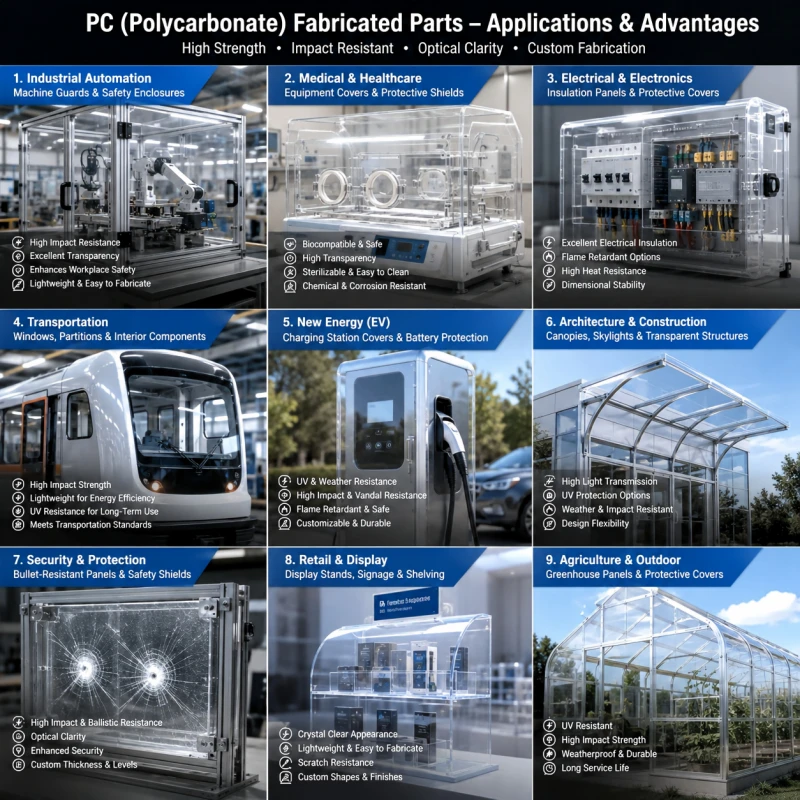
بصفتي محترفًا outdoor new energy polycarbonate enclosure custom manufacturer with 15 years of export experience, we deeply understand the material selection confusion and processing quality pain points of global new energy equipment manufacturers. We integrate independent R&D and production of outdoor functional polycarbonate sheets, mold development, vacuum forming, CNC precision processing, surface treatment and finished product export packaging to provide global customers with truly worry-free one-stop customized services.
12.1. Professional outdoor charger special polycarbonate sheet independent production
We independently produce full-range outdoor UV-resistant, flame-retardant, low-temperature resistant and salt spray resistant polycarbonate sheets for charging stations. All adopt 100% virgin imported raw materials, no recycled materials mixed. We can customize V2/V0 flame retardant grade, single/double-sided UV coating, transparent/frosted matte surface and different thickness specifications according to customer project needs, completely solving the problem of unstable raw material quality of third-party procurement.
12.2. Customized mold development and personalized shaping processing
According to customer 3D drawings and sample requirements, we independently complete vacuum forming mold development and hot bending mold production. Optimize mold structure and processing parameters in advance for charging station shell characteristics such as large curvature, deep drawing and assembly precision, effectively avoiding common defects such as thinning, deformation and poor assembly of special-shaped shells.
12.3. Full standardized processing technology system
We strictly implement the whole process of pre-drying, constant temperature forming, slow cooling shaping, annealing stress relief, CNC finishing and weather-resistant printing. All processes are self-produced and self-processed without external outsourcing, ensuring stable and consistent batch quality of finished products, avoiding quality fluctuation caused by multi-party processing.
12.4. High-precision assembly customization capability
Support precise hole opening, sinking, grooving, embedded nut processing, waterproof sealing structure customization, fully matching various brand charging station internal assembly standards. The finished product has a precise size, tight assembly, no gap and no shaking, reaching high-standard commercial engineering grade quality.
12.5. Flexible order quantity and fast delivery
Support new product prototype proofing, small batch trial production and large-scale engineering batch orders, with no rigid high MOQ limit. With complete production line equipment and standardized process management, we shorten the proofing cycle and mass production cycle, ensuring timely delivery of global new energy projects.
12.6. Complete qualification report & free technical support
All products have complete outdoor aging test report, flame retardant test report, salt spray test report and export certification, meeting global project acceptance standards. Our professional technical team provides free material selection guidance, process optimization suggestions, and defect prevention solutions for customers, helping you reduce project cost and quality risk.
13. Final Purchasing & Processing Summary for Global New Energy Buyers
The outdoor EV charger polycarbonate enclosure is not a simple plastic shell, but a functional safety protection component related to the long-term stable operation of new energy charging equipment. Metal shells are easy to corrode, ABS shells are easy to age, acrylic shells are easy to break, and only professional outdoor modified polycarbonate material can adapt to all-weather outdoor harsh environments for a long time.
In the procurement and customization process, material grade selection, thickness matching, processing technology control and structural design are equally important. Simply pursuing low price and ignoring material function and process standard will lead to frequent later maintenance and equipment safety hazards, which greatly increase the comprehensive project cost.
If you are looking for a stable-quality, high-standard custom polycarbonate enclosure supplier for new energy charging station projects, our factory can provide a one-stop solution from material selection optimization, process customization, to finished product delivery.