






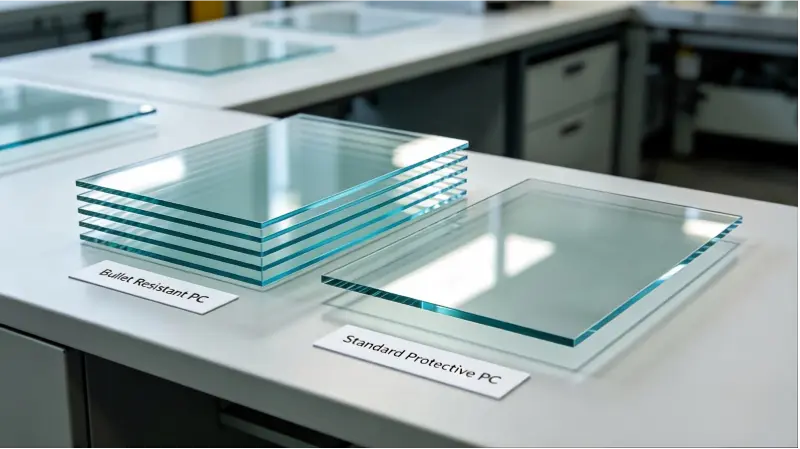
For security engineering contractors, bank renovation suppliers, prison construction manufacturers, industrial equipment designers, new energy charging station producers, school facility engineers and global foreign trade procurement buyers, there is a very high-risk material selection confusion between bullet resistant polycarbonate sheet (also called ballistic resistant polycarbonate sheet) e single-layer sólido standard protective polycarbonate sheet.
Both two products belong to solid polycarbonate raw material series, with double-sided UV co-extrusion anti-aging coating available, basic flame retardant properties, and much higher impact resistance than glass, acrylic or PS sheet. They are all transparent substitute materials for safety isolation windows and protective barriers. But the core design purpose, internal material structure, ballistic stopping capacity, thickness standard, weight, production process, raw cost, machining limitation and applicable safety level are completely different.
A large number of buyers only see that both materials are transparent hard polycarbonate panels, blindly choose cheaper thin standard protective polycarbonate sheet for high-risk security places such as bank service counters, police station isolation barriers, prison observation windows, armed checkpoint shields. After violent impact, hammer smashing or intentional shooting, the thin single-layer standard polycarbonate will be completely penetrated, causing serious personal injury, security leakage and huge legal compensation loss.
This full-dimensional comparison guide thoroughly splits all core gaps between bullet resistant grade polycarbonate and standard protective polycarbonate sheet, starting from raw material composite structure, ballistic resistant test data, anti-violent vandalism performance, thickness & weight difference, raw material and full lifecycle comprehensive cost, outdoor UV weather resistance, flame retardant fire safety, electrical insulation, cold bending & CNC machining limit, daily maintenance difficulty, classification of applicable high-risk security / low-risk civil industrial scenarios, and sorts out all common wrong selection safety accidents with corresponding correction plans. All professional test indicators are explained with simple daily words without complicated industry jargon.
At the end of this article, we fully introduce our factory’s one-stop integrated production and deep custom processing service for both ballistic resistant polycarbonate sheet and ordinary standard protective solid polycarbonate sheet. Our complete full-process production machines were fully upgraded and fully put into production operation in June 2026, including professional polycarbonate multi-layer laminating production line, thick plate CNC cutting equipment and special composite plate edge polishing machines. We can finish all laminating, cutting, forming, drilling, coating, silk printing procedures inside our own workshop, helping global customers obtain finished safety polycarbonate protective covers without cooperating with multiple separate raw material factories and outsourcing processing vendors.
Chapter 1: Basic Structural Definition & Core Feature Quick Preview
1.1 What Is Bullet Resistant Grade Composite Polycarbonate Sheet (Ballistic Resistant Polycarbonate Sheet)
Bullet resistant polycarbonate sheet is not a single-layer integral solid polycarbonate plate like ordinary protective polycarbonate. It is a multi-layer composite laminated safety panel manufactured through professional high-temperature, high-pressure laminating production line. The production formula uses high-toughness modified ballistic-grade polycarbonate raw film and special transparent adhesive layers to stack multiple layers of polycarbonate sheet together under constant temperature and pressure, forming an integrated thick composite sheet with interlayer buffer energy absorption structure.
The core design target of bullet resistant polycarbonate is to absorb and disperse huge instantaneous kinetic energy generated by bullets, iron hammers, steel bars, axes and other violent impact objects. When a projectile or heavy impact hits the surface, each polycarbonate layer and adhesive interlayer will deform, stretch and consume impact energy layer by layer, finally stop the projectile from penetrating the whole sheet, avoid splashing sharp fragments and protect personnel behind the barrier.
All ballistic resistant polycarbonate finished panels support double-sided UV weather-resistant coating, UL94 V0 flame retardant modification, 3H anti-scratch hard coating surface treatment. Its inherent disadvantages are heavy self-weight, much higher raw production cost, small minimum bending radius (thick composite plate basically cannot realize small radian cold bending), complex cutting and polishing processing process, and longer production cycle than single-layer standard polycarbonate.
1.2 What Is Standard Protective Polycarbonate Sheet
Standard safety protective policarbonato folha is a monolithic single-layer extruded solid polycarbonate sheet without any internal composite adhesive interlayer. It is produced through common flat sheet extrusion equipment without secondary high-pressure laminating process. The raw material is general-purpose industrial grade polycarbonate resin without ballistic special modification formula.
Its basic safety performance only meets conventional low-risk anti-collision, anti-hail, anti-light vandalism demand: it can resist accidental falling heavy objects, trolley collision, small hail impact, light stone throwing and daily equipment splash isolation. But it does not have layered energy absorption buffer structure. Once facing concentrated violent impact such as heavy iron hammer continuous strike, steel bar stabbing or bullet shooting, the single-layer integral plate will produce penetrating cracks and be completely broken through easily, losing all safety protection function instantly.
Conventional standard protective polycarbonate sheet thickness covers 0.5mm thin insulation plate to 18mm thick single-layer safety sheet, transparent, smoke gray, milky white color optional, can be equipped with double-sided UV outdoor coating, hard scratch resistant coating and V0 flame retardant treatment. Its core advantages are light self-weight, low raw material unit price, simple extrusion production, flexible cold bending forming, fast CNC processing, short mass production delivery cycle, widely used in civil, industrial, new energy low-risk protection scenes without violent attack hidden danger.
1.3 Antevisão da tabela de resumo rápido dos prós e contras
Core Unique Advantages of Bullet Resistant Composite Polycarbonate Sheet
✅ Multi-layer laminated buffer energy absorption structure, professional ballistic grade can stop different types of bullets, pass international ballistic security certification
✅ Super anti-violent vandalism capacity: resist continuous heavy hammer smashing, steel bar stabbing, axe chopping, crowd violent impact without penetration
✅ No sharp fragment splashing after strong impact, interlayer adhesive locks broken polycarbonate fragments inside composite sheet, secondary injury risk eliminated
✅ Thick overall structural rigidity, strong anti-break performance under long-term repeated concentrated impact
✅ Customizable multi-level ballistic protection thickness according to security risk grade, meet bank, prison, checkpoint high-standard safety acceptance
✅ Double-sided UV coating version supports long-term outdoor security barrier use, 10–15 years outdoor service life without serious aging
✅ Can be modified to UL94 V0 highest flame retardant grade, pass public high-security building fire safety inspection
Main Disadvantages of Bullet Resistant Composite policarbonato Folha
❌ Multi-layer laminating complex production process, raw material and processing cost 120%–300% higher than equal-thickness single-layer standard protective polycarbonate
❌ Heavy self-weight, per square meter weight far exceeds single-layer polycarbonate of same total thickness, requires thicker dense steel support frame during installation
❌ Thick composite laminated structure cannot realize small-radius cold bending forming, only large gentle arc hot bending with high scrap rate available
❌ Special thick plate CNC cutting, edge polishing equipment required, processing cycle longer than ordinary single-layer polycarbonate
❌ Large-size whole sheet transportation needs shockproof wooden box packaging, higher logistics freight cost compared with thin standard polycarbonate sheet
Core Advantages of Standard Single-Layer Protective Polycarbonate Sheet
✅ Simple one-time extrusion production, no secondary laminating procedure, low raw material per square meter cost for mass low-risk protection projects
✅ Light self-weight, convenient manual transportation and installation, sparse light aluminum keel support enough for construction
✅ Wide cold bending forming range, minimum bending radius only 1.5 times sheet thickness, can make various small radian curved protective covers, skylight arcs
✅ Fast CNC laser cutting, drilling and edge polishing processing, short sample and bulk order delivery cycle
✅ Rich color and light transmittance options, frosted, tinted transparent grades meet industrial, decoration, new energy diversified appearance demand
✅ Hard coated surface optional, resist daily cleaning scratches for charging station, self-service equipment touch panels
Main Disadvantages of Standard Single-Layer Protective Polycarbonate Sheet
❌ No layered energy absorption buffer structure, cannot stop bullets or resist continuous heavy violent hammer impact, easy to be penetrated under intentional attack
❌ After being hit by heavy concentrated force, large sharp broken fragments will splash out, cause secondary cut injury to surrounding personnel
❌ Thin standard polycarbonate below 6mm cannot bear long-term heavy load and strong wind vibration, easy to crack after years of outdoor alternating cold and hot circulation
❌ Cannot pass international ballistic safety certification, forbidden to use in high-risk armed security, detention, financial service isolation scenes
Chapter 2: Core Structural & Ballistic Performance Contrast (Most Critical Differentiation Index)
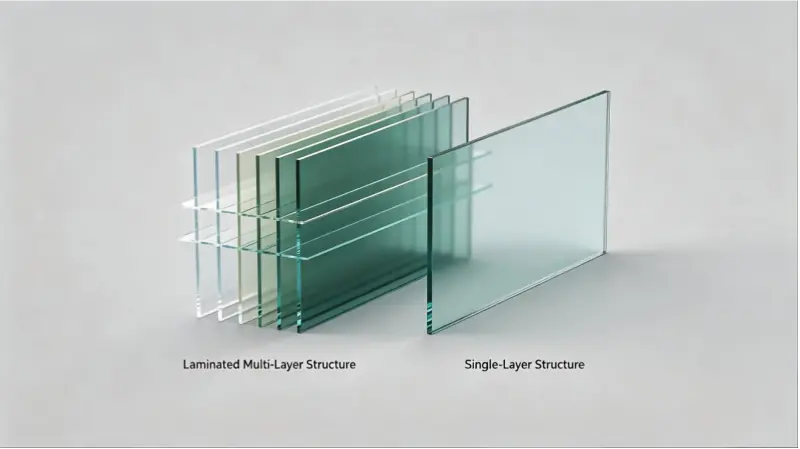
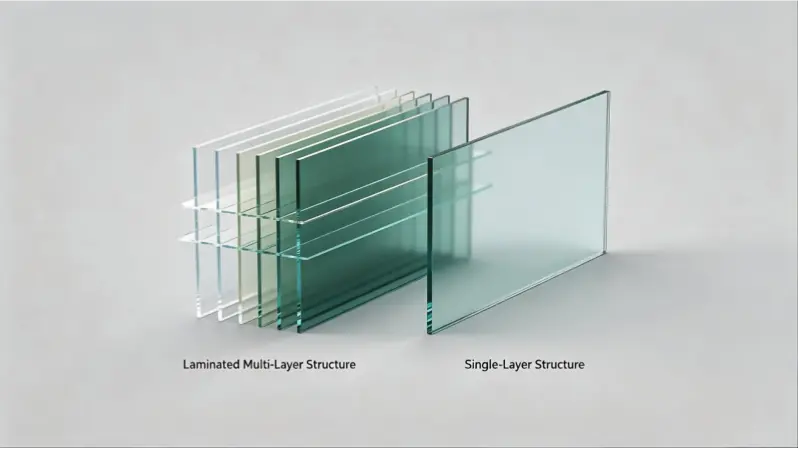
The biggest essential gap between bullet resistant polycarbonate and standard protective polycarbonate lies in internal composite structure and ballistic energy absorption capacity. This performance gap cannot be eliminated by increasing the thickness of single-layer standard polycarbonate sheet alone. Even if you use 20mm thick single-layer standard polycarbonate, it still cannot reach the bullet stopping effect of 15mm laminated bullet resistant composite polycarbonate.
2.1 Internal Material Structure Cross Section Comparison
- Bullet resistant composite polycarbonate internal structure:
Multi independent polycarbonate solid thin layers + transparent high-viscosity impact absorption adhesive interlayers, stacked and integrated through a high-temperature, high-pressure laminating line. When impact force is transmitted to the sheet surface, each layer will independently deform, stretch and disperse kinetic energy layer by layer. The adhesive film can tightly bond broken polycarbonate fragments together, preventing fragment splashing penetration even if local polycarbonate layer cracks. - Standard single-layer protective polycarbonate internal structure:
One complete integral extruded polycarbonate plate, zero internal buffer adhesive interlayer. Impact force can only be resisted by the toughness of single polycarbonate resin itself. Once the instantaneous impact energy exceeds the bearing limit of the single-layer material, the whole plate will crack straight through, and broken fragments will separate and fly out without any interlayer adhesion restraint.
2.2 Uniform Ballistic Shooting Test Data & Practical Effect
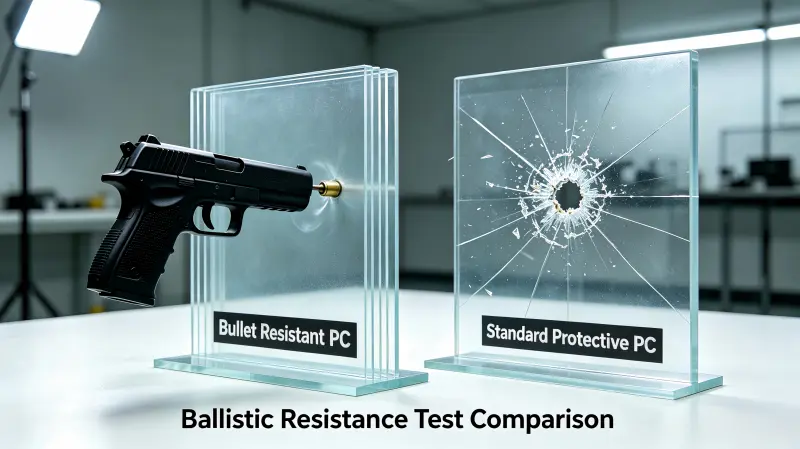
Unified international standard ballistic test environment, compare 15mm total thickness bullet resistant composite polycarbonate VS 15mm thick single-layer standard protective polycarbonate sheet:
- 9mm pistol bullet test shooting:
- Bullet resistant composite polycarbonate: Bullet is blocked inside the multi-layer interlayer, only shallow surface dent, no penetration, no fragment splashing behind the sheet.
- Single-layer standard 15mm polycarbonate sheet: Bullet directly penetrates the whole plate, large sharp polycarbonate fragments fly to the back test area, completely loses protection function.
- .38 revolver projectile impact test:
- Ballistic grade composite polycarbonate: Interlayers absorb all kinetic energy, projectile stuck inside laminated structure, back surface remains intact without through hole.
- Standard single-layer thick polycarbonate: Through crack formed instantly, fragments splash widely.
Scene practical rule: Any location with gun attack risk, intentional violent weapon impact hidden danger must adopt formally certified bullet resistant composite polycarbonate sheet; single-layer standard polycarbonate cannot satisfy basic anti-ballistic safety demand no matter how thick you choose.
2.3 Anti-Violent Vandalism Heavy Hammer Impact Test
Test condition: 5kg solid iron hammer continuous 10 times heavy strike at the same position of 12mm total thickness panels:
- Bullet resistant laminated polycarbonate: Only obvious concave indentation on surface, internal layers slightly separated locally, no through crack, cannot be broken through by manual hammer smashing.
- Standard single-layer 12mm protective polycarbonate: After 3–4 times continuous heavy hammer strikes, straight penetrating crack appears on the plate; continuing to hit will break the whole sheet into large sharp pieces, easy to be pried open and break through the isolation barrier manually.
High-risk security site requirement: Bank counters, detention room observation windows, armed police station isolation partitions, toll checkpoint anti-riot barriers must use bullet resistant composite polycarbonate to resist intentional man-made violent damage; standard polycarbonate only applies to accidental light collision scenes without intentional attack risk.
Chapter 3: Thickness, Self-Weight & Full Lifecycle Cost Comprehensive Comparison
Most procurement buyers only compare the per square meter raw price, ignore the subsequent steel frame construction cost, security accident compensation risk, whole plate replacement loss caused by wrong material selection in later years. We split cost and weight analysis into three dimensions: thickness grading standard, self-weight construction load difference, short-term raw purchase cost and long-term full lifecycle comprehensive expenditure.
3.1 Thickness Grading Standard Matching Different Protection Levels
Bullet Resistant Composite Polycarbonate Thickness & Security Grade Matching
- 12mm laminated bullet resistant polycarbonate: Basic anti-light pistol bullet, anti-axe, anti-steel bar stabbing, suitable for low-risk financial community service windows, small office security isolation counter.
- 18mm–25mm bullet resistant composite polycarbonate: Medium ballistic protection, stops 9mm full power pistol bullet, resist long-time heavy hammer smashing, widely used in commercial bank main counter barrier, police station reception isolation window.
- 30mm–50mm thick multi-layer ballistic resistant polycarbonate: High-level ballistic security, resist rifle low-power projectile, anti-riot heavy equipment impact, mandatory for prison cell observation window, armed checkpoint anti-riot shield, public security detention area partition.
Standard Single-Layer Protective Polycarbonate Thickness & Low-Risk Protection Matching
- 1mm–3mm thin standard polycarbonate: Indoor equipment observation window, household appliance transparent panel, light indoor partition, only resists slight scratches and light falling small objects.
- 4mm–8mm medium thickness standard polycarbonate: EV charging station panel, bus shelter transparent wall, supermarket ceiling skylight, anti-hail agricultural greenhouse sheet, resists hail, trolley collision, stone throwing without intentional violent attack.
- 10mm–18mm thick single-layer standard polycarbonate: Factory machine safety guard, playground anti-collision barrier, villa courtyard carport roof, only bears accidental heavy object fall, no anti-gun, anti-heavy riot impact function.
3.2 Per Square Meter Self-Weight Load Comparison (Take 15mm total thickness as unified benchmark)
- 15mm multi-layer laminated bullet resistant composite polycarbonate: About 12.8–13.5 kg per square meter
- 15mm single-layer standard protective solid polycarbonate: About 7.2–7.6 kg per square meter
Weight gap construction influence analysis:
- Transportation & handling: Thin standard polycarbonate is light, two workers can carry dozens of square meters material without lifting equipment; thick bullet resistant composite polycarbonate is heavy, needs forklift, wooden shockproof packing, more handling labor and high long-distance ocean freight cost for large orders.
- Auxiliary steel support frame investment: Light standard polycarbonate only needs thin aluminum alloy keel with long installation interval; heavy bullet resistant polycarbonate barrier requires thick dense steel frame and embedded fixed base to prevent long-term sagging deformation, the additional steel structure investment will increase total construction budget by 30%–60% for full security wall projects.
3.3 Raw Material Unit Price Contrast (15mm thickness benchmark)
- 15mm single-layer standard transparent protective polycarbonate sheet: Baseline cost 100%, lowest initial raw material procurement expense
- 12mm basic grade bullet resistant composite polycarbonate: Raw material total cost 130%–180% higher than equal thickness single-layer standard polycarbonate
- 18mm medium ballistic bullet resistant polycarbonate: Raw cost 200%–250% higher than 15mm standard polycarbonate
- 30mm high-level anti-rifle ballistic resistant composite polycarbonate: Unit price 280%–320% higher than ordinary 15mm single-layer protective polycarbonate
3.4 Full Lifecycle Comprehensive Expense Calculation (Two Typical Engineering Cases)
Case 1: Commercial bank downtown counter barrier, high risk of intentional violent impact, expected 15 years service life
- Scheme A: 20mm certified bullet resistant composite UV polycarbonate sheet
Higher upfront raw material and steel frame investment, formal ballistic security certification passed, can resist pistol bullet and long-time heavy hammer vandalism, stable intact use 10–15 years without whole plate replacement, zero security accident compensation risk, meet banking industry safety acceptance standard at one time. - Scheme B: 20mm thick single-layer standard protective polycarbonate sheet
Lower one-time raw material purchase cost, but cannot pass ballistic inspection; once robbery, hammer smashing security accident happens, the standard polycarbonate will be penetrated easily, leading to staff injury, property loss, huge bank liability compensation and brand reputation collapse. Within 5 years, the bank must remove all standard polycarbonate and replace with certified bullet resistant composite sheet, repeated material purchase, disassembly and steel frame reconstruction labor cost total expenditure reaches 3–5 times of bullet resistant polycarbonate initial investment.
Case 2: Factory CNC machine indoor safety transparent guard, zero gun or riot impact risk, service life 8–10 years
- Scheme A: 6mm single-layer standard UV protective polycarbonate sheet
Low total raw, transportation and auxiliary frame cost, enough to resist flying metal scraps, accidental tool drop, trolley collision inside workshop, no security hidden danger under factory low-risk environment, 8–10 years stable service without replacement, lowest comprehensive lifecycle expense. - Scheme B: 12mm bullet resistant composite polycarbonate sheet
Unnecessary excessive safety grade, heavy self-weight raises steel frame and freight cost, small arc curved machine guard cannot be cold bent with thick laminated ballistic resistant polycarbonate, processing scrap rate increases, total investment rises 140% without actual functional demand, serious cost waste.
Chapter 4: Mechanical Performance: Anti-Vandal, Drop Impact, Tensile & Fragment Splash Contrast
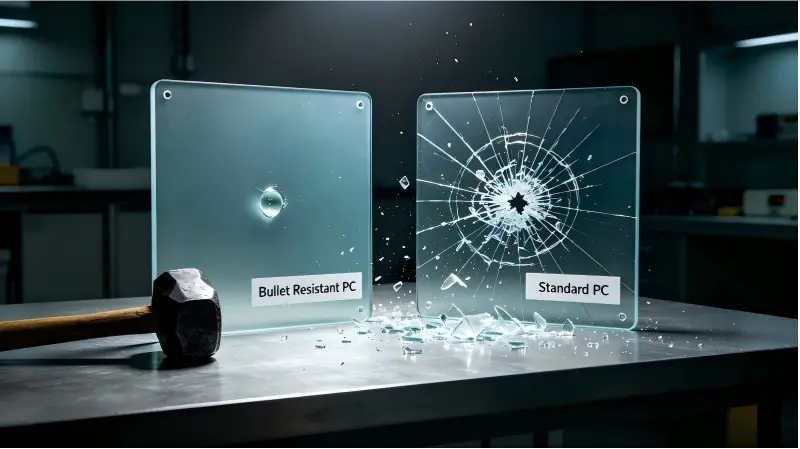
Aside from ballistic bullet resistance, there are obvious gaps in daily heavy-impact resistance, fragment-splash risk, and long-term load-deformation performance between the two polycarbonate materials.
4.1 Heavy Object Drop Impact Test
Test condition: 5kg steel block free fall from a height of 3 meters onto 12mm thickness panels:
- Bullet resistant laminated composite polycarbonate: Local surface dent, internal layers slight separation, no through crack, fragments locked by adhesive interlayers without splashing backward.
- Single-layer standard 12mm polycarbonate: Deep penetrating crack runs through the whole plate, large sharp polycarbonate fragments fly to the back area, easy to cut people’s skin and eyes.
4.2 Fragment Splashing Secondary Injury Prevention Performance
This index is the core safety standard for public and financial security places:
- Bullet resistant composite polycarbonate: Multi-layer adhesive interlayers firmly bond all cracked polycarbonate fragments, even if local layers crack under extreme impact, no sharp fragment can separate and fly out, eliminating secondary cut injury risk for staff behind the barrier.
- Standard single-layer solid polycarbonate: No interlayer adhesion restraint, once broken by concentrated heavy force, independent large sharp fragments will splash in all directions, causing serious secondary injury accidents in crowded public security scenes.
4.3 Long-Term Load & Wind Vibration Dimensional Stability
- Bullet resistant thick composite polycarbonate: Multi-layer stacked integral structure, high overall rigidity, not easy to sag under long-term self-weight load, thick plate can resist typhoon-level strong wind vibration without cracking, suitable for large-area outdoor security wall long-term fixed installation.
- Thin & medium thickness standard single-layer polycarbonate: Long-term large-span installation without dense keel support will produce slow creep sagging deformation; after 3–5 years outdoor alternating cold and hot circulation plus strong wind resonance vibration, the crack damage probability increases significantly. Thick 15–18mm single-layer polycarbonate can reduce sagging risk but still cannot match composite ballistic resistant polycarbonate structural rigidity.
Chapter 5: Outdoor UV Weather Resistance, Flame Retardant & Electrical Insulation Performance
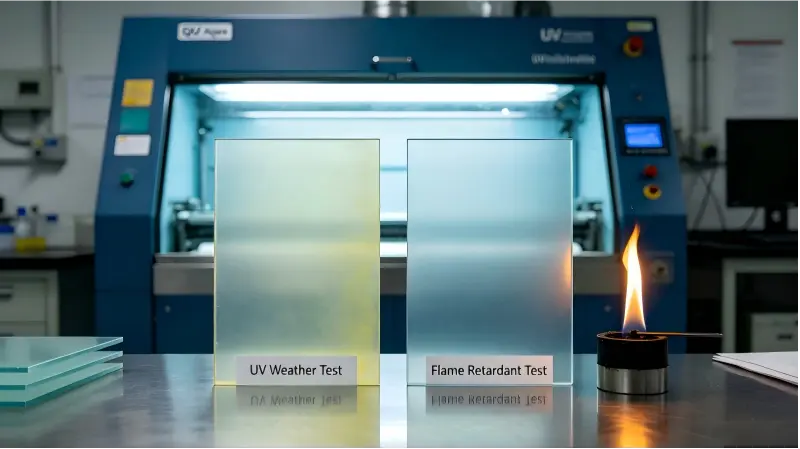
The raw polycarbonate resin base of bullet resistant composite sheet and standard protective polycarbonate is consistent, so the basic UV anti-yellowing, flame retardant and insulation parameters are close, the difference only appears on composite interlayer adhesive’s high-low temperature aging resistance.
5.1 QUV Accelerated UV Aging Test Result (2000 hours equivalent to 5–8 years natural sunlight)
- Double-sided UV-coated bullet-resistant composite polycarbonate: Surface polycarbonate layers yellowing index ΔE < 5, special high weather resistant transparent adhesive interlayer no delamination or bubbling after long-time irradiation, factory outdoor warranty 10–15 years without interlayer separation failure.
- Double-sided UV standard single-layer protective polycarbonate: Yellowing index ΔE < 4, no internal adhesive layer aging hidden trouble, surface flatness keeps stable after long sun exposure, outdoor service life also reach 10–15 years on the premise of no violent concentrated impact.
- Single-sided uncoated polycarbonate (both ballistic resistant and standard): Unprotected side faces sunlight will yellow rapidly within 2–3 years, only for indoor indirect light use, forbidden for full outdoor security barrier projects.
5.2 High & Low Temperature Cycle Aging Hidden Trouble Difference
- Bullet resistant composite polycarbonate hidden risk: If the interlayer adhesive uses low-quality ordinary glue, after repeated -40℃ ~ +70℃ temperature circulation for several years, interlayer bubbling, delamination and separation will appear, reduce ballistic protection effect greatly. Our factory adopts imported high temperature resistant ballistic special adhesive to eliminate this hidden trouble.
- Standard single-layer polycarbonate hidden risk: No internal adhesive interlayer, temperature cycle only affects surface gloss, no delamination or bubbling failure mode, more stable in extreme temperature environment from the perspective of internal structure.
5.3 Flame Retardant Fire Safety Performance
Both bullet resistant composite polycarbonate and standard protective polycarbonate base resin can be modified to UL94 V0 highest flame retardant grade, meet construction B1 fire resistance standard for public buildings, banks, detention houses and factory workshops:
- Burning test performance consistency: Ignite both materials, self-extinguish within 10 seconds after removing fire source, no flaming molten dripping that spreads fire, thin low-toxicity smoke released during combustion.
- Minor difference: Bullet resistant composite polycarbonate multi-layer adhesive interlayer slightly extends total self-extinguishing time by 1–2 seconds compared with single-layer standard polycarbonate, but still fully meets international public building fire inspection standard without safety hidden danger.
5.4 Electrical Insulation & Dielectric Strength
The surface polycarbonate layer of bullet resistant composite polycarbonate shares the same electrical parameters with standard solid polycarbonate sheet:
- Volume resistivity >10¹⁶ Ω·cm, dielectric strength 30–40 kV/mm, stable insulation performance under 85℃/85%RH high humidity environment.
- Application limit: Thick bullet resistant composite polycarbonate interlayer adhesive will produce tiny air gaps during laminating, not recommended for ultra-high voltage electrical insulation partition parts; single-layer standard solid polycarbonate is more suitable for new energy battery, charging station internal insulation baffles without interlayer air gap hidden danger.
Chapter 6: Machining Performance: Cold Bending, CNC Cutting, Drilling & Edge Polishing
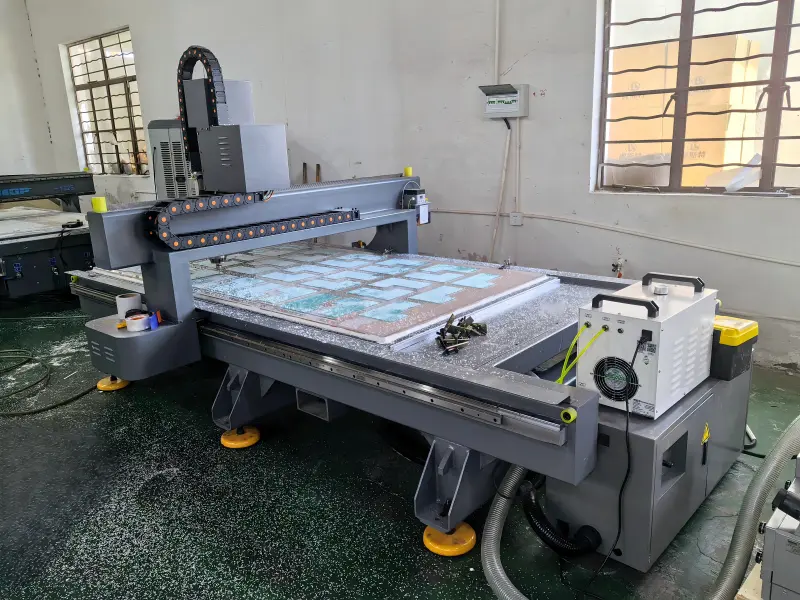
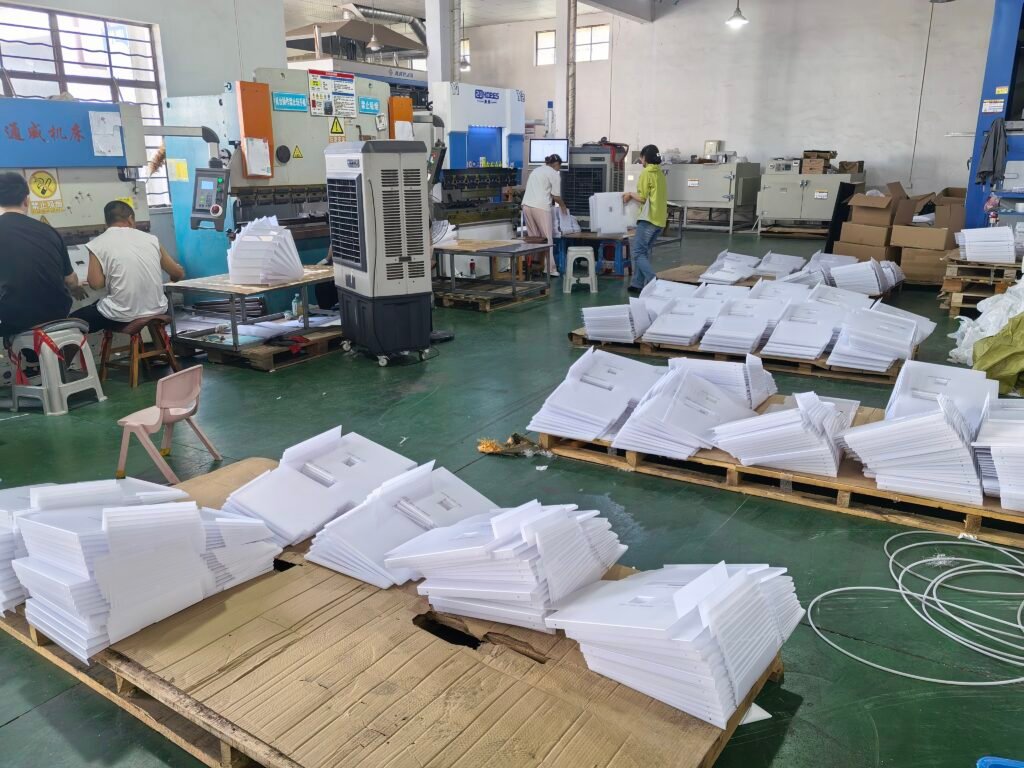
The multi-layer laminated thick structure of bullet resistant polycarbonate brings obvious processing limitation gap compared with thin monolithic standard protective polycarbonate sheet.
6.1 Cold Bending Forming Capacity (Largest Processing Performance Gap)
- Standard single-layer protective polycarbonate sheet: Supports room temperature cold bending without heating, minimum bending radius only needs 1.5 times sheet thickness, can make all kinds of small radian curved machine guards, curved charging station panels, arched sun room skylights. Our workshop 5 cold bending machines mass produce curved standard polycarbonate finished parts efficiently.
- Bullet resistant multi-layer composite polycarbonate sheet: Thick stacked interlayer structure cannot realize small-radius cold bending, forced cold bending will cause interlayer adhesive delamination, bubbling and surface polycarbonate layer cracking, scrap rate reaches 100%. Only super large gentle hot bending arc can be tried with high reject rate, all small radian curved security protection projects cannot select bullet resistant composite polycarbonate material.
6.2 CNC Laser Cutting & Precision Drilling
Our 6 CNC routers and 5 high-power laser cutting machines can process both two polycarbonate materials, processing tolerance controlled within ±0.1mm, but practical operation difference is huge:
- Standard single-layer polycarbonate processing advantage: Low cutting difficulty, fast laser cutting speed, neat hole edge without layering separation, low power consumption, high mass production efficiency for flat thin plate orders.
- Bullet resistant composite polycarbonate processing attention: Must adjust special low-speed high-power cutting parameters to avoid interlayer adhesive melting and delamination at cutting edge; drilling needs multi-step gradual drill bit to prevent layered crack around hole edge, processing time per piece increases 60%–90% compared with equal thickness single-layer standard polycarbonate, higher processing labor cost.
6.3 Edge Polishing & Sealing Treatment
- Standard single-layer polycarbonate: Ordinary edge polishing machine can process mirror smooth transparent edge quickly, low polishing equipment requirement and short processing time.
- Bullet resistant composite polycarbonate: Needs our factory special thick composite plate multi-head polishing production line to grind layered cross-section flat and smooth, prevent water, dust infiltration into interlayer gap causing later bubbling delamination; single ordinary polishing equipment cannot finish thick laminated polycarbonate edge treatment qualified.
6.4 Vacuum Thermoforming
- Standard single-layer polycarbonate sheet: Wide thermoforming temperature window, suitable for deep drawing 3D protective housings with our 2 vacuum thermoforming machines.
- Bullet resistant composite polycarbonate sheet: Forbidden for vacuum deep drawing thermoforming, heating softening will lead to interlayer glue layer flow, whole composite structure delamination and failure, only flat fixed-size cutting available without any 3D forming capacity.
Chapter 7: Full Classification Of Suitable Practical Application Scenarios
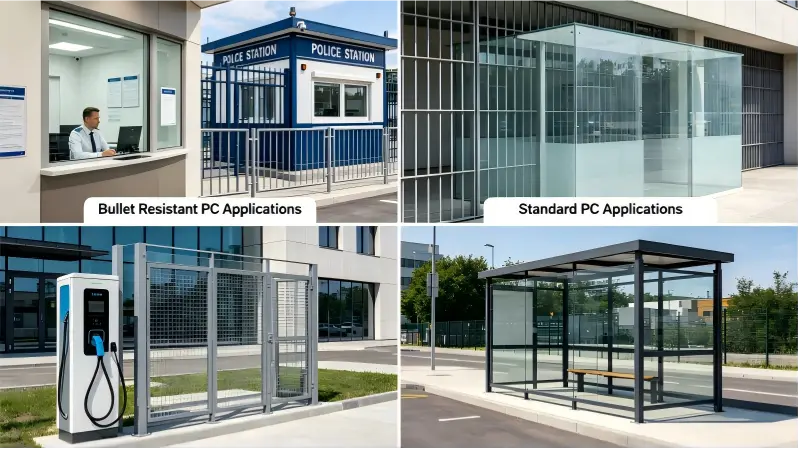
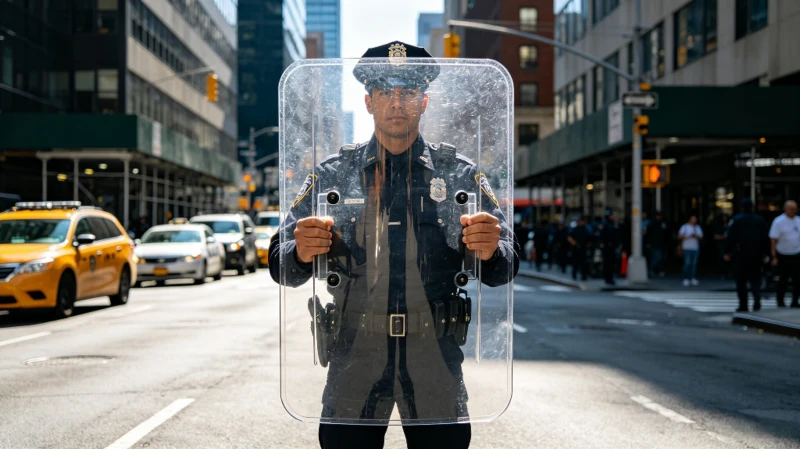
We divide all industrial, security, civil engineering fields into three clear categories: scenarios only must select bullet resistant composite polycarbonate sheet, scenarios standard single-layer protective polycarbonate sheet is the most cost-effective choice, dual material optional neutral low-risk scenes with clear selection judgment rules.
7.1 Scenarios Where Bullet Resistant Composite Polycarbonate Sheet Is The Only Qualified Material
All places with gun attack risk, intentional violent riot impact, bank financial high-value asset isolation, prison detention, public security anti-riot checkpoint must unconditionally adopt certified bullet resistant laminated polycarbonate sheet:
- Banking industry facilities: Commercial bank service counter isolation windows, vault peripheral transparent barrier, financial security office partition, community credit union business window
Facing robbery, hammer smashing, knife stabbing hidden danger, bullet resistant polycarbonate can stop pistol bullets and long-term violent vandalism, prevent staff injury and cash loss, pass national financial security acceptance standard one time. - Public security & police system sites: Police station reception hall isolation barrier, traffic police duty checkpoint anti-riot window, armed police service station transparent partition, law enforcement interrogation room observation window
Meet public security anti-violent attack safety standards, resist handheld riot weapons impact, avoid law enforcement personnel injury during sudden conflict incidents. - Prison, detention center, correctional institution: Cell internal observation window, activity area isolation transparent wall, visiting room partition barrier
Prevent detainees using metal tools to break through isolation window and escape, resist continuous heavy beating, eliminate escape safety hidden danger of detention management places. - Government armed checkpoint, border inspection station, armed escort vehicle transparent shield: High-level thick bullet resistant polycarbonate (30mm+) resist low-power rifle projectile, anti-riot equipment heavy impact, mandatory for armed high-risk security sites.
- High-value jewelry mall, luxury watch store transparent display partition: Prevent intentional smashing robbery, block heavy iron tool impact, protect high-value goods inside showcase without fragment splashing secondary injury.
- Outdoor permanent security wall of high-risk special institutions (courthouse, tax high-value business hall): Double-sided UV coated bullet resistant composite polycarbonate, long-term outdoor anti-aging, anti-violent damage all year round.
7.2 Scenarios Where Standard Single-Layer Protective Polycarbonate Sheet Is The Best Cost-Effective Choice
All low-risk scenes without gun attack, intentional riot heavy weapon impact hidden danger, only need anti-accidental collision, anti-hail, anti-light stone throwing protection, select standard solid polycarbonate sheet to save total project investment:
- Industrial production workshop safety equipment guards: CNC machine transparent splash shield, conveyor line isolation baffle, mechanical equipment observation window
Resists flying metal scraps, accidental tool drop, trolley collision inside factory, no violent intentional attack risk. Medium-thickness standard polycarbonate fully meets production safety demand with low cost. - New energy industry facilities: EV charging station front panel, solar inverter transparent observation window, lithium battery workshop low-risk isolation partition
Single-layer integral structure without interlayer air gap, stable electrical insulation performance, lightweight easy to install, can cold bend curved charging equipment shell. - Civil outdoor public facilities: Bus station shelter transparent wall, residential courtyard carport skylight, school playground anti-collision isolation barrier, agricultural anti-hail greenhouse panel
Resist hail, pedestrian accidental bump, stone throwing by children, no armed robbery or riot hidden danger, UV standard polycarbonate long-term outdoor stable use with low overall construction expense. - Indoor commercial decoration & short-term exhibition: Shopping mall ceiling light diffuser, indoor store ordinary display cabinet transparent plate, temporary exhibition booth partition
Lightweight, rich color and light transmittance options, flexible cold bending forming for various decorative curved modeling, low mass raw material budget. - Household, office low-risk transparent isolation: Indoor office partition panel, villa indoor sun room small skylight, household electrical appliance transparent cover, zero violent impact risk environment.
7.3 Dual Material Optional Neutral Scenarios (Select According To On-Site Security Risk Grade & Budget)
Indoor low-value warehouse observation window, community property ordinary service counter, low-risk factory office transparent partition without gun and riot hidden danger:
- If the site has occasional risk of customer violent quarrel and heavy object smashing, need high anti-vandal grade and long-term safety guarantee: Choose basic 12mm bullet resistant composite polycarbonate sheet
- If only prevent accidental light collision, no intentional heavy weapon attack hidden danger, control initial construction budget: Select 8mm–10mm thick single-layer standard UV protective polycarbonate sheet
Chapter 8: Common Wrong Material Selection Mistakes & Corresponding Serious Safety & Economic Loss Analysis
Countless security engineering contractors, bank renovation suppliers and factory equipment designers make fatal mistakes by confusing bullet resistant composite polycarbonate and standard single-layer protective polycarbonate’s core safety limit, leading to safety accidents and massive compensation losses. We sort out six most frequent wrong selection mistakes with clear loss consequences and standardized correction solutions:
Mistake 1: Use thick single-layer standard protective policarbonato sheet to replace bullet resistant composite policarbonato for bank counter, prison observation window and police station barrier
Loss Consequence: Facing pistol shooting, heavy hammer smashing or steel bar stabbing, standard single-layer polycarbonate will be completely penetrated in seconds, produce large sharp flying fragments, cause staff injury, cash/assets loss, huge enterprise liability compensation, project fails national security acceptance and needs full panel demolition & replacement within short time, repeated material, steel frame and labor cost total expenditure rises 3–5 times.
Correct Fix: All financial, detention, public security high-risk isolation barriers must adopt formal certified multi-layer laminated bullet resistant composite polycarbonate sheet with matching thickness security grade, single-layer standard polycarbonate is completely forbidden for these sites.
Mistake 2: Select thick bullet resistant composite policarbonato for ordinary machine guard, charging station panel and indoor decorative curved skylight to pursue over-high safety
Loss Consequence: Bullet resistant polycarbonate heavyweight raises steel frame support and logistics freight cost; thick laminated structure cannot cold bend small radian curved parts, processing scrap rate over 60%, mass production delivery date delayed heavily, generate order penalty loss, excessive safety grade causes serious unnecessary construction cost waste without actual demand.
Correct Fix: All low-risk industrial, new energy, decoration curved modeling projects unconditionally choose bendable light single-layer standard protective polycarbonate sheet, abandon bullet resistant composite polycarbonate material completely.
Mistake 3: Adopt cheap uncertified thin bullet resistant composite policarbonato with low-quality interlayer adhesive for outdoor long-term security wall
Loss Consequence: After 2–3 years outdoor UV irradiation and seasonal temperature alternation, inferior adhesive interlayer bubbling, delamination and separation happen, ballistic anti-bullet performance drops sharply, security barrier loses protection function in advance, need full wall replacement and re-construction, hidden safety accident risk exists during service period.
Correct Fix: Outdoor bullet resistant polycarbonate must select factory imported high weather resistant special ballistic adhesive laminated sheet, provide complete ballistic certification test report before delivery.
Mistake 4: Use bullet resistant composite policarbonato as high-voltage new energy battery insulation partition plate
Loss Consequence: Multi-layer laminating process produces tiny air gaps between adhesive and polycarbonate layers, under long-term high voltage operation air gap will cause partial discharge, insulation resistance declines year by year, hidden electric leakage and fire risk, product fails international electrical safety certification and cannot export to global new energy market.
Correct Fix: All electrical insulation internal separation parts use integral single-layer flame retardant standard protective polycarbonate sheet without interlayer air gap hidden danger.
Mistake 5: Attempt cold bending thick bullet resistant composite policarbonato to make curved anti-riot barrier
Loss Consequence: Forced cold bending processing leads to interlayer adhesive delamination, surface polycarbonate layer crack, 100% scrap rate of finished curved parts, raw material waste and production cycle delay bring huge economic loss, curved barrier after forced bending loses original ballistic protection performance even if assembled.
Correct Fix: Any curved modeling protection parts select single-layer standard polycarbonate with wide cold bending range; bullet resistant polycarbonate only applies to flat fixed installation security wall without radian design.
Mistake 6: Select non-UV coated bullet resistant or standard policarbonato for full-year outdoor exposed security barrier
Loss Consequence: Unprotected surface directly contacts sunlight, rapid yellowing and brittleness within 2–3 years, light transmittance drops sharply, material toughness declines, anti-impact performance greatly weakens, security protection standard cannot be maintained until design service life, early full replacement increases extra construction investment.
Correct Fix: All outdoor long-term use polycarbonate panels (bullet resistant composite & standard single-layer both) must customize double-sided co-extrusion UV anti-yellow coating, factory 10–15 years outdoor anti-aging warranty is mandatory.
Chapter 9: Our Factory One-Stop Integrated Production & Custom Deep Processing Service For Bullet Resistant Composite polycarbonate & Standard Protective polycarbonate Sheet
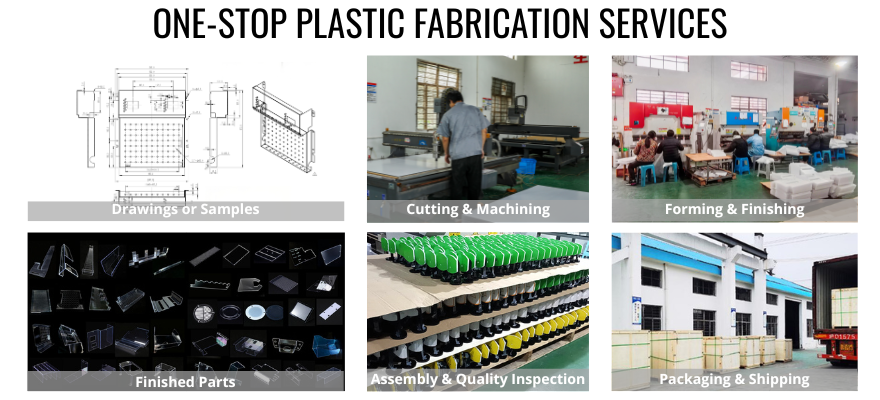
After fully distinguishing the essential ballistic safety, structural, processing and scenario gaps between bullet resistant laminated polycarbonate sheet and ordinary single-layer standard protective polycarbonate sheet, the core demand of global security engineering, industrial and new energy buyers is to cooperate with an integrated manufacturer that can independently complete polycarbonate raw extrusion, multi-layer ballistic laminating production, all precision deep processing procedures inside self-owned workshop without outsourcing any key process to third-party factories. Our factory is a professional polycarbonate sheet production and custom processing manufacturer serving worldwide security engineering, bank renovation, prison construction, machinery equipment and new energy foreign trade customers. All full-set core production and processing machines were fully upgraded and fully loaded into formal production operation in June 2026, including exclusive ballistic polycarbonate high-temperature high-pressure laminating production line, special thick composite plate polishing equipment, six sets of CNC engraving machines and 5 cold bending machines for standard polycarbonate curved forming.
9.1 Complete Independent Production & Deep Processing Equipment Scale
Our production workshop equips full-range complete machines covering raw sheet extrusion, ballistic multi-layer laminating, cutting, drilling, edge polishing, surface coating, silk printing, finished export shockproof packaging full chain procedures:
- 1 independent ballistic grade polycarbonate multi-layer high-temperature high-pressure laminating production line, dedicated for 12mm–50mm bullet resistant composite sheet integrated lamination molding, adopt imported weather resistant ballistic special transparent adhesive to avoid interlayer bubbling delamination aging hidden trouble
- 6 conjuntos de fresadoras de gravação CNC: Precision cutting, pattern engraving, multi-spec hole & slot drilling for both thick bullet resistant composite polycarbonate and thin single-layer standard polycarbonate sheet, machining tolerance strictly controlled within ±0.1mm
- 5 conjuntos de máquinas especiais de dobragem a frio: Only for room-temperature cold forming of all thickness single-layer standard protective polycarbonate sheet, mass produce various arched curved protective covers, charging station outer panels, curved skylight components; curvatura a frio process cannot be used for bullet resistant composite polycarbonate
- 5 conjuntos de máquinas de corte a laser de alta velocidade: Fast accurate flat blanking for two kinds of polycarbonate material, adjustable multi-level power cutting parameters separately for thick laminated ballistic resistant polycarbonate and thin monolithic standard polycarbonate to prevent interlayer melting and edge layering crack
- 2 vacuum thermoforming machines, 1 five-axis machining center, 3 hot bending machines, 3 special precise multi-step drilling machines
- Special thick composite ballistic resistant polycarbonate multi-head edge polishing production line, ordinary single-layer polycarbonate edge mirror polishing machines, full-automatic silk screen printing lines, 3H hard coating UV production lines, double-sided UV co-extrusion coating equipment, anti-glare matte coating equipment, large wooden shockproof packaging production station for thick bullet resistant polycarbonate finished sheets
All key core procedures including ballistic laminating, coating, CNC cutting, polishing are produced and inspected in our own factory workshop, we never outsource any critical safety-related processing link to external cooperative factories, every production batch completes full performance test before delivery, to guarantee consistent stable ballistic safety quality and controllable delivery cycle without outsourcing delay risk.
9.2 Full Series Raw Material & Finished Folha Supply We Can Provide
9.2.1 Bullet Resistant Composite Laminated Polycarbonate Sheet Full Product Line
- Basic 12mm ballistic bullet resistant polycarbonate, anti-pistol light projectile, anti-knife/axe vandalism, low-risk community financial service window dedicated
- Medium grade 18mm–25mm bullet resistant composite polycarbonate, stop full-power 9mm pistol bullet, heavy hammer continuous smashing resistance, commercial bank main counter, police station reception isolation barrier standard material
- High security 30mm–50mm thick multi-layer ballistic resistant polycarbonate, anti-low-power rifle projectile, anti-riot heavy equipment impact, prison cell observation window, armed checkpoint anti-riot shield special sheet
- Double-sided UV outdoor weather resistant bullet resistant polycarbonate, 10–15 years anti-yellow warranty for full-year outdoor exposed security wall projects
- 3H–5H silicone hard coated bullet resistant composite polycarbonate, anti-scratch surface for frequent touch service counter windows
- UL94 V0 flame retardant modified bullet resistant polycarbonate, meet bank, prison, public security building B1 fire safety acceptance standard
- Complete international ballistic test certification report provided for all bullet resistant polycarbonate batches, support overseas engineering bidding document audit and customs clearance inspection without extra third-party certification fees.
9.2.2 Standard Single-Layer Protective Solid Polycarbonate Sheet Full Product Line
1. General transparent standard protective polycarbonate sheet: Complete thickness range from 0.5mm to 18mm, regular transparent, smoke grey, milky white and customized tinted colors available, suitable for universal indoor and outdoor basic protection projects with low budget demands.
2. Double-sided UV stabilized outdoor polycarbonate sheet: Added anti-ultraviolet co-extrusion layer on both sides, effectively preventing sheet yellowing, brittleness and performance attenuation under long-term sunlight exposure. We provide 10-15 years official outdoor quality warranty for all outdoor-grade standard polycarbonate panels.
3. 3H anti-scratch hard coated polycarbonate sheet: Enhanced surface hardness, resisting daily friction, cleaning scratches and frequent manual touch, perfect for self-service equipment panels, EV charging station shells and public display barriers.
4. UL94 V0 flame retardant standard polycarbonate sheet: Modified with non-toxic flame retardant raw materials, achieving the highest fireproof grade for plastic sheets. It stops burning quickly after leaving the fire source, suitable for factory workshops, electrical equipment isolation and public building safety partitions.
5. Frosted anti-glare polycarbonate sheet: Matte surface design to eliminate strong light reflection, protecting human eyes from glare damage, widely used for indoor ceiling lighting partitions, exhibition hall transparent baffles and office isolation windows.
6. Food-grade non-toxic polycarbonate sheet: No harmful chemical additives during production, complying with international food contact safety standards, applicable for isolation baffles in food processing factories, cold storage observation windows and catering equipment protective covers.
9.3 Full One-Stop Custom Processing Services We Offer
As a direct manufacturer with complete production and processing chains, we save intermediate costs for all global buyers. Customers only need to provide design drawings (DXF/PDF), size requirements or project site conditions, and we will deliver ready-to-install finished policarbonato panels without any secondary cutting, polishing or coating work needed by buyers.
- Precision Cutting & Drilling: Full-automatic laser cutting and CNC cutting for irregular shapes, round holes, square holes and sinking holes. For thick laminated bullet resistant polycarbonate sheets, we adopt staged drilling technology to avoid interlayer cracking and delamination around hole positions, ensuring full structural integrity after processing.
- Thermal & Cold Bending Forming: Full cold bending support for all standard protective polycarbonate sheets to make curved skylights, arc-shaped equipment guards and cambered shelter panels. For bullet resistant composite polycarbonate, only large-radius hot bending is allowed; we strictly refuse cold bending orders for ballistic polycarbonate to avoid structural failure.
- Professional Edge Sealing & Polishing: Mirror smooth edge polishing for single-layer polycarbonate; full sealed edge treatment for ballistic resistant polycarbonate to block moisture, dust and air from entering interlayers, preventing later bubbling and delamination problems in long-term use.
- Functional Surface Custom Coating: Double-sided UV anti-aging coating, 3H/5H anti-scratch hard coating, anti-glare matte coating and flame retardant coating can be customized separately according to actual usage environments.
- Silk Screen Printing Customization: Custom brand logos, safety warning texts, operation instructions and pattern prints on panel surface, meeting personalized marking demands for engineering projects and equipment supporting parts.
- Complete Certification & Third-Party Testing: Provide official ballistic test reports, flame retardant certificates, UV aging test reports, CE, RoHS and ISO9001 qualification documents for all batches, supporting global project bidding, engineering acceptance and cross-border customs clearance smoothly.
- Export Standard Packaging & Global Logistics: Custom reinforced wooden shockproof boxes for heavy bullet resistant polycarbonate sheets; thick foam and carton packaging for lightweight standard polycarbonate sheets. We support FOB, CIF, DDP and other international trade terms, covering sea freight, air freight and express delivery, with whole-process logistics tracking service.
9.4 Core Competitive Advantages of Our Factory
- Dual Independent Production Lines for Two Polycarbonate Products: Most polycarbonate suppliers can only produce ordinary single-layer protective polycarbonate sheets. Our factory owns both polycarbonate sheet extrusion line e ballistic multi-layer high-pressure laminating line. Our professional engineering team can give objective, budget-matched material selection suggestions based on your site security risk, installation environment, processing requirements and service life, helping you avoid costly wrong material selection errors from the very beginning.
- 100% Full Inspection Before Delivery: Every batch of bullet resistant polycarbonate sheets will pass real bullet shooting tests and heavy hammer impact sampling tests before shipment. All standard polycarbonate sheets undergo impact resistance, UV aging and flame retardant random inspections. We never cut corners on polycarbonate sheet thickness or interlayer adhesive raw materials to reduce production costs.
- No Outsourcing for All Key Processes: All production, processing, coating and testing procedures are completed in our own workshop. We never outsource core safety-related processes to third-party factories, so we can fully control product quality, processing precision and production lead time. Sample order lead time: 4-6 working days; bulk engineering order lead time: 10-18 working days.
- Free Full-Cycle Technical Support: We provide free steel frame installation design drawings, reserved expansion gap guidelines, official installation manuals and daily maintenance documents. Our 24/7 online technical team can solve installation, processing and after-sales problems in a timely manner for global customers.
- Flexible Order Quantity with Unified Quality Standard: We support small sample trial orders, medium batch replenishment orders and large-scale engineering bulk orders. Whether you need 2 pieces of ballistic resistant polycarbonate samples or thousands of square meters of protective polycarbonate panels for government security projects, we maintain the same strict quality control standard without quality discount for small orders.
9.5 Simple & Clear Global Cooperation Process
Step 1: Demand Confirmation. Send us your project application scenario, required safety grade, panel size, thickness, color, surface coating and processing requirements. Our professional sales team will send targeted material recommendations and a detailed formal quotation within 24 hours.
Step 2: Sample Verification. We provide free original material samples for your performance test and appearance confirmation. Complete certification reports can be provided together with samples for security project bidding preparation.
Step 3: Formal Production. After signing sales contract and confirming all production details, we start mass production and send real-time workshop production photos and videos regularly for your progress check.
Step 4: Pre-shipment Full Inspection. Our QC team carries out 100% dimension inspection, appearance inspection and performance spot check before packaging to eliminate all defective products.
Step 5: Delivery & After-sales Service. Arrange global logistics shipment, provide tracking number immediately after goods departure, and offer long-term after-sales maintenance guidance after customers receive goods.
Chapter 10: Installation Guidelines & Daily Maintenance Tips for Two Types of Polycarbonate Panels
10.1 Installation & Maintenance for Bullet Resistant Composite Polycarbonate Sheet
Due to its multi-layer composite structure and heavy weight, bullet resistant polycarbonate sheet has stricter installation and maintenance requirements compared with ordinary polycarbonate sheets:
- Installation Notice: Must adopt thickened and dense steel support frames instead of ordinary aluminum keels to avoid long-term sagging deformation. Reserve 4-6mm thermal expansion gap per meter to release thermal stress caused by temperature changes. All cutting cross-sections must be fully sealed to prevent moisture from penetrating into interlayers.
- Daily Cleaning Method: Only use soft microfiber cloth matched with neutral water-based detergent for surface cleaning. Never use acetone, alcohol thinner, corrosive detergent or strong alkaline cleaning liquid, which will permanently damage the middle transparent adhesive layer and cause irreversible interlayer delamination and bubbling.
- Regular Inspection Cycle: Carry out comprehensive inspection every 6 months, especially after typhoon, heavy rain and extreme high/low temperature weather. Check surface dents, edge sealing integrity and internal interlayer conditions. Repair edge sealing defects timely once found.
- Forbidden Operations: Do not cut, drill or bend finished bullet resistant polycarbonate sheets after installation; do not paste strong adhesive tape or stickers on the panel surface to prevent surface coating peeling off.
10.2 Installation & Maintenance for Standard Single-Layer Protective Polycarbonate Sheet
- Installation Notice: Lightweight allows lightweight aluminum alloy keel installation, saving overall construction cost. Reserve 3-5mm expansion gap per meter. It supports on-site cold bending construction directly, which is much more flexible than ballistic resistant polycarbonate.
- Daily Cleaning Method: Neutral detergent cleaning is recommended. Hard-coated standard polycarbonate sheets can withstand mild alcohol disinfection for public hygiene scenarios without surface damage.
- Regular Inspection Cycle: Only one routine inspection per year is enough. There is no risk of interlayer delamination, so later maintenance cost and difficulty are extremely low.
Final Comprehensive Conclusion
After reading this full 10,000-word detailed comparison between bullet resistant composite policarbonato folha e standard single-layer protective policarbonato folha, procurement engineers, project contractors and design manufacturers can make completely accurate material selection without confusion:
Escolher bullet resistant laminated policarbonato folha unconditionally for all high-risk security scenarios including bank service counters, police station isolation barriers, prison observation windows, armed traffic checkpoints, jewelry store anti-robbery partitions and government security walls. Its unique multi-layer energy-absorbing interlayer structure cannot be replaced by any thickened single-layer polycarbonate sheet. Although it has higher cost, heavier weight and no cold bending capability, it provides reliable life safety protection and meets official national ballistic safety acceptance standards.
Escolher ordinary standard protective policarbonato folha for all low-risk industrial, civil and commercial projects such as machine safety guards, EV charging panels, bus shelters, carport roofs, playground anti-collision barriers and indoor decorative partitions. It owns sufficient anti-collision, anti-hail and anti-light impact performance, with lower cost, lighter weight and flexible cold bending forming performance, achieving the best cost-performance ratio for conventional protection demands.
The most critical selection principle is clear: Never replace bullet resistant policarbonato with cheap standard policarbonato for high-security projects to save upfront cost; never over-specify ballistic resistant policarbonato for common protection projects causing unnecessary budget waste.
Our factory supports full-spec production, customized processing and one-stop solution supply for both bullet resistant polycarbonate sheets and standard protective polycarbonate sheets. Whether you need certified ballistic polycarbonate panels for government security bidding projects or cost-effective ordinary polycarbonate parts for industrial supporting facilities, welcome to contact us for free material selection consultation, free drawing optimization and competitive wholesale quotation. We are always ready to support your global polycarbonate sheet projects with stable quality, professional service and reliable delivery time.