






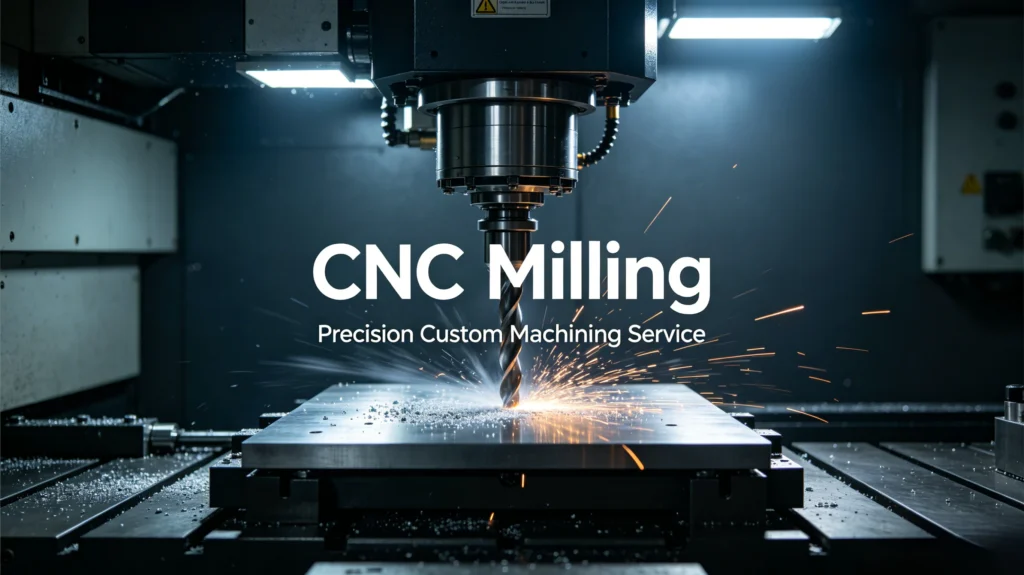
Das CNC-Fräsen ist eine der am häufigsten verwendeten subtraktive Fertigung Verfahren in der modernen Industrie. Dabei werden computergesteuerte Rotationsschneidwerkzeuge eingesetzt, um Material aus einem massiven Block oder Blech zu entfernen und komplexe 2D- und 3D-Formen mit hoher Präzision, engen Toleranzen und ausgezeichneter Oberflächengüte zu erzeugen.
Ob Sie nun kundenspezifische Kunststoffteile, Metallkomponenten, Gravieren von PC-Platten, Schneiden von Acrylplatten oder Bearbeitung von Formhohlräumen, Das CNC-Fräsen bietet unübertroffene Flexibilität, Genauigkeit und Wiederholbarkeit.
In diesem umfassenden Leitfaden erklären wir Ihnen alles, was Sie wissen müssen: Definition, Funktionsprinzip, Arten von CNC-Fräsmaschinen, Materialien, Vorteile, Einschränkungen, typische Anwendungen und unseren professionellen CNC-Frässervice.
1. Was ist CNC-Fräsen?
CNC-Fräsen (Computer Numerical Control milling) ist eine Bearbeitungsmethode, bei der programmierte Befehle zur Steuerung der Bewegung von Schneidwerkzeugen und Werkstücken. Die Spindel treibt Mehrzahnfräser (Schaftfräser, Kugelfräser, Planfräser) an, die sich mit hoher Geschwindigkeit drehen, während sich das Werkstück entlang der Achsen X, Y und Z bewegt, um Material abzutragen und die gewünschte Geometrie zu formen.
Anders als CNC-Drehen (für runde Teile), Fräsen ist ideal für flache Oberflächen, Hohlräume, Schlitze, Löcher, Konturen und komplexe 3D-Strukturen.
Wesentliche Merkmale
- Digitale Steuerung: CAD → CAM → G-Code → CNC-Maschine
- Mehrachsige Bewegung: 3-Achse, 4-Achse, 5-Achse
- Subtraktives VerfahrenAbtragen von Material aus festem Material
- Hohe Präzision: typische Toleranz ±0,02 mm ~ ±0,1 mm
2. Wie CNC-Fräsen funktioniert: Schritt-für-Schritt-Verfahren
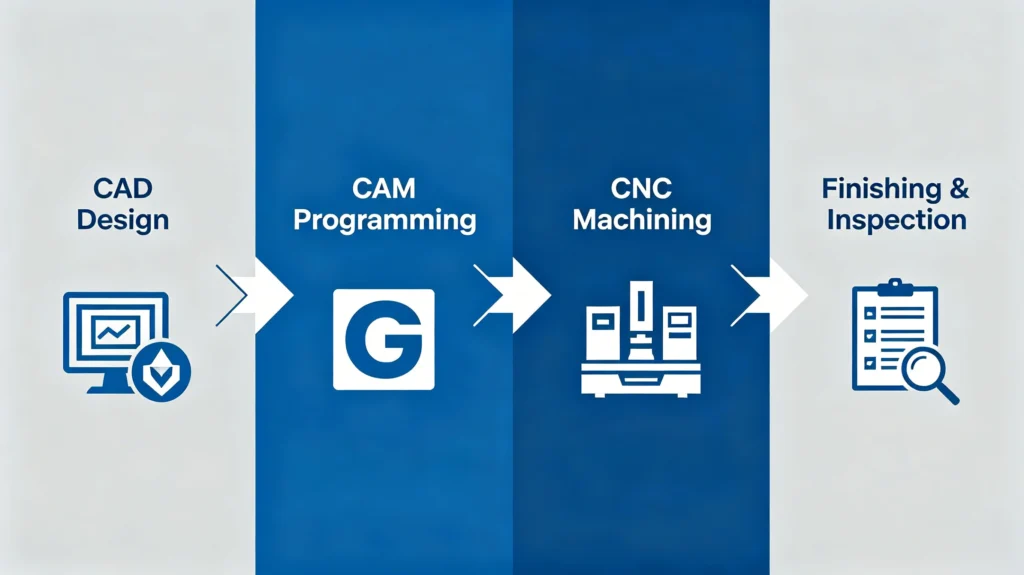
Schritt 1: CAD-Modell entwerfen
Ingenieure erstellen 2D-Zeichnungen oder 3D-Modelle mit SolidWorks, AutoCAD, UG, Pro/E.
Schritt 2: CAM-Programmierung
CAM-Software (Mastercam, UG CAM, SolidCAM) wandelt das Modell in G-Code, Definition von Werkzeugwegen, Spindeldrehzahl, Vorschubgeschwindigkeit und Schnitttiefe.
Schritt 3: Einrichtung der Maschine
- Werkstück auf dem Tisch fixieren (Schraubstock, Halterung, Vakuumplatte)
- Einbau von Schneidwerkzeugen (Fräser, Bohrer, Gewindebohrer)
- Einstellen von Werkzeuglänge, Arbeitskoordinate, Kühlmittelanlage
Schritt 4: Grobfräsen
Entfernen Sie das meiste Material schnell mit großer Schnitttiefe und hohem Vorschub, wobei 0,2-0,5 mm für die Endbearbeitung übrig bleiben.
Schritt 5: Fertigfräsen
Geringe Tiefe, hohe Spindeldrehzahl, präziser Werkzeugweg zum Erreichen von Endmaß, Toleranz und Oberflächenrauhigkeit (Ra 0,8-3,2 μm).
Schritt 6: Entgraten und Inspektion
Scharfe Kanten entfernen; Maße mit Messschieber, Mikrometer, CMM prüfen; ggf. Oberflächenbehandlung vornehmen.
3. Arten von CNC-Fräsmaschinen
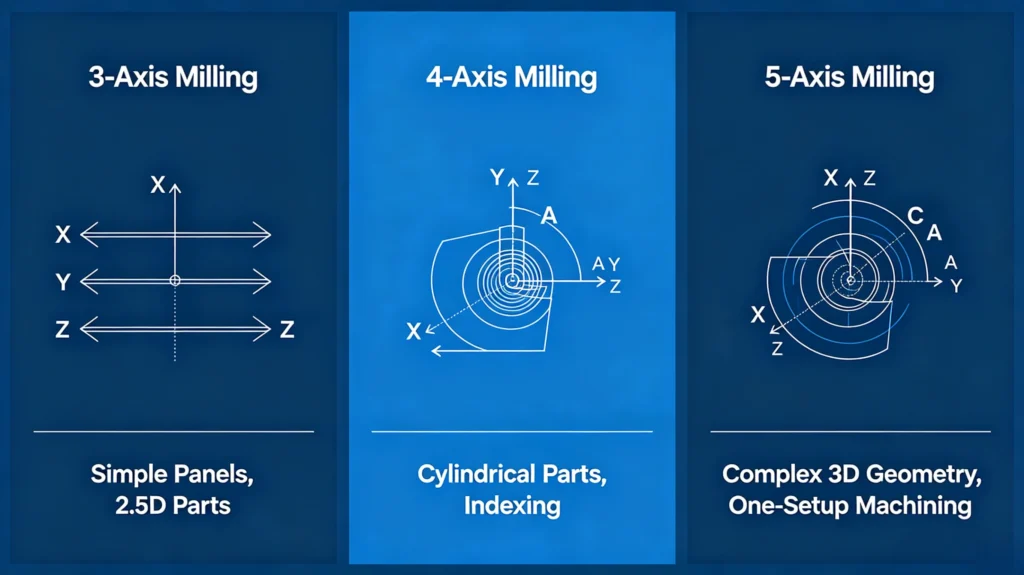
3.1 3-Achsen-CNC-Fräsen
- X, Y, Z lineare Bewegung
- Am häufigsten, kostengünstig
- Geeignet für flache Teile, einfache Hohlräume, PC-Platten, Acrylplatten
3.2 4-Achsen-CNC-Fräsen
- Hinzufügen einer Drehachse (A oder B)
- Drehendes Schneiden, schraubenförmige Nuten, Indexbearbeitung
- Ideal für zylindrische Teile, Gussformen, Vorrichtungen
3.3 5-Achsen-CNC-Fräsen
- X, Y, Z + zwei rotierende Achsen (A/C oder B/C)
- Komplexe Bearbeitung in einer Aufspannung
- Perfekt für Laufräder, Turbinenschaufeln, Teile für die Luft- und Raumfahrt, komplexe Gussformen
3.4 Vertikales vs. horizontales Fräsen
- Vertikal: Spindel vertikal, allgemein für allgemeine Teile, PC, Acryl, Aluminium
- Horizontal: Spindel horizontal, gut für tiefe Kavitäten, Massenproduktion, bessere Spanabfuhr
4. Werkstoffe für das CNC-Fräsen
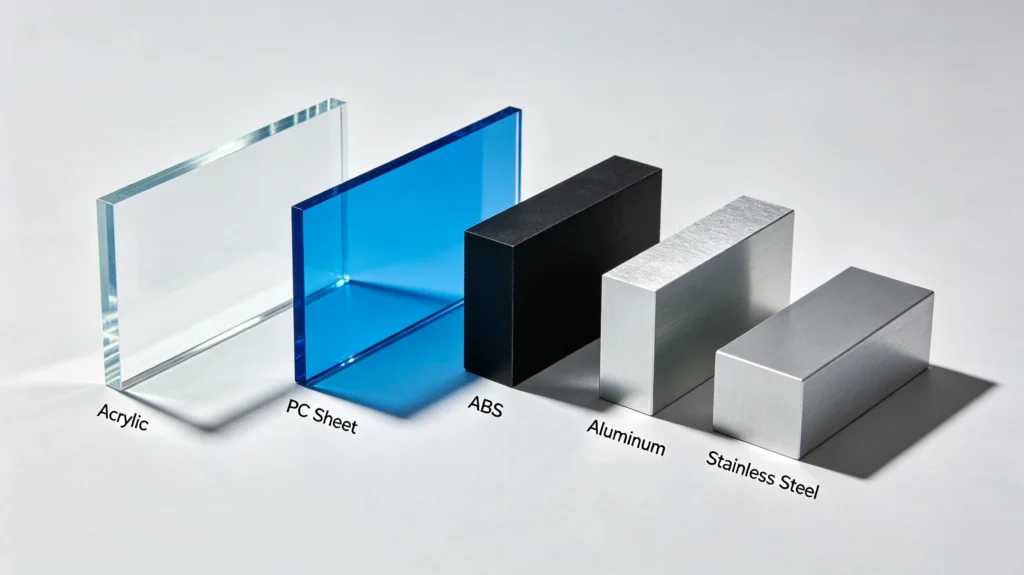
CNC-Frässupport eine breite Palette von Kunststoffen und Metallen, jeweils mit spezifischen Schnittparametern.
4.1 Kunststoffe (am beliebtesten für unseren Service)
- PC (Polycarbonat): hochschlagfest, transparent, hitzebeständig; für Platten, Abdeckungen, Gehäuse
- Acryl (PMMA)klar, glänzend, leicht zu bearbeiten; für Displays, Beschilderungen, Lichtleiter
- ABS: robust, kostengünstig; für Gehäuse, Koffer, Strukturteile
- PVC, POM, Nylon: technische Kunststoffe für Zahnräder, Isolatoren, Vorrichtungen
4.2 Metalle
- Aluminium 6061/7075Leicht, hochfest; Luft- und Raumfahrt, Automobilindustrie, Kühlkörper
- Rostfreier Stahl 304/316: korrosionsbeständig; Medizin, Lebensmittel, Marine
- Messing, Kupfer: elektrische Teile, Wärmeleitung
- TitanHochfest, biokompatibel; Luft- und Raumfahrt, medizinische Implantate
4.3 Holz, Schaumstoff, Verbundwerkstoffe
Für Prototypen, Modelle, Schablonen, kundenspezifische Vorrichtungen.
5. Die wichtigsten Vorteile des CNC-Fräsens
✅ Hohe Präzision und enge Toleranzen
Genauigkeit bis zu ±0,02 mm, geeignet für anspruchsvolle Branchen wie Medizin, Luft- und Raumfahrt, Elektronik.
✅ Fähigkeit zu komplexer Geometrie
Leicht zu produzieren Schlitze, Löcher, Taschen, Konturen, 3D-Flächen die eine manuelle Bearbeitung nicht erreichen kann.
✅ Ausgezeichnete Reproduzierbarkeit
Einmal programmiert, kann die Maschine Folgendes produzieren 1 oder 10.000 identische Teile mit gleichbleibender Qualität.
✅ Breite Materialkompatibilität
Funktioniert mit fast allen Kunststoffen und Metallen, ideal für Multimaterialprojekte.
✅ Schnelle Prototypenerstellung und niedrige Mindestbestellmenge
Unterstützung 1-Stück-Prototyp, Kleinserie, Massenproduktion; keine Kosten für Schimmel.
✅ Gute Oberflächengüte
Ra 0,8-3,2 μm; kann poliert, eloxiert, lackiert, direkt mit Siebdruck versehen werden.
6. Beschränkungen des CNC-Fräsens
- Höhere Kosten als beim Spritzgießen für Massenproduktion (10k+)
- Nicht effizient für sehr dünne Wände (<0,5 mm)
- Erfordert CAD/CAM-Kenntnisse und Programmierzeit
- 5-Achsen-Maschinen haben hohe Ausrüstungskosten
7. Industrielle Anwendungen des CNC-Fräsens
7.1 Kunststoffteile und Elektronikindustrie
- PC-Platte, Acrylplatte, Display-Abdeckung, Gerätegehäuse
- Kühlkörper, Isolator, Strukturbügel
- Bedienfeld, Tastenplatte, Sockel für Membranschalter
7.2 Luft- und Raumfahrt & Automotive
- Strukturteile aus Aluminiumlegierung, Motorkomponenten
- Kundenspezifische Halterungen, Innenverkleidungen, Formteile
7.3 Medizinische Ausrüstung
- Chirurgische Teile aus rostfreiem Stahl, Titanimplantate
- Gehäuse für medizinische Geräte, Präzisionsbefestigungen
7.4 Formen- und Werkzeugbau
- Hohlraum, Kern, Schieber der Spritzgussform
- Druckgussformen, Stanzformen, Vorrichtungen
7.5 Werbung und Dekoration
- Beschilderung aus Acryl, 3D-Logo, Leuchtkasten, Display-Ständer
- Transparente PC-Abdeckung, Dekorplatte
8. CNC-Fräsen im Vergleich zu anderen Verfahren
CNC-Fräsen vs. Laserschneiden
- Fräsen: 3D, tiefes Schneiden, hohe Präzision, dickes Material
- LaserSchnell, dünnes Blech, nur 2D, geringere Präzision
CNC-Fräsen vs. 3D-Druck
- FräsenBessere Materialfestigkeit, Oberflächengüte, Toleranz
- 3D-DruckKomplexe interne Struktur, keine Werkzeugkosten, langsam für Masse
CNC-Fräsen vs. Spritzgießen
- FräsenKeine Form, niedriges MOQ, schneller Prototyp
- Spritzgießen: niedrige Stückkosten für Masse, hohe Werkzeugkosten
9. Professioneller CNC-Frässervice von unserem Unternehmen
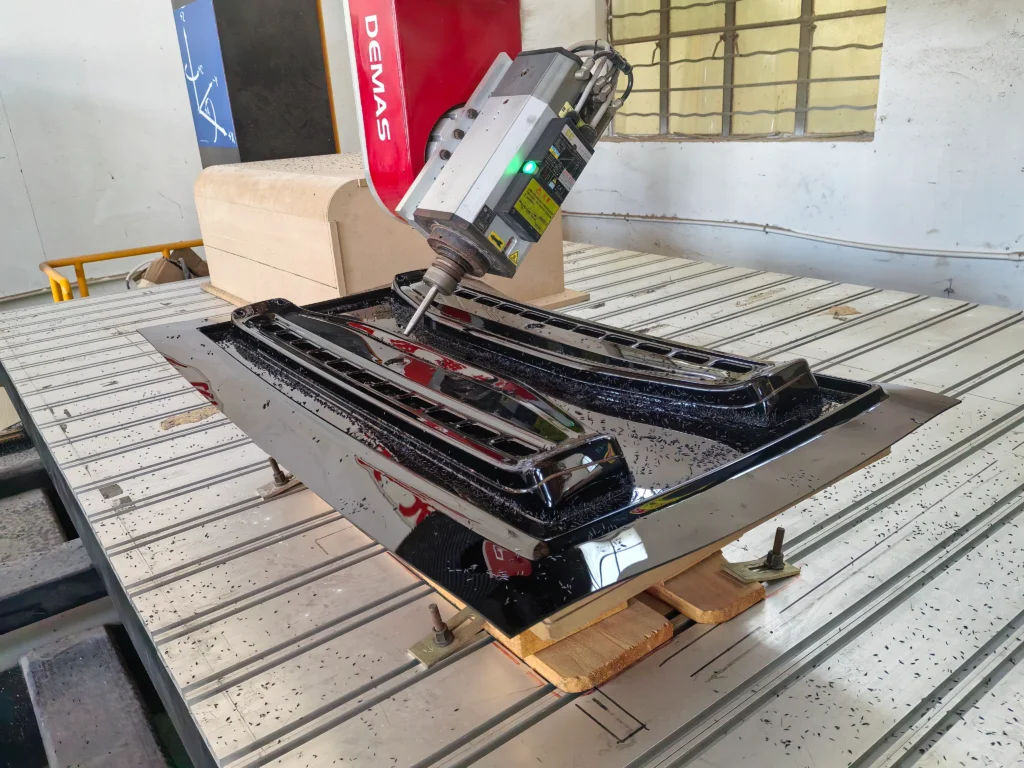
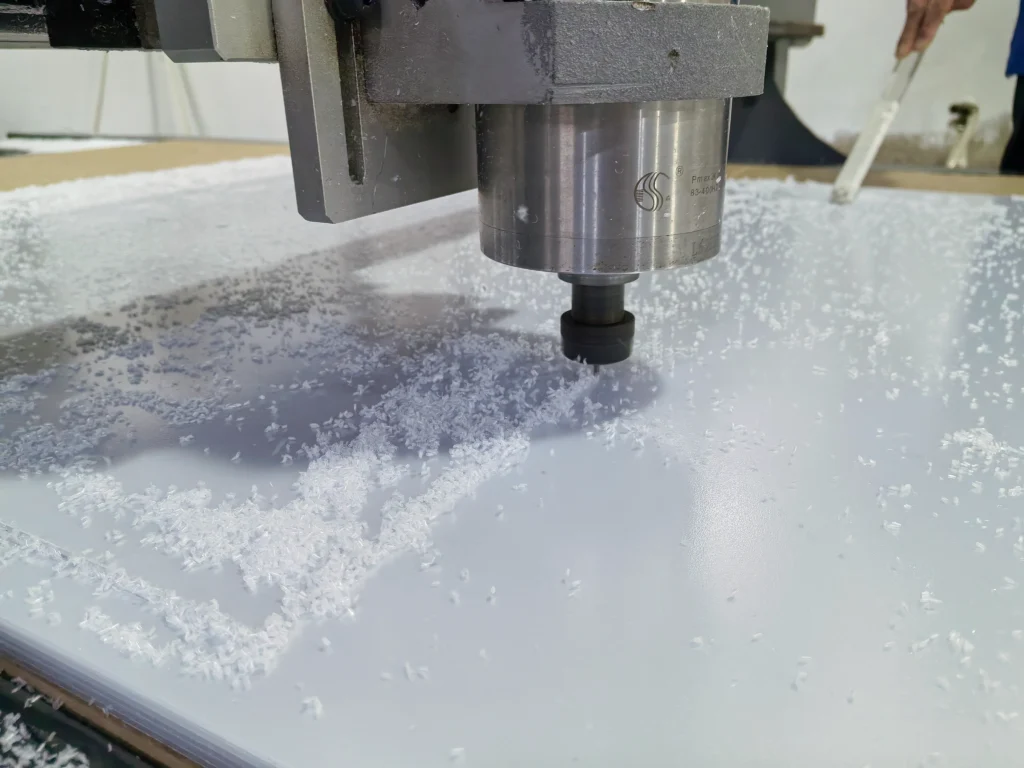
Wir sind spezialisiert auf Alles aus einer Hand: CNC-Fräsen und Bearbeitungsservice nach Maß für Kunststoffplatten, mit Schwerpunkt auf PC, Acryl, ABS Präzisionsfertigung.
Unser Serviceangebot
- 3-Achsen & 5-Achsen CNC-Fräsen
- Gravieren von PC-Platten, Schneiden von Acryl, Bearbeitung von ABS-Gehäusen
- Schneiden von Sondergrößen, Bohren von Löchern, Schlitzen, Konturieren
- Oberflächenbehandlung: Polieren, Siebdruck, UV-Druck
- Alles aus einer Hand: von CAD-Konstruktion → CAM-Programmierung → CNC-Fräsen → Nachbearbeitung → Qualitätsprüfung → Auslieferung
Warum uns wählen
- Fortschrittliche Ausrüstung: Hochpräzise CNC-Zentren, strenge Toleranzkontrolle (±0,02 mm)
- Materialkenntnisse: Umfassende Erfahrung mit PC, Acryl, ABS und anderen Kunststoffen
- Niedriges MOQ: Unterstützung 1-teiliger Prototyp zur Massenproduktion
- Schnelle Vorlaufzeit: Schnelle Programmierung, effiziente Bearbeitung, pünktliche Lieferung
- Qualitätsgarantie: 100% Maßkontrolle, Qualitätskontrolle der Oberfläche
- Kundenspezifische Lösung: Kostenlose Designberatung, optimierter Prozess zur Kosteneinsparung
Für wen wir arbeiten
- Elektronikhersteller: PC-Panels, Acryl-Display-Abdeckungen
- Gerätefabriken: Gehäuse, Halterungen, Schalttafeln
- Werbeunternehmen: Acrylschilder, Logos
- Medizin und Luft- und Raumfahrt: Gehäuse, Halterungen, Schalttafeln
- Designstudios und F&E-Teams: Rapid Prototyping
Ob Sie eine vollständige Zeichnung oder einfach ein Idee, können wir Ihnen professionelle CNC-Fräslösungen anbieten, die auf Ihr Material, Ihre Größe, Toleranz und Anwendungsumgebung zugeschnitten sind.
Kontaktieren Sie uns heute um Ihre kostenloser Kostenvoranschlag und Designunterstützung.