






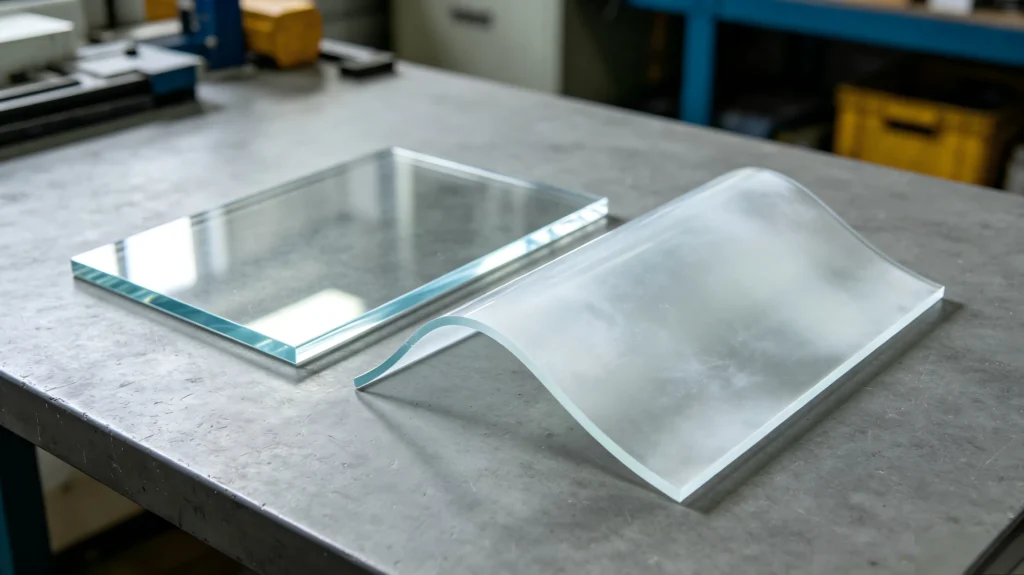
1. ¿Por qué? El blanqueamiento y el estiramiento-adelgazamiento son defectos habituales en el procesamiento de las láminas de policarbonato
Láminas de policarbonato (PC) Se utilizan ampliamente en protecciones de seguridad para maquinaria, componentes interiores del transporte ferroviario, carcasas de dispositivos médicos, recintos para equipos de nuevas energías, ventanas de seguridad y cubiertas protectoras para exteriores, gracias a su extraordinaria resistencia al impacto, su elevada transmitancia de la luz y su amplio rango de temperaturas.
Sin embargo, muchos compradores y fabricantes se enfrentan a problemas molestos. Incluso cuando se utiliza el mismo lote de chapas en bruto, las piezas acabadas de un taller siguen siendo cristalinas y uniformes, mientras que las piezas procesadas en otra fábrica presentan marcas difusas y blanquecinas a lo largo de las líneas de plegado o en las zonas curvas. Las zonas locales de las carcasas curvas se vuelven demasiado estirado y demasiado fino. La transparencia disminuye, el rendimiento mecánico se deteriora y, en casos graves, hay que desechar todo el lote.
La mayoría de la gente tiende a culpar en primer lugar a la calidad de la materia prima. La experiencia práctica en la producción demuestra que La mayoría de los defectos de blanqueamiento y adelgazamiento se deben a unos ajustes de procesamiento inadecuados, más que a una mala calidad de las láminas en bruto.. Las láminas de policarbonato importadas y totalmente nuevas pueden adquirir un tono blanquecino si los parámetros de fabricación no son los adecuados. Por el contrario, las láminas de PC con contenido reciclado que se han procesado correctamente pueden alcanzar una calidad superficial aceptable si se siguen procedimientos estrictamente controlados.
El blanqueamiento superficial no es solo una cuestión estética. El «blanqueamiento por tensión» indica la presencia de microfisuras y microvacíos en el interior del policarbonato, lo que significa que existen tensiones internas residuales en las piezas.. Durante el transporte, el montaje, el contacto con disolventes o la exposición al aire libre, las zonas blanqueadas son muy vulnerables a la propagación de grietas y a fracturas inesperadas. El estiramiento y el adelgazamiento debilitan directamente la resistencia estructural. Las zonas demasiado delgadas pueden romperse ante un impacto. El espesor real se sale de las especificaciones, lo que aumenta las tasas de rechazo y el coste total de producción.
En el caso de los pedidos de exportación al extranjero y de los proyectos médicos y de tránsito ferroviario, incluso un ligero blanqueamiento o un espesor local insuficiente pueden provocar el rechazo de un lote. Para fabricar de forma constante componentes de policarbonato que cumplan los requisitos, los fabricantes deben comprender el mecanismo físico que subyace a estos defectos y aplicar un control a lo largo de toda la cadena de producción, que abarque la selección de las materias primas, el pretratamiento, los parámetros de las máquinas, las herramientas y los hábitos de los operarios.
Muchos fabricantes a pequeña escala carecen de una experiencia consolidada en los procesos, lo que da lugar a elevadas pérdidas derivadas del método de ensayo y error. Con más de 13 años de experiencia práctica en fabricación de planchas de policarbonato, Yucheng Board Industry ha gestionado un gran número de pedidos de curvado en caliente, curvado en frío, termoformado al vacío de chapas gruesas y mecanizado de precisión CNC. Hemos examinado numerosas muestras defectuosas que presentaban defectos de blanqueamiento y adelgazamiento, y hemos acumulado conocimientos prácticos al respecto. En este artículo se ofrecen consejos prácticos y completos, tanto para la producción interna como para proyectos OEM subcontratados.
2. Principios básicos: ¿Qué es el blanqueamiento por tensión y el estiramiento?–reducción del número de componentes del ordenador
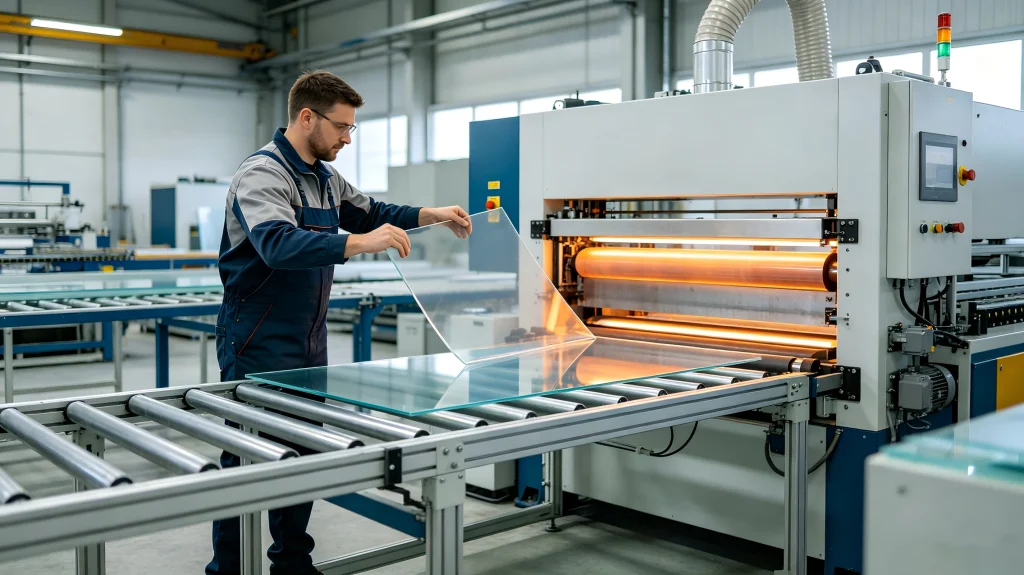
Muchos operadores detectan defectos sin comprender las causas físicas subyacentes, y ajustan los parámetros basándose únicamente en el método de prueba y error.
2.1 Blanqueamiento por tensión del policarbonato
El policarbonato está formado por largas cadenas moleculares de polímero. Cuando una zona concreta sufre una fuerza de tracción excesiva, una compresión o un impacto repentino, las cadenas moleculares se estiran más allá del límite elástico. Se generan innumerables huecos microscópicos en el interior del material, conocidos como los fenómeno de agrietamiento. La luz incidente se dispersa en esos diminutos huecos, y el policarbonato, que en un principio era transparente, adquiere un tono blanco lechoso y turbio, lo que denominamos blanqueamiento por estrés.
⚠️ Punto clave: El blanqueamiento no implica una fractura completa, pero demuestra que microestructural daños en el interior del material. Aunque las piezas no se rompan con la mano, siguen existiendo riesgos ocultos. Bajo la acción de las vibraciones, los cambios de temperatura o el contacto con alcohol o detergentes, las zonas blanquecinas pueden convertirse en grietas visibles y provocar un fallo definitivo.
Dos categorías principales de defectos de blanqueamiento:
1)Blanqueamiento por tensión mecánica: Provocado por el doblado en frío, Corte CNC, tirones bruscos o una fuerza de sujeción excesiva.
2)Blanqueamiento por tratamiento térmico: Un calentamiento desigual, un ajuste incorrecto de la temperatura o un presecado insuficiente provocan la aparición de una neblina plateada y manchas blanquecinas tras el curvado en caliente o el termoformado.
2.2 Estiramientos–defecto de aclareo
El estiramiento y adelgazamiento se produce principalmente en termoformado al vacío y procesos de embutición profunda y doblado en caliente. Una vez que la lámina de policarbonato se ablanda con el calor, la fuerza del vacío o la geometría del molde tiran del material y lo estiran. Las zonas sometidas a un gran estiramiento adquieren un grosor inferior al grosor nominal original.
Ejemplo: Espesor original de la chapa: 5 mm. Tras el moldeado al vacío, el espesor de las paredes en las esquinas curvas y las zonas abombadas puede reducirse hasta 2,5-3 mm. Si los requisitos del plano especifican un espesor mínimo de 4 mm, dichos componentes no cumplen con los requisitos.
Consecuencias de un adelgazamiento excesivo: reducción de la resistencia al impacto local, riesgo de rotura, espesor irregular de la pared que provoca deformaciones, o incluso el desgarro del material laminado cuando se supera el límite de elasticidad.
Nota: Stress whitening and stretching–thinning often appear together. Over-stretched positions become thinner and develop whitish haze simultaneously.
Simple analogy: When you squeeze and bend transparent ice block, micro-internal cracks make the ice look milky-white, similar to stress whitening of PC sheets. Stretching-thinning works like pulling plastic wrap; harder pulling creates thinner material until tearing happens.
Once we understand the mechanism, all practical processing tips aim for two core goals:
- Avoid excessive local tensile or compressive force to prevent crazing and whitening;
- Distribute stretching evenly across the sheet surface, avoid concentrated heavy drawing on small local spots so as to control stretching-thinning.
3. Which processing procedures easily trigger whitening and thinning issues
Different fabrication processes bring different defect risks. Early risk identification supports targeted prevention.
- Curvado en caliente: Localized heating by heating wire leads to uneven temperature distribution, whitening along bending lines; too-small bend radius causes stress concentration and whitening.
- Doblado en frío: Bending at room temperature without thermal softening. Stress whitening along the bend line is the most frequent failure.
- Thick–sheet vacuum forming / curved housing thermoforming: Main risk is stretching–thinning, with whitening on corners and crown areas. Widely seen on large machine guards and equipment housings.
- CNC routing, grooving & drilling: Dull cutting tools or an improper feed-speed ratio can squeeze and tear polycarbonate, creating cutting whitening on groove walls and cut edges, obvious for transparent parts.
- Compression thermoforming: Excessive clamping pressure causes squeeze-induced whitening and local material thinning near clamping borders.
- Secondary re–procesamiento: Re-bending or re-heating pre-formed semi-finished parts superimposes residual stress and easily triggers whitening.
When receiving outsourced OEM orders, Yucheng Board Industry often inspects customer-submitted failed samples from third-party workshops. Many drawings only specify original sheet thickness without mentioning minimum finished wall thickness after forming. Defective thin-wall parts are discovered after production. At the project preliminary stage, our engineers evaluate forming risks and propose suggestions for raw-sheet thickness and fillet radius optimization to avoid such losses.
4. Raw material selection: Reduce risks at the source
Sheet material quality directly influences anti-whitening and anti-stretching performance. The same machine parameters deliver totally different outcomes for different polycarbonate grades.
4.1 Prefer virgin extruded polycarbonate sheets; be cautious with high–content recycled sheets
Polycarbonate with large recycled fraction has shortened molecular chains and decreased toughness. Under equal forming conditions, recycled-content sheets are much more prone to stress whitening and tearing. For medical devices, rail-transit components, new-energy enclosures and export orders, virgin–material extruded PC sheets are strongly recommended. Do not pursue low cost with high–recycled sheets.
4.2 Control sheet thickness tolerance
Large thickness fluctuation of incoming sheets creates problems. A nominal 5 mm sheet with actual thickness ranging from 4.4- 5.6 mm will develop severe local thinning after vacuum forming on originally thinner spots. For vacuum-forming and deep-draw curved-shell projects, select sheets with thickness tolerance within ±0.15 mm whenever possible.
4.3 Differentiate general PC, flame–retardant PC and co–extruded UV–resistant PC
- General transparent PC sheet: Best toughness, wide processing window, relatively resistant to whitening.
- Flame-retardant UL94-V0 PC: Flame-retardant additives reduce material toughness. Under identical processing parameters, FR-PC is more sensitive to stress whitening. A larger bend radius and reduced stretching ratio should be adopted for FR-PC fabrication.
- Double-sided co-extruded UV-resistant PC: Suitable for outdoor applications. Spray-coated UV sheets are NOT suitable for deep thermoforming; coating may blister and delaminate under high temperature. Choose co-extruded UV-protected sheets for thermal forming projects.
4.4 Hard–coated scratch–resistant PC sheets
Hard surface coating lowers surface scratch risk yet has limited ductility. Hard-coated PC tends to develop whitening and micro-cracks on the coating layer when bent with small radius. Design documents shall adopt generously enlarged bend fillets for hard-coated polycarbonate.
4.5 Raw–sheet storage requirement
Polycarbonate is highly hygroscopic. Exposed in humid workshop air, sheets absorb moisture. Subsequent high-temperature processing generates bubbles and silvery whitish crazing. Keep the original protective film intact before processing. Avoid bare-sheet storage under humid conditions; minimize long-term stockpiling.
Yucheng Board Industry maintains abundant stock of various polycarbonate grades: general transparent PC, UL94-V0 flame-retardant PC, double-sided co-extruded UV-resistant sheets and hard-coated PC. After receiving customer drawings, our team recommends proper material grade matching for application scenarios to prevent batch-defect risks caused by incorrect raw-sheet selection.
5. Pre–processing preparation: Drying, stress relieving & edge deburring
Pre-treatment consumes production time yet greatly improves final yield. Many fabricators skip pre-treatment: they cut and bend sheets directly after unpacking, resulting in massive whitening defects afterwards.
5.1 Pre–drying procedure (critical step)
Polycarbonate absorbs moisture from ambient air. Moisture inside sheets vaporizes under heating and creates micro-bubbles and silvery crazes appearing as hazy whitish surface marks, which are frequently misdiagnosed as raw-material failure.
✅ Standard drying parameters: Oven temperature 110-120 °C; do NOT exceed 130 °C to prevent premature sheet softening and deformation. Drying duration depends on sheet thickness: 2-3 mm sheets require 2-4 hours; 5-8 mm sheets require 4-8 hours; thicker sheets demand longer drying cycles. After drying is complete, avoid long-term exposure in a humid environment and start fabrication promptly.
❌ Common mistakes: Setting the oven temperature over 140 °C leads to sheet softening; storing dried sheets in a humid workshop for hours before processing, sheets re-absorb moisture and drying work becomes useless.
5.2 Release inherent residual stress of incoming sheets
Extruded polycarbonate sheets carry certain built-in extrusion stress. For high-spec parts, annealing before processing releases internal stress: hold sheets at 120 °C for 2-4 hours, then cool slowly inside the oven. Annealing significantly lowers stress-whitening risk during forming.
Annealing may be omitted for ordinary machine guards and viewing windows. For medical-grade transparent components and high-end export parts, annealing pre-treatment is highly recommended.
5.3 Deburr all cutting edges to eliminate stress–concentration origins
Sawing or cutting leaves burrs and tiny micro-notches on sheet edges. Those micro-notches act as stress-raising points. During bending or thermoforming, cracks and whitening initiate from notch positions and spread across the material surface. Before bending or thermoforming, grind all edges smoothly and fully remove burrs and micro-chips. Never feed sheets with sharp burrs into forming machines.
6. Practical tips for hot bending: Prevent whitening and local thickness reduction in bending zones
Hot bending is widely used for polycarbonate safety shields and partition panels. Hot-bending whitening mostly originates from uneven heating, improper temperature setting and insufficient bend radius.
6.1 Adopt balanced double-sided heating; avoid localized overheating
Many heating-wire hot-bending devices heat sheets merely from single side. One surface reaches high temperature while the reverse side stays underheated. Uneven thermal conditions create unbalanced stress distribution and whitish haze exactly along bending lines.
👉 Practical advice: Use double-sided heating whenever possible. If single-sided heating wire is your only option, flip sheets halfway through the heating cycle to guarantee balanced thermal input for both surfaces. Avoid heating only one face continuously.
6.2 Strictly control the processing-temperature window
Optimal hot-bending temperature range for polycarbonate sheet: 175–195 °C.
– Too low temperature: Insufficient softening. Forced bending builds huge internal stress, resulting in whitening along bend lines.
– Too high temperature: Thermal degradation occurs, sheets turn yellow, blister and develop hazy whitish defects. Do not keep polycarbonate above 245 °C for long periods.
⚠️ Polycarbonate has narrow thermo-processing window. A minor temperature shift of 10+ °C leads to totally different surface quality. Run a trial bending test with identical incoming sheets before mass production. Confirm optimal heating time and temperature settings instead of launching full-batch fabrication directly.
6.3 Do not adopt excessively small bend radius
Many customers expect sharp-angle bending on drawings, yet polycarbonate cannot form sharp corners.
✅ General rule: Inner bend radius for hot bending shall be at least 3 times sheet thickness. Example: 5 mm PC sheet requires inner bend R ≥15 mm. A smaller bend radius amplifies local stretching and the probability rises sharply.
If the customer drawing specifies too-small fillet radius, communicate the drawing modification at an early stage; otherwise, whitening defects will inevitably appear after hot-bending.
6.4 Forming and cooling procedure
Maintain the clamping fixture locked until polycarbonate sheets cool down fully after hot-bending. Releasing clamps while material remains hot causes spring-back and builds residual stress, which may produce delayed whitening afterwards. Fixture inserts must carry proper fillets; sharp-angled pressing bars leave indentation and squeeze-whitening marks.
6.5 Prohibit repeated re–heating on identical bending position
Repeated heating on the same bend zone degrades polymer performance and triggers whitening & yellowing. If hot-bending trial fails, replace raw sheet instead of re-heating defective component for repair.
Yucheng Board Industry is equipped with multiple professional hot–bending machines supporting double–sided balanced heating. Trial–bending samples are produced first to verify zero–whitening performance before mass–batch production. For overseas–order safety guards, we strictly control bend radius and communicate drawing feasibility in advance to minimize non–conformity risk.
7. Cold bending best practices: Avoid stress whitening and over–stretching
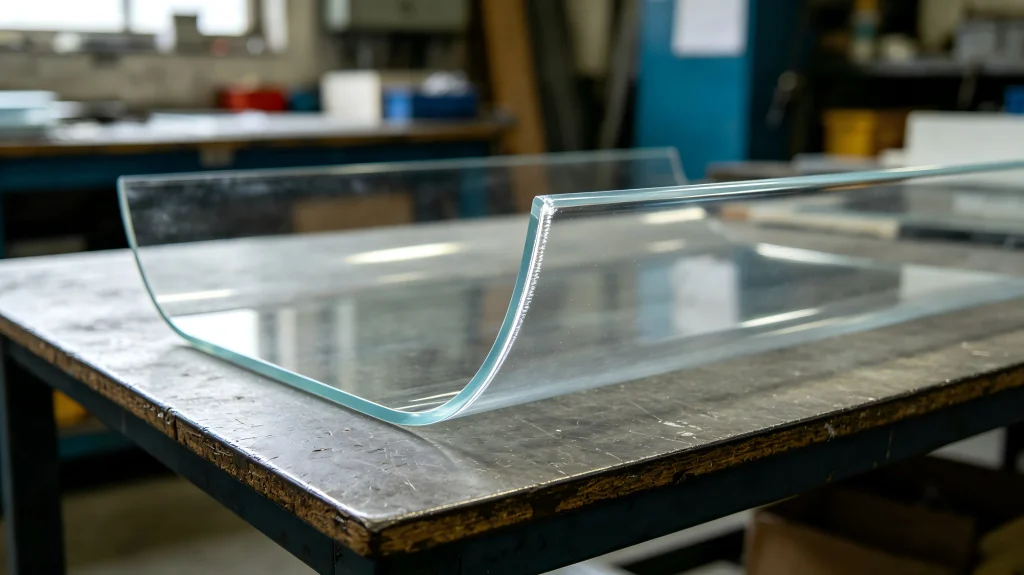
Doblado en frío means bending polycarbonate sheets at ambient temperature without heating. It delivers high efficiency without heating equipment, yet stress whitening along the bend line becomes the most frequent headache for fabricators.
⚠️ Critical background knowledge: Polycarbonate cold-bending cannot achieve very tight bend radii. Industry-recognized safe guideline: Minimum cold-bend radius should be 100-175 times the sheet thickness. Example: For a 2 mm sheet, minimum safe bend radius ranges from 200- 350 mm. Bending below this threshold almost certainly generates stress whitening. Many customers expect compact cold-bend geometry, which exceeds material physical limitations and leads to unavoidable whitening.
7.1 Tooling & mold optimization
Bending-machine upper punch must carry generous fillet. Never use a sharp knife-edge punch. Sharp edge concentrates squeezing force onto narrow line and creates an obvious whitish imprint along the bending line. Increase punch fillet radius to distribute pressure over wider contact area. Select appropriate opening width for lower bending die; avoid too-narrow die opening.
7.2 Slow and steady bending movement
Never apply fast-impact press motion for cold bending. Sudden impact forces polymer chains to deform violently without sufficient relaxation time and immediately generates stress whitening. Operate the press with slow uniform descending speed, allowing gradual molecular-chain deformation and suppressing the whitening phenomenon.
7.3 Pre–treatment of sheet edges
As mentioned in the pre-processing section, all burrs and micro-notches generated during cutting must be fully polished off for cold-bending blanks. Edge micro-defects serve as stress-initiation points for whitening and crack propagation.
7.4 Scenarios where cold–bending should be avoided
1)Flame-retardant UL94-V0 PC sheets: Reduced material toughness makes cold-bending whitening highly probable. Hot-bending is strongly preferred.
2)Thick sheets over 6 mm: Cold-bending hardly avoids whitening defects.
3)High-transparency optical-grade components with zero-whitening cosmetic requirements: Adopt the hot-bending process and abandon cold-bending.
For projects constrained by mechanical structure and forced to adopt cold-bending, Yucheng Board Industry will truthfully communicate physical material limits with customers. If the drawing bend radius is too small, we suggest revising geometry or switching over to hot-bending instead of accepting technically unfeasible orders and causing subsequent disputes.
8. Vacuum forming / thick–sheet thermoforming: Solve over–stretching, thinning and whitening on curved housings
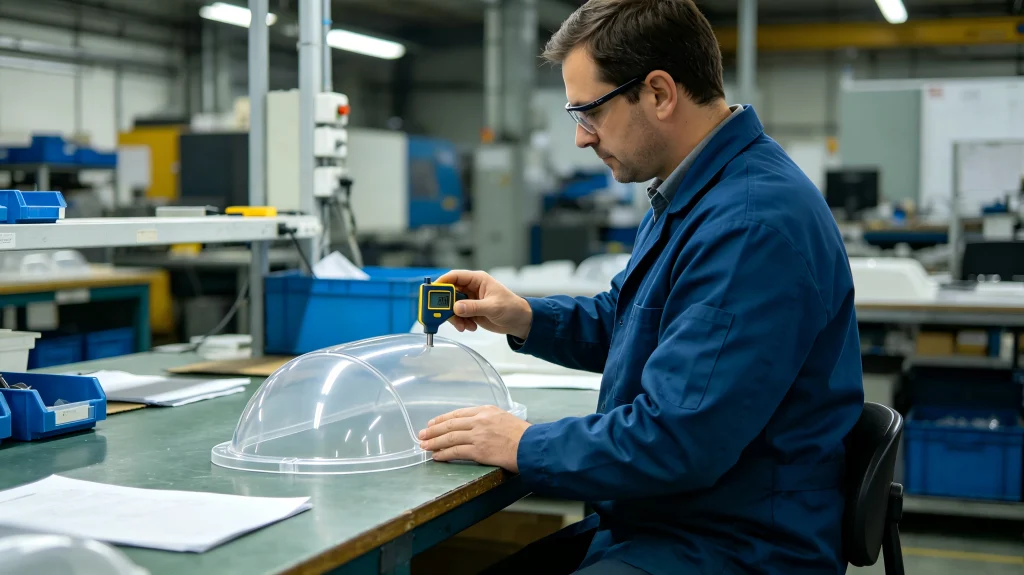
Thick-sheet vacuum forming produces PC curved enclosures, machine guards and new-energy protective shells. Primary risks are over-stretching, thinning, and whitish marks on curved corners. Many drawings only specify original incoming sheet thickness without defining minimum wall thickness after forming. Fabricators find corners become too thin after production.
8.1 Select raw–sheet thickness with stretching allowance reserved
Wall thickness will inevitably decrease on crown and corner areas after thermoforming. Calculate thickness loss caused by material stretching during the design-material-selection phase. Example: If finished housing requires minimum wall thickness 3.5 mm, do not simply choose 3.5 mm raw sheet; adopt 5 mm incoming sheet to compensate for stretching-caused thickness reduction. Housings suffering deep-draw deformation need thicker starting sheets.
8.2 Mold design optimization to distribute stretching and prevent localized heavy drawing
1)Implement large fillet radii for all mold corners, eliminate sharp angles. Sharp mold corners concentrate vacuum-forming stretching force, leading to severe thinning plus whitening defects.
2)Adopt pre-stretching structure if applicable, distributing material deformation over the whole sheet surface instead of concentrating drawing force within small local zone.
3)Optimize clamping-frame pressure: Excessive clamping pressure locks the sheet firmly and prevents material flow during forming, forcing local over-stretching, thinning and whitening. Insufficient clamping pressure leads to sheet shifting. Adjust clamping pressure iteratively during trial runs and find balanced setting.
8.3 Uniform heating across full sheet surface
Numerous vacuum-forming defects originate from uneven heating: some zones are overheated while other areas stay cold. Overheated soft spots get stretched excessively and turn thin and whitish.
✅ Maintain homogeneous temperature distribution across the whole sheet, heat both front and reverse sides. Avoid one-sided overheating. Do not apply over-long heating cycles which trigger polymer thermal degradation. Complete pre-drying must be finished before vacuum forming; undried sheets develop widespread silvery haze defects.
8.4 Do NOT activate full vacuum suction instantly
Many operators turn the vacuum pump to maximum power for perfect mold replication. Instant strong vacuum force pulls sheet violently and creates severe local stretching-thinning and whitening. Practical approach: Gradually build vacuum level step-by-step for gentle forming and reduce sudden tensile stress.
8.5 Mandatory mold trial with real raw sheets
Before mass production for new housing molds, produce trial samples using identical polycarbonate sheets. Measure actual wall thickness at multiple key positions, especially heavily-stretched crown and corner zones. If measured minimum wall thickness falls below drawing specification, optimize mold geometry, incoming-sheet thickness or heating parameters. Confirm qualified sample performance before full-scale manufacturing.
Yucheng Board Industry owns large-format thick-sheet vacuum-forming equipment for custom PC curved housings and safety-guard OEM projects. After receiving housing drawings, our engineers evaluate stretching severity and propose raw-sheet-thickness recommendations. Wall thickness is measured at multiple points on trial samples to control stretching-thinning within the permissible range while avoiding crazing and whitening. We deliver full service covering sampling and mass-volume production.
9. How to eliminate cutting whitening in CNC routing, grooving and drilling
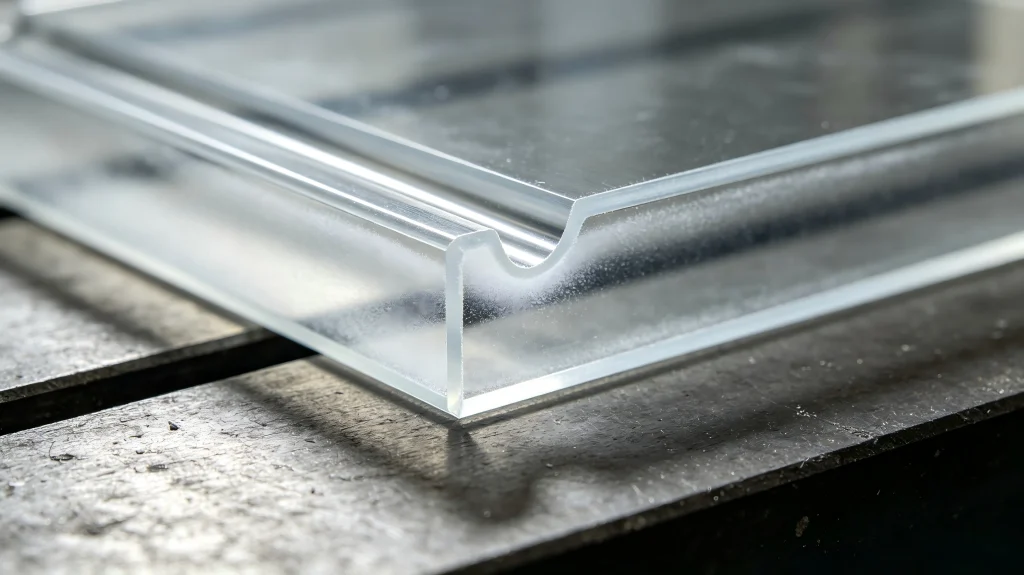
Whitening defects also frequently occur during CNC-machining operations. Cutting whitening mainly comes from dull cutting tools or mismatched spindle-speed-feed-rate settings. Tools squeeze and tear polycarbonate material and generate internal crazing leading to hazy cut surfaces, especially visible for transparent parts.
9.1 Tool selection: Keep cutting edges sharp; replace worn tools regularly
Do not process polycarbonate sheets with dull cutters. Dull tools tear and squeeze material instead of clean shearing, directly causing cutting whitening. Select special spiral end-mills engineered for plastic processing. Immediately replace cutters once edge wear appears.
9.2 Match spindle speed and feed–rate parameters
Adopt relatively high spindle-rotating speed and moderate low feed-per-tooth. High-speed thin-chip removal performs clean cutting and minimizes squeezing effect. Low spindle speed combined with aggressive feed amplifies material squeezing and whitening risk. Reserve small finishing allowance and execute a light finishing pass to eliminate cutting-induced whitish marks.
9.3 Chip removal and cooling strategy
Ensure effective chip evacuation. Swarf rubbing against workpiece surface creates friction-caused whitening. Use compressed-air jet to blow away chips and dissipate cutting heat. Oil-based cutting fluids are forbidden; polycarbonate suffers stress-cracking risk when contacting certain oils. Compressed-air cooling is preferred; micro-quantity water-soluble coolant is allowed for special cases.
9.4 Clamping fixture: Avoid over–tight clamping force
Excessive clamping pressure squeezes polycarbonate sheets and introduces built-in compressive stress, resulting in post-machining whitening. Place a soft rubber cushion between the fixture and the sheet surface to distribute clamping force and prevent rigid point-pressure loading.
9.5 Drilling operation tips
Hole-edge whitening and micro-chipping are common for polycarbonate drilling. Use high spindle speed with low feed rate. Apply step-drilling strategy: drill pilot hole first then enlarge hole diameter progressively. Avoid aggressive sudden drill penetration, which creates squeezing-induced whitening and micro-cracks around the hole perimeter.
10. Mold & fixture design: Minimize pulling force on polycarbonate sheets
Many whitening-thinning problems are rooted in defective tooling design rather than wrong process parameters.
- Add generous fillet radii for all pressing bars and mold edges contacting polycarbonate. Sharp corners produce squeeze-stress whitening marks under clamping pressure.
- Fixture design should realize large-area uniform contact distributing clamping load; avoid concentrated point-loading.
- Vacuum-forming mold vent holes should not be oversized. Excessively large vents cause local dents plus localized over-stretching. Keep vent-hole dimensions reasonable and evenly distributed.
- Maintain mold surface dry and clean without water or oil contamination. Oil and moisture vaporize under high temperature and create silvery whitish spot defects inside formed sheets.
11. Hidden influence of workshop temperature & humidity
Workshop environment conditions impact final yield, yet often get ignored.
- High ambient humidity: Sheets re-absorb moisture during waiting time between pre-drying and forming, producing silvery crazing after thermoforming. After drying, cover sheets to minimize air exposure in humid weather.
- Low workshop temperature in winter: Molecular mobility of polycarbonate decreases under cold ambient conditions. Identical bending parameters produce a higher risk of whitening in cold winter workshops. Appropriate pre-heating can be applied for sheets in low-temperature seasons.
- Dust and oil contamination: Wipe the sheet surface clean before forming. Surface impurities may trigger local forming defects under high temperature.
12. Can whitened or over–thinned parts be repaired? When should parts be scrapped
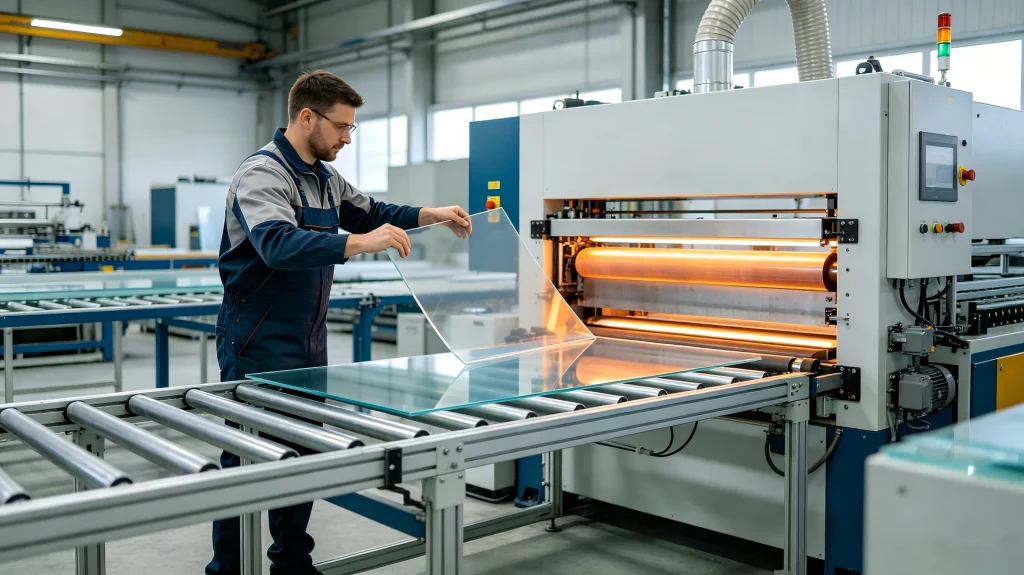
Defective components inevitably appear in real-world workshops. Factories tend to repair bad parts to save cost. Distinguish defect severity, do not blindly repair parts and create hidden quality hazards.
12.1 Stress–whitening evaluation
1)Minor surface whitening only with surface-level crazing without visible micro-cracks: Wet-sand followed by polishing may restore transparent appearance. Important reminder: Micro-crazes still exist inside the material even after surface polishing; residual internal stress remains. Resistencia a los impactos and solvent resistance degrade. Repaired parts are only acceptable for non-critical internal components. Never use polished-repaired parts for safety-related guards, medical or export-grade products.
2)Whitening accompanied by visible micro-cracks: Scrap component directly; no feasible repair. Cracks will propagate during service life.
12.2 Stretching–thinning evaluation
– Slight thickness reduction yet every measured wall-thickness point still meets the drawing-specified minimum wall-thickness requirement, no whitening or micro-cracks: components can be kept.
– Local wall-thickness drops below minimum allowable dimension defined on drawing: Scrap immediately even if surface looks fine. Over-thinned zones lose structural strength and risk mechanical failure. Never deliver out–de–spec thin–wall parts to customers to avoid after–sales liability.
Internal quality standard of Yucheng Board Industry: Parts with structural whitening or out-of-spec stretching-thinning are classified as non-conforming and scrapped. Repaired components will not be mixed into mass-delivery batches. If trial samples show whitening or thinning defects submitted by our clients, our team analyzes root causes and adjusts fabrication parameters instead of merely polishing the surface to cover defects.
13. Common misunderstandings in polycarbonate fabrication
❌ Misunderstanding 1: Polycarbonate is super-tough so you can bend it arbitrarily.
✅ Truth: High toughness does not mean unlimited deformation capacity. Exceeding the material’s deformation limit triggers stress whitening. Flame-retardant PC is even more sensitive.
❌ Misunderstanding 2: Whitening is purely a cosmetic issue without strength impact; deliver parts anyway.
✅ Truth: Whitening equals internal micro-void crazing and hidden residual-stress risk. Cracks may develop under solvent contact, vibration or low-temperature environments, leading to export-order rejection.
❌ Misunderstanding 3: Higher processing temperature always makes forming easier.
✅ Truth: Polycarbonate has a narrow thermal-processing window. Excessive temperature causes thermal degradation, blistering, yellowing and whitening.
❌ Misunderstanding 4: Skip pre-drying step to save production hours.
✅ Truth: Fabricating moist sheets in humid weather generates batch silvery-crazing and whitening. Scrap losses outweigh drying-cycle cost.
❌ Misunderstanding 5: Force cold-bending with tiny bend radius without modifying drawings.
✅ Truth: Physical material limitation. Forced cold-bending definitely creates whitening. Either enlarge bend radius or switch to hot-bending technology.
❌ Misunderstanding 6: Maximize vacuum suction power for perfect mold replication in thermoforming.
✅ Truth: Instant full vacuum creates violent material stretching, local thinning and whitening. Gradual vacuum-ramping delivers better results.
❌ Misunderstanding 7: Continue production with dull CNC cutters as long as material gets separated.
✅ Truth: Dull tools squeeze and tear polycarbonate and create cutting whitening. Cracks may propagate starting from whitened zones after assembly.
14. Yucheng Board Industry one–stop PC sheet OEM fabrication service to help you avoid whitening & thinning problems
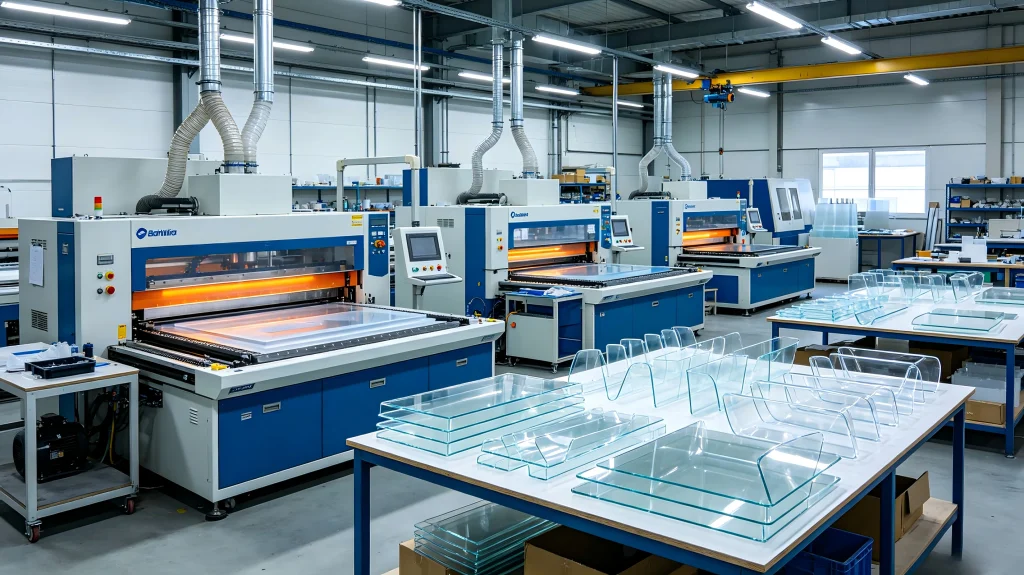
Purchasing managers and mechanical engineers frequently face pain points: In-house workshops lack mature polycarbonate-fabrication know-how. Trial production repeatedly produces whitening and stretching-thinning defects with high scrap rates and unstable lead times. Outsourcing to small fabricators brings inconsistent quality between prototype and mass-batch goods.
Suzhou Yucheng Board Industry Co., Ltd. was founded in 2013, with over 13-year-long practical experience in complete polycarbonate-sheet fabrication. We own a full set of in-house workshop equipment: hot-bending machines, cold-bending presses, 5-axis CNC centers, thick-sheet vacuum-forming machines, routing-engraving equipment, precision drilling and polishing facilities. We provide one-stop solution covering raw-sheet supply, custom fabrication, finished-product packaging and export shipment.
Targeting the industry-wide headache of PC-sheet whitening and stretching-thinning, Yucheng Board Industry implements standardized internal-control workflow:
- Drawing evaluation at pre-project phase: Our engineering team assesses bend radius and stretching ratio from customer drawings, identifies potential whitening-thinning risks. If drawing parameters approach material physical limits, we actively propose geometry-optimization suggestions instead of accepting technically unfeasible orders blindly.
- Raw–material management: Large-volume stock of virgin-grade polycarbonate sheets: general transparent PC, UL94-V0 flame-retardant PC, double-sided co-extruded UV-resistant sheets and hard-coated PC. We select proper material matching application scenarios and protect sheets against moisture during warehouse storage.
- Standardized pre-processing workflow: For high-spec orders, we execute sheet pre-drying, stress-relief annealing and full edge-deburring to eliminate root causes of silvery-crazing whitening.
- Sample validation before mass production: Prototypes are manufactured first for new projects. Visual inspection for whitish haze is performed. Wall thickness is measured on multiple positions of vacuum-formed housings to verify no excessive stretching-thinning occurs. Mass production starts only after customer sample approval.
- Parameter documentation: Temperature, heating time, clamping pressure, and CNC feed-speed settings of validated samples are fully recorded and strictly reproduced during mass-batch production to guarantee consistency between samples and bulk goods.
- Finished-goods inspection before shipment: The quality-control team focuses inspection on bending zones and heavily-stretched curved surfaces, checking for silvery-crazing whitening. Wall-thickness measurement is implemented for thermoformed housings. Defective components get scrapped directly without being repaired or mixed into shipment.
- Multi-industry project capability: We serve rail-transit interior parts, medical-device protective housings, new-energy equipment enclosures and overseas export projects. We are familiar with CE, RoHS, and REACH certification requirements and can supply related documents for customs clearance and project acceptance. We accept small-batch sampling orders, medium- to large-volume mass production, and long-term cooperative projects equally regardless of order quantity.
If you are troubled by polycarbonate-sheet whitening and stretching-thinning defects, send us your drawings and application requirements. Yucheng Board Industry evaluates your project and delivers reliable OEM custom-fabrication service.
15. Industry–specific quality suggestions: Rail transit, medical devices, new–energy protective covers
- Médico–device PC housings & viewing windows: Highest-spec requirement. Virgin-material sheets mandatory. Prioritize hot-bending, minimize cold-bending usage. Implement pre-drying plus annealing treatment. Zero-stress-whitening acceptance standard. Strict wall-thickness control after forming. Repaired parts must not enter final assembly.
- Rail-transit interior components: Mostly adopt UL94-V0 flame-retardant PC. FR-PC is more susceptible to whitening. Enlarge the bend radius in the design stage. Avoid cold bending whenever possible, use thermoforming. Control stretching-thinning strictly to guarantee component stability under long-term vibration environment.
- New-energy-equipment protective housings: Mostly large-size vacuum-formed curved shells. Emphasize wall-thickness allowance calculation for raw sheets to compensate for stretching-thinning. Select double-sided co-extruded UV-resistant sheets for outdoor-deployed units. Prevent silvery-crazing whitening, which accelerates crack propagation under outdoor weathering.
- General industrial safety guards and viewing windows: Balance performance and cost according to drawing specifications. Identify risk points ahead of production.
16. Frequently Asked Questions
Q1: Does whitening on processed PC parts always indicate bad-quality raw sheets?
A: Not necessarily. Numerous real-world cases prove premium virgin sheets develop whitening under wrong fabrication parameters. Recycled-content sheets can achieve acceptable surface quality with a properly controlled process. Whitening defects are mostly process-related. Troubleshooting should cover pre-treatment, temperature setting, bend radius and stretching ratio.
Q2: Is zero-whitening achievable for cold-bending polycarbonate sheets?
A: Near-zero-whitening can be achieved with a sufficiently large bend radius. If compact bend radius is forced by mechanical structure constraints, complete whitening elimination becomes difficult due to polycarbonate material properties. Switching to hot-bending forming is recommended.
Q3: How to verify whether vacuum-formed housing suffers out-of-spec stretching-thinning?
A: Do not rely merely on the original incoming sheet thickness reading. Use a thickness gauge to measure the actual remaining wall thickness on heavily stretched crown and corner areas of finished housing and compare with minimum wall-thickness specified on drawings.
Q4: Can lightly-whitened and polished-repaired components be used for outdoor application?
A: Not recommended. Polishing only conceals surface appearance while micro-crazing damage still exists inside the material. Whitened zones degrade and crack rapidly under outdoor UV radiation and weathering. Do not deploy repaired parts outdoors.
Q5: What special points should be noted when fabricating flame-retardant PC sheets compared with standard transparent PC?
A: Flame-retardant PC shows reduced toughness and higher whitening tendency. Adopt an enlarged bend radius, a lower stretching ratio, and more conservative processing parameters. Prioritize hot forming and minimize cold-bending usage.