






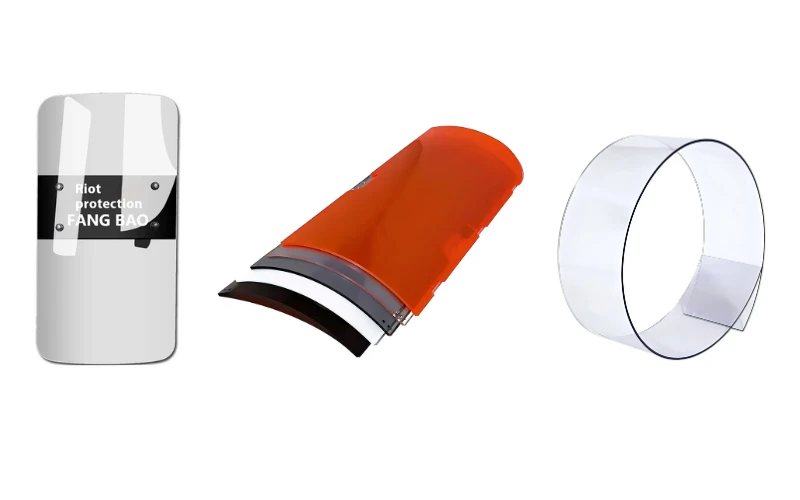
Most procurement engineers and product designers are familiar with basic solid polycarbonate sheet fabrication, such as CNC cutting, drilling and simple line hot bending. When projects require complete curved shells, curved protective enclosures, semi-closed housings or dome-shaped transparent guards, ordinary line bending cannot meet requirements. This is where one-piece forming of polycarbonate (PC) curved shells comes into play.
One-piece forming for polycarbonate curved shells is a thermoforming process. Flat solid polycarbonate sheets are evenly heated until flexible. With molds, vacuum negative pressure or air pressure stretches materials into 3D curved-shell components in a single operation. The finished shell is one integral piece, without glue joints or welding seams. It fully retains polycarbonate’s core advantages: high impact resistance, good light transmission and wide temperature tolerance.
⚠️Key difference reminder: Simple line hot bending only produces single-direction curves. One-piece curved shell forming supports multi-direction curved surfaces, concave cavities and dome-style housings. Many customers suffer sample scrap because they treat complex shell parts as ordinary line-bending workpieces.
Table of Contents
- What is one-piece forming for polycarbonate curved shells? Core differences vs line hot bending & injection molding
- Why solid polycarbonate sheet works great for curved shell thermoforming: fundamental material properties
- Main one-piece forming technologies for polycarbonate curved shells: vacuum forming, pressure forming, plug-assist forming, twin-sheet forming
- Full production workflow: sheet selection → pre-drying → clamping → uniform heating → forming → cooling under pressure → trimming & post-processing → quality inspection & shipment
- Critical design parameters: draft angle, fillet radius, draw depth ratio, shrinkage & wall-thinning risk
- Practical experience for different solid polycarbonate sheet thicknesses (2-12 mm)
- Common defects in polycarbonate shell thermoforming: root causes & practical solutions
- Suitable & unsuitable application scenarios, real-world industry cases
- Secondary post-processing for thermoformed polycarbonate shells: CNC machining, UV printing, screen printing, hard-coating & assembly tips
- Yucheng Board Industry OEM / ODM one-piece forming service for polycarbonate curved shells
- FAQ from prototype sampling to mass production
- Summary for designers & procurement engineers
1. What is one–piece forming for Polycarbonat curved shells? Core differences vs line hot bending & injection molding
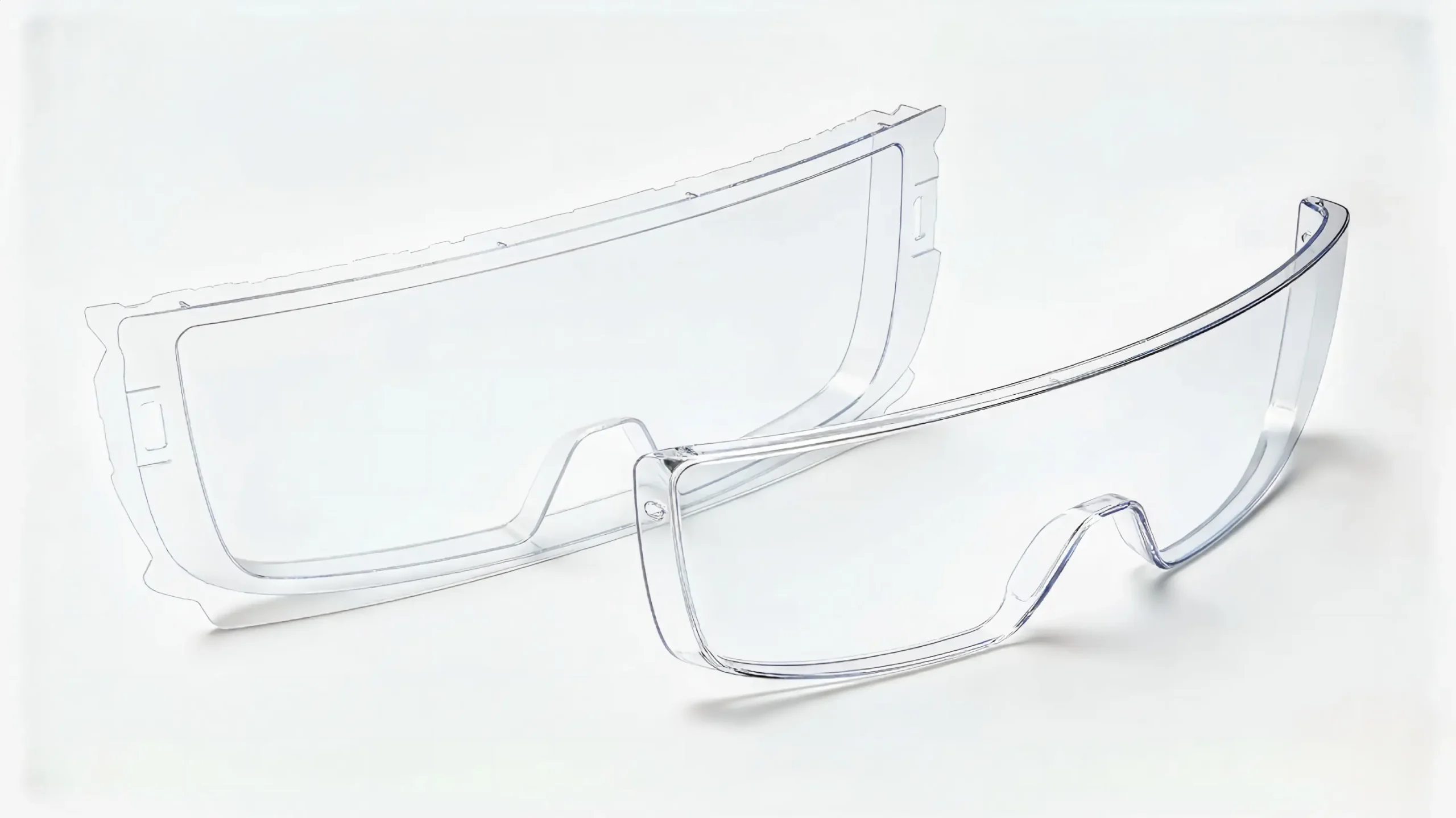
One-piece forming of polycarbonate curved shell belongs to heavy-gauge thermoforming. The raw input material is finished solid polycarbonate sheet, not plastic pellets.
Working principle: Solid polycarbonate sheets are clamped tightly on machine frames. Sheets are heated evenly to 160-180 °C to gain ductility. Vacuum or compressed air pushes softened polycarbonate material to fully fit mold contours to create 3D curved shells. Pressure is maintained until full cooling and shape locking. Excess material is trimmed off to obtain integral shell components.
Many buyers confuse three manufacturing methods: simple line hot bending, polycarbonate shell one-piece thermoforming and injection molding. Wrong process selection will cause higher cost and delayed lead time.
① Simple line hot bending
Only local heating along one straight line. Only single-direction arcs or angles are achievable. Complex multi-direction curved housings or domes are impossible. Suitable for simple curved baffles, not for closed shells. Low equipment cost for simple workpieces.
② One-piece thermoforming for polycarbonate curved shell
Raw material: finished solid polycarbonate sheet
Tooling: single-sided mold (aluminum or resin mold). Tooling cost is far lower than injection molding steel molds.
Vorteile: Extra-large size shells up to 3 m width are achievable. Perfect fit for prototype sampling, small-batch and medium-volume orders. One-piece seamless structure keeps the high transparency and outstanding impact resistance of polycarbonate sheet. Transparent large-size housings are easy to realize, which is difficult for injection molding.
Limitations: Wall thinning occurs at corner positions during stretching, which must be considered at the design stage. Pre-drying procedure for polycarbonate sheets is mandatory.
③ Injection molding Raw material
Polycarbonate plastic pellets.
Tooling: Expensive double-sided steel mold with extremely high tooling investment.
Vorteile: Uniform wall thickness, excellent fine-detail reproduction, ideal for mass-production small-size components.
Limitations: Prohibitive mold cost for large-size shells. Transparent injection-molded polycarbonate parts easily generate flow marks and silver streaks. Not economical for low-volume orders.
✅Key takeaway: For large–size transparent curved shells with prototype / small–zu–medium batch quantity, prioritize Polycarbonat one–piece thermoforming. For mass–production small–size housings, evaluate injection molding.
At Yucheng Board Industry, we frequently receive injection-molding-origin 3D drawings for polycarbonate thermoforming projects. Drawings lack proper fillets, draft angles or contain excessive draw depth, leading to first-article failure. Design must match thermoforming rules instead of directly copying injection–molding drawings
2. Why solid Polycarbonat sheet works great for curved shell thermoforming: fundamental material properties
Not every plastic sheet performs well for one-piece curved shell forming. PMMA (acrylic) tends to crack during thermoforming. PETG delivers good toughness but limited heat resistance. ABS has poor optical transparency. Solid polycarbonate sheet is the top industrial choice for transparent curved housings.
- Excellent thermoplastic behavior: Polycarbonate softens above the glass-transition temperature ~145 °C and hardens again after cooling, enabling repeated thermal shaping.
- Superior impact toughness: Thermoformed polycarbonate curved shells retain outstanding shatter-resistant performance. That explains why machine safety guards, medical device housings and new-energy protective shells widely adopt polycarbonate thermoformed parts. Even stretched corners with reduced wall thickness still outperform acrylic shells in anti-impact performance.
- High optical clarity: Clear solid polycarbonate sheet achieves 86-89% light transmittance. Thermoformed curved shells maintain high transparency for observation windows.
- Wide operating temperature range: Continuous service temperature ranges from -40 °C to 120 °C. Flame-retardant polycarbonate, anti-static polycarbonate and UV-resistant polycarbonate sheets can all be thermoformed for diversified industrial requirements.
⚠️Two critical weaknesses of polycarbonate you cannot ignore for shell thermoforming: First, polycarbonate sheet absorbs moisture from ambient air. Trapped moisture turns into steam under high forming temperature, generating bubbles and silver streaks inside finished shells. Pre-drying is a non-skippable procedure for polycarbonate shell thermoforming. Skipping pre-drying brings massive scrap risk. Second, wall thinning naturally appears on stretched corners. Excessive deep-draw structure should be avoided in product design.
At Yucheng Board Industry, every batch of solid polycarbonate sheets for shell forming goes through standardized pre-drying according to sheet thickness to eliminate bubble defects at the source. Many fabricators skip the drying procedure to save time and suffer high reject rates.
3. Main one-piece forming technologies for polycarbonate curved shells
Four mainstream thermoforming solutions for solid polycarbonate curved shells: Vakuumverformung, pressure forming, plug-assist forming, twin-sheet forming. Choose the proper technology according to shell geometry.
3.1 Vacuum forming
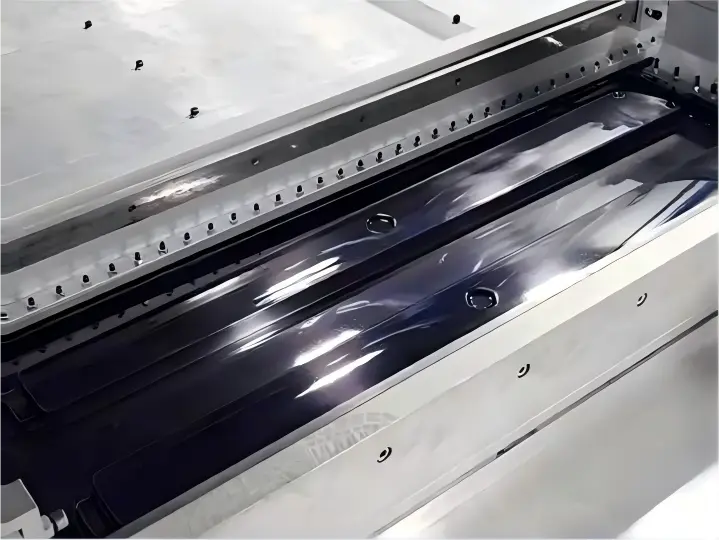
Most widely adopted one-piece forming method for polycarbonate curved shells. Heated soft polycarbonate sheet is sealed against the mold surface. Vacuum pump evacuates air between the sheet and mold. Atmospheric pressure pushes the polycarbonate sheet onto the mold contours to create shells.
✅Best for shallow-draw shells, safety guards, curved protective hoods, transparent domes.
✅Advantages: Mature technology, moderate mold cost, supports large-size components.
❌Limitations: Obvious wall-thinning for deep-draw shells; limited fine-detail reproduction.
3.2 Pressure forming
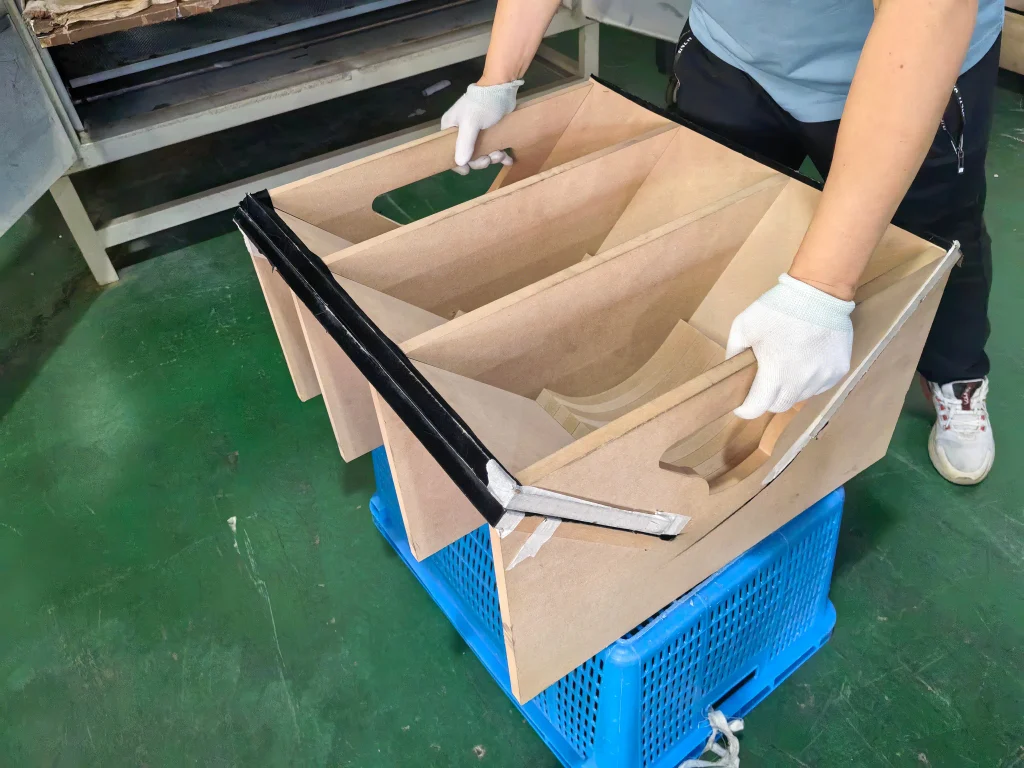
Based on vacuum forming, compressed air is applied from the upper side of the sheet. Higher pressure pushes polycarbonate material into the mold cavity.
✅Best for deep-draw housings and parts requiring fine surface details. Better wall-thickness uniformity compared with pure vacuum forming.
✅Advantages: Improved detail replication, reduced wall-thinning effect.
❌Limitations: Higher equipment investment, strict mold sealing requirement, higher production cost.
3.3 Plug-assist forming
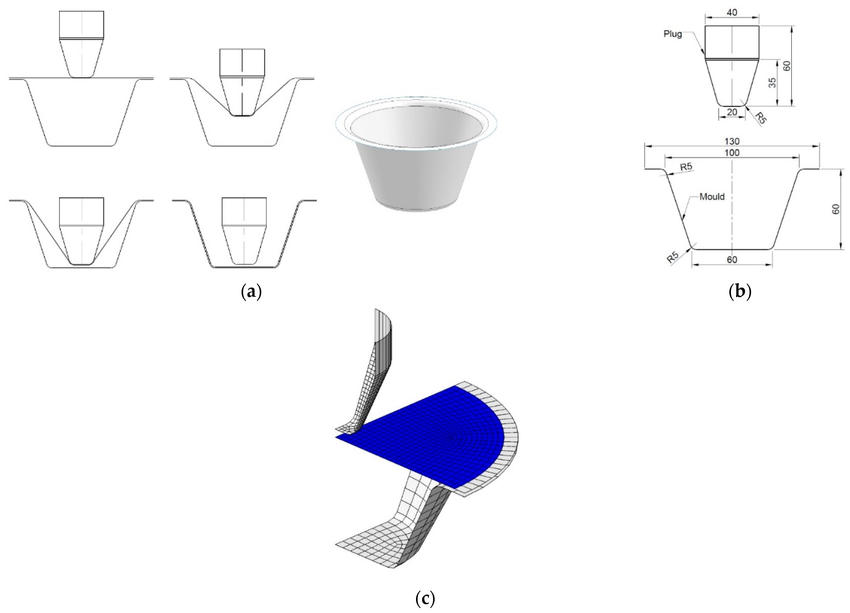
Optimized solution for deep-draw shells. Mechanical plug pushes softened polycarbonate sheet partially into mold cavity before vacuum is activated. Pre-stretching mitigates severe corner thinning and tearing risk.
Key reminder: When draw–depth ratio exceeds 0.7, plug–assist forming is strongly recommended to avoid corner tearing and hole–through scrap.
3.4 Twin-sheet forming
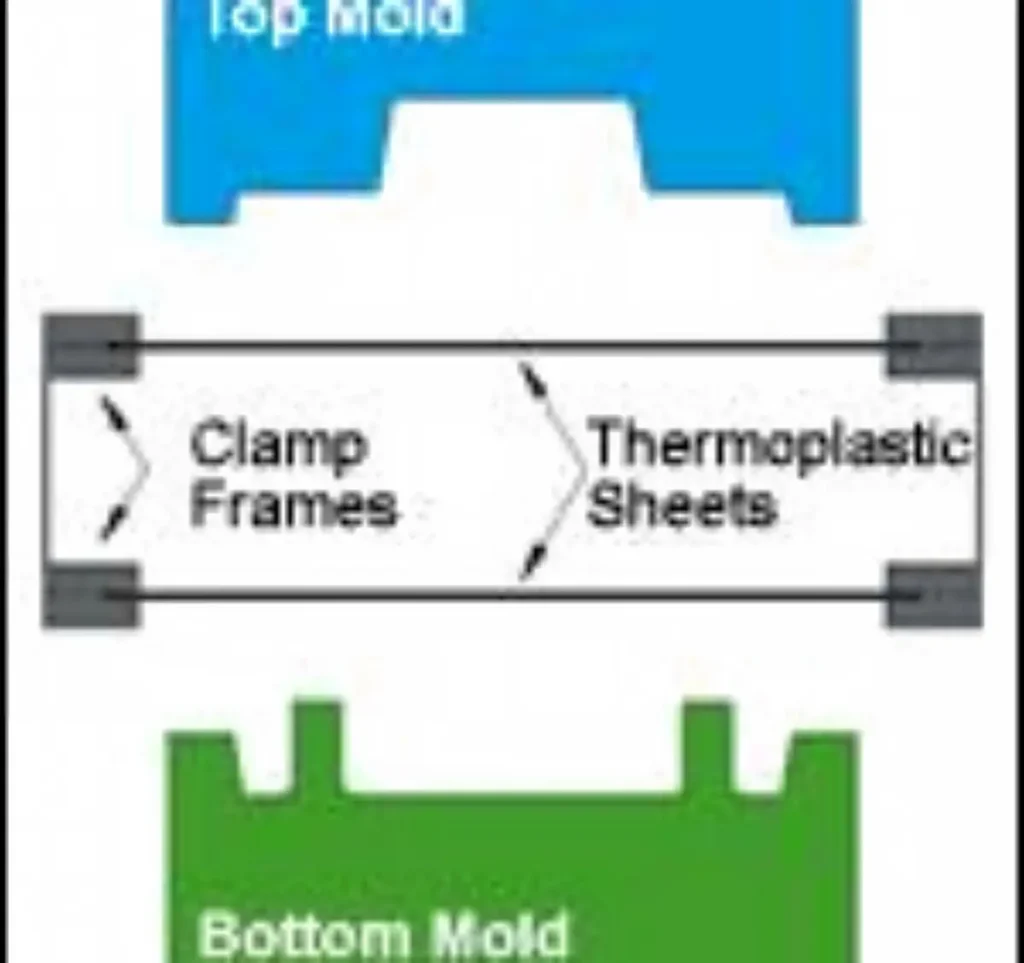
Two solid polycarbonate sheets are heated simultaneously and formed by upper & lower molds. Sheet edges are heat-fused together to produce hollow sealed shells.
✅Best for hollow floating structures, double-layer protective housings.
❌Limitations: High technical difficulty, higher cost, relatively narrow application scope.
Yucheng Board Industry’s heavy-gauge thermoforming equipment supports vacuum forming and pressure forming. Our technical team evaluates customer 3D files and recommends the optimal forming process before mold manufacturing.
4. Full production workflow: sheet selection → pre-drying → clamping → uniform heating → forming → cooling under pressure → trimming & post-processing → quality inspection & shipment
4.1 Sheet material selection
Virgin-grade solid polycarbonate sheet is preferred for polycarbonate curved shell one-piece forming. Recycled polycarbonate sheets contain impurities and easily produce bubbles and surface blemishes during thermoforming, not recommended for industrial housings.
Specify sheet grade: clear polycarbonate, flame-retardant polycarbonate, anti-static polycarbonate, double-sided UV-coated polycarbonate.
Important note: Hard-coated polycarbonate sheets require strict temperature control during forming. Overheating causes cracking and whitening of hard-coat layers. Notify the fabricator in advance for adjusted processing parameters.
Recommended thickness reference: 2-3 mm: small shallow-draw shells, face shields; 4-6 mm: most industrial safety guards & housings, most widely used thickness range; 8-12 mm: heavy-duty protective shells for deep-draw structures.
4.2 Pre-drying (critical step, never skip)
Moisture inside polycarbonate sheets generates bubbles and silver marks after heating, which is the top cause of failure in thermoformed polycarbonate shells.
Reference drying parameters: circulating hot-air oven at 115-120 °C. Sheets hang vertically with air gaps between each sheet. Drying duration depends on thickness: 2-3 hours for 3 mm sheet; 4-6 hours for 6 mm sheet; 6-8 hours for 8-10 mm sheet. Start forming right after drying. Long-term exposure to ambient air causes re-absorption of moisture; sheets need re-drying.
Yucheng-Plattenindustrie owns independent drying ovens to perform thickness-matched pre-drying for every polycarbonate shell project.
4.3 Clamping
Pre-dried solid polycarbonate sheets are mounted and evenly locked on the thermoforming machine frame. Loose clamping leads to sheet shifting and wrinkling during heating.
4.4 Uniform heating
Dual-side infrared heating brings solid polycarbonate sheets to the forming temperature of 160- 180 °C.
Critical point: Avoid local overheating, which causes material degradation, yellowing and surface defects. Insufficient heating leads to tearing at corners during forming. Operators judge forming readiness by observing uniform sheet sag. Thick sheets must be heated from both sides. Single-side heating creates uneven inner-outer temperature and severe warpage after forming.
4.5 Forming operation
Reach target temperature, transfer sheet to mold station, activate vacuum/pressure / plug-assist sequence. Gradually build vacuum pressure. Instant full vacuum concentrates stress on corners and tears polycarbonate shells.
4.6 Cooling under pressure
Maintain vacuum or air pressure until the polycarbonate shell fully cools down before releasing. Many low-level fabricators demold prematurely for higher throughput. Huge internal residual stress remains inside shells, resulting in post-demold warpage, dimension drift and delayed stress cracking. Keep proper mold temperature to avoid ultra-fast uneven cooling.
4.7 Trimming and post-processing
As-formed workpieces contain large excess borders. 5-axis CNC milling trims outlines, cuts openings and notches.
Hinweis: Laser cutting is not recommended for thermoformed polycarbonate blanks. Laser thermal burning creates heavy internal stress on cutting edges, bringing cracking risk. CNC-Fräsen is preferred. Edge polishing removes burrs for smooth assembly.
4.8 Quality inspection & shipment
Inspection items: appearance check (bubbles, scratches, tears, wrinkles); dimension measurement; warpage inspection; spot wall-thickness testing. Qualified shells are protected with PE film, foam corner protection, export carton or pallet packaging.
5. Critical design parameters: draft angle, fillet radius, draw depth ratio, shrinkage & wall-thinning risk
Most Thermoformung failures stem from improper design instead of machine issues. Many customers directly reuse injection-molding drawings and suffer prototype losses. Observe these parameters at the drawing phase.
5.1 Fillet radius
Sharp inside corners are the biggest enemy for polycarbonate thermoformed shells. All internal corners must have a fillet radius ≥0.5 × sheet thickness. Sharp corners create stress concentrations, leading to tearing during forming or in-service cracking after production.
5.2 Draw depth ratio (depth/opening width)
Safe draw-depth ratio for solid polycarbonate vacuum forming ≤ 1:1. Shell depth cannot exceed maximum opening width. When ratio exceeds 0.7, plug-assist forming should be considered. Avoid ratio higher than 1:1 whenever possible.
5.3 Draft angle
Side walls of shells must have a draft angle; the minimum recommended value is 3-5°. Zero-draft structure causes sticking during demolding and shell tearing. Undercut geometry cannot be realized with standard single-sided thermoforming molds; a split structure is required.
5.4 Forming shrinkage
Solid polycarbonate thermoforming shrinkage rate: 0.5-0.7%. Mold dimensions require oversize compensation to offset shrinkage. Otherwise, the finished shell dimension will be undersized.
5.5 Wall-thinning risk
Wall thickness drops at stretched corners and bottom areas. Flat zones keep the original sheet thickness. Do not place mechanical load-bearing features on heavily thinned corner regions.
When customers send us 3D drawings, our technical team provides a free design review, points out unreasonable fillets, draw-depth and draft-angle issues and offers modification suggestions to reduce prototype loss.
6. Practical experience for different solid polycarbonate sheet thicknesses (2-12 mm)
- 2–3 mm solid Polycarbonat Blatt: For small shallow-draw shells. Keep draw-depth ratio under 0.5. Short heating and cooling cycle. Lower overall rigidity, large shells tend to warp.
- 4–6 mm solid Polycarbonat Blatt: Most popular thickness for industrial housings. Balanced rigidity and forming tolerance. Adopt plug-assist forming for draw-depth ratio between 0.7-1. Widely used for machine guards, medical enclosures and new-energy protective shells.
- 8–12 mm heavy–duty solid Polycarbonat Blatt: For heavy-duty protective housings. Longer drying and heating cycle to guarantee homogeneous temperature. High-strength mold required. Wall-thinning still happens at corners. Avoid load-bearing features on corner sections.
Reminder: Simply increasing sheet thickness cannot eliminate corner wall-thinning caused by material stretching. Optimize shell geometry, enlarge fillets and reduce draw depth for better results, meanwhile control material cost.
7. Common defects in polycarbonate shell thermoforming: root causes & practical solutions
Based on our long-term export production experience, we list high-frequency defects, root causes and actionable countermeasures.
Defect 1: Internal bubbles & silver streaks
Root cause: Incomplete pre-drying; sheets re-absorb moisture after drying. Moisture vaporizes under high forming temperature. Solution: Follow thickness-matched drying schedule; finish forming quickly after drying; re-dry sheets exposed to humid air.
Defect 2: Corner wall thinning, tearing, hole-through
Root cause: Too small internal fillet; excessive draw-depth ratio; over-sagging sheet; vacuum pressure built up too fast. Solution: Enlarge inner fillet radius; optimize product geometry; adopt plug-assist forming; ramp up vacuum pressure gradually.
Defect 3: Surface wrinkle and ripple marks
Root cause: Loose sheet clamping; local overheating; insufficient mold vent holes. Solution: Tighten clamping frame evenly; calibrate heating system; add mold vent holes.
Defect 4: Post-demold warpage & spring-back deformation
Root cause: Demold before full cooling; uneven sheet heating; too-cold mold; heavy residual internal stress. Solution: Extend pressure-holding cooling cycle; dual-side balanced heating; raise mold temperature moderately; perform annealing process to release internal stress if necessary.
Defect 5: Poor mold detail reproduction, incomplete forming
Root cause: Insufficient sheet heating; insufficient vacuum pressure; clogged mold vent holes. Solution: Properly extend heating duration; inspect vacuum pump performance; clean blocked vent holes regularly.
Defects are usually caused by multiple overlapping factors. Yucheng Board Industry reviews the full set of parameters including drying, heating, pressure and cooling to solve defective samples.
8. Suitable & unsuitable application scenarios, real-world industry cases
✅Highly recommended scenarios for polycarbonate one-piece curved shell forming
- Transparent safety guards for industrial automation equipment: machine protective housings with visual observation requirements, anti-splashing impact resistance. Yucheng Board Industry supplies large quantities of such thermoformed polycarbonate shells for overseas automation OEM customers.
- Medical device protective enclosures: impact-resistant transparent instrument housings, some polycarbonate grades support disinfection cycles.
- New-energy equipment protective domes: outdoor applications with UV-resistant solid polycarbonate sheets.
- **Curved guards for rail-transport equipment, retail display curved transparent housings, daylight domes.
- Order profile: prototype sampling, small–batch & medium–batch production; large–size housing, avoid high–cost injection steel mold investment.
❌Not recommended scenarios
- Requirement for perfectly uniform wall thickness across entire shell: wall-thinning is unavoidable for thermoforming, injection molding is a better choice.
- Complex under-cut fine features: cannot be achieved by standard single-sided thermoforming mold.
- Tiny components with millions-volume mass production: injection molding brings better cost performance.
- Long-term contact with strong solvent chemicals: polycarbonate parts face high stress-cracking risk, material evaluation is mandatory.
9. Secondary post-processing for thermoformed polycarbonate shells: CNC machining, UV printing, screen printing, hard-coating & assembly tips
Thermoformed polycarbonate shells are semi-finished blanks. Most projects require further post-processing.
- Opening, slotting and cut-outs: Prioritize 5-axis CNC milling. Avoid laser cutting; the laser process creates heavy residual stress on cut edges.
- Drucken: For curved shells, UV curved printing is preferred. Conventional screen printing works for mild curvature only; steep curved surfaces suffer poor registration accuracy. Remove static electricity and surface grease before printing operation.
- Hard–coating treatment: Hard-coating after thermoforming is difficult. Purchase pre–hard–coated solid Polycarbonat sheets before thermoforming. Strictly control forming temperature to prevent coating cracking or whitening.
- Assembly guidance: Keep sufficient clearance for screw holes, install silicone gaskets. Do not over-tighten screws, over-compression induces stress cracking around holes. Clean finished shells only with neutral water-based detergent; avoid aggressive solvents.
10. Yucheng Board Industry OEM / ODM one-piece forming service for polycarbonate curved shells
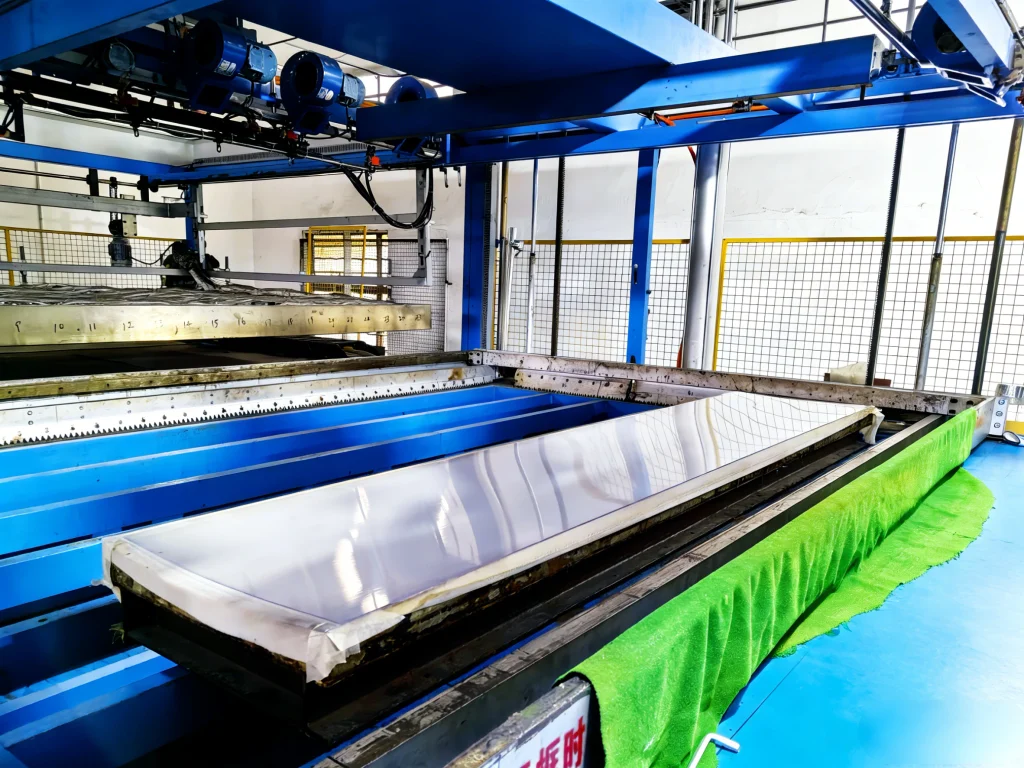
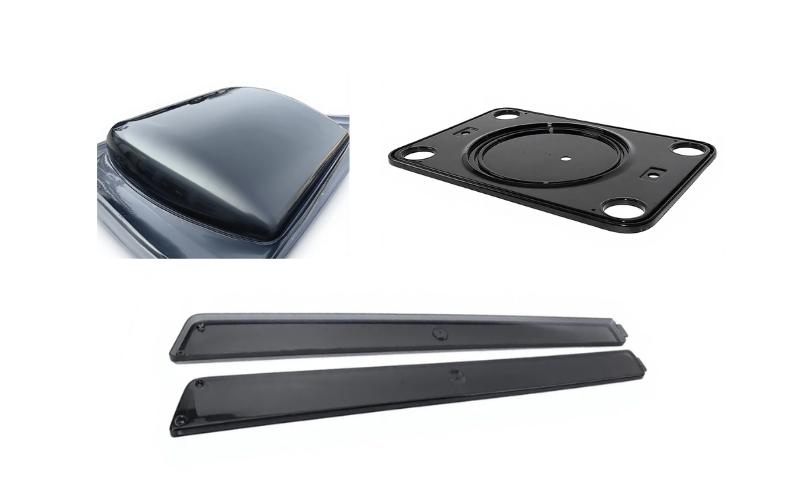
We were founded in 2013. We specialize in solid polycarbonate sheet fabrication for more than 10 years. Our factory is equipped with heavy-gauge thermoforming machines, 5-axis CNC centers and independent drying ovens. We deliver one-stop OEM / ODM service: sheet supply → one-piece thermoforming → post-processing → printing → finished-product packaging.
Our service scope:
✅Prototype sampling & mass-volume production from customer 3D drawings or physical samples for polycarbonate curved shell one-piece forming;
✅Multiple sheet grades available: clear polycarbonate, UL94 V-0 flame-retardant polycarbonate, anti-static polycarbonate, UV-weather-resistant solid polycarbonate sheets;
✅Complete secondary processes: CNC milling, edge polishing, UV printing, Siebdruck;
✅Support low-volume prototype and large-volume export orders;
✅Export-grade packaging: PE protective film, foam corner guard, fumigated pallet, customer OEM private labeling supported;
✅Free pre-production drawing technical review to identify design risks and avoid prototype scrap loss.
Many overseas buyers send us 3D files directly. Our team provides a full solution including sheet selection, forming-process recommendation and mold suggestion. Customers receive finished polycarbonate shells without coordinating multiple separate suppliers, reducing communication risk and quality inconsistency.
If you are working in the automation equipment, medical device or new-energy industry and have demands for one-piece forming of polycarbonate curved shells, feel free to contact Yucheng Board Industry. We help you turn design drawings into qualified finished housings.
11. FAQ from prototype sampling to mass production
Q1: What is the typical lead time for polycarbonate curved shell prototype?
A: After drawing confirmation, mold manufacturing takes 7-12 days, and prototype sampling takes 3-5 days. Total sample lead time is 10-17 days, subject to shell complexity.
Q2: Is thermoforming mold expensive?
A: Resin molds or aluminum molds cost much less than injection-molding steel molds, suitable for small- to medium-sized batches. High-durability aluminum mold for large-volume production.
Q3: Does wall-thinning after forming mean parts are defective?
A: Wall-thinning is physical material behavior. If draw-depth and fillet rules are followed, limited wall-thinning is acceptable and parts maintain functional performance.
Q4: Can we use recycled polycarbonate sheet for one-piece shell forming?
A: Not recommended. Recycled sheets contain impurities, high bubble & defect risk. Virgin-grade solid polycarbonate sheet is preferred for industrial housings.
Q5: How to handle warpage after thermoforming?
A: Optimize heating & cooling parameters as a priority. Annealing treatment can release internal residual stress.
12. Summary for designers & procurement engineers
- Do not directly reuse injection-molding drawings for polycarbonate thermoforming, technical review is mandatory.
- Never skip the pre-drying procedure, it is the first threshold for good-quality polycarbonate shells.
- Eliminate sharp inner corners, set a sufficient fillet radius; follow a safe draw-depth ratio; apply proper draft angle.
- Adopt plug-assist forming for deep-draw shells.
- Demold only after full cooling, avoid premature demolding for faster throughput.
- Choose CNC milling for cut-outs instead of laser cutting. Keep assembly clearance and install gaskets.
- Cooperate with a full-capability fabricator integrating sheet supply, thermoforming and post-processing to avoid multi-supplier quality-control risks.