


Einleitung
When selecting glazing and enclosure panels for engineering projects, buyers and designers often focus on two core functions: sound insulation und Wärmedämmung. There are many panel options available on the market, including acrylic sheet, tempered glass, color steel panel, FRP, and widely used PC-Platte (Polycarbonatplatte). The difference in sound and heat insulation performance between different materials is quite large.
Most buyers can only find scattered data online, without real-world test results. Many manufacturers only publish ideal lab data. Once installed on construction sites, factories or greenhouses, the actual performance may not match the marketing data.
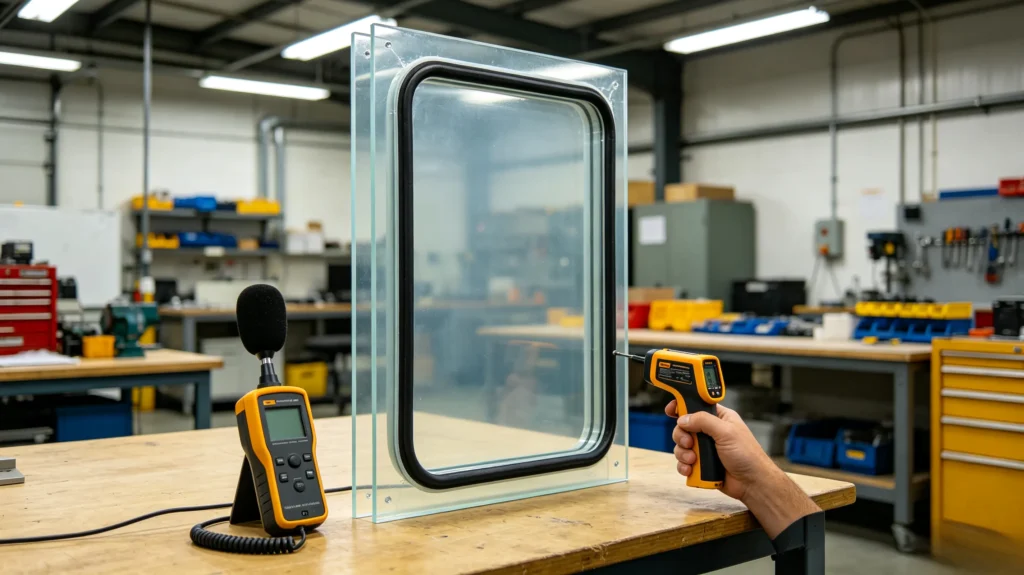
In this article, we will carry out PC sheet sound insulation and thermal insulation basic performance test analysis. We will explain the working principle of solid polycarbonate sheet und multiwall polycarbonate sheet for noise blocking and heat preservation, share groups of practical test data, compare how thickness, panel structure and installation methods affect PC sheet sound insulation effect und PC sheet thermal insulation performance. We will also sort out key factors that affect test readings, correct common industry misunderstandings, and guide you to select suitable PC-Blatt according to your on-site noise level and local temperature difference.
As an experienced manufacturer specializing in PC sheet fabrication, Yucheng BoardIndustry provides custom processing service for solid PC sheet and multiwall polycarbonate sheet. A large number of our projects require both daylighting, sound insulation and thermal insulation. During project delivery, we completed dozens of field tests, covering factory noise reduction, greenhouse heat preservation, station canopy, rail transit noise barrier, equipment protective cover and building skylight projects. We do not merely sell finished PC-Blatt. We can recommend proper panel thickness and structure according to your site noise data and climate temperature difference. We also provide cutting, bending, drilling, film coating and OEM one-stop processing service, solving all kinds of PC-Blatt application challenges.
1. What is PC sheet? Difference between solid polycarbonate sheet and multiwall polycarbonate sheet
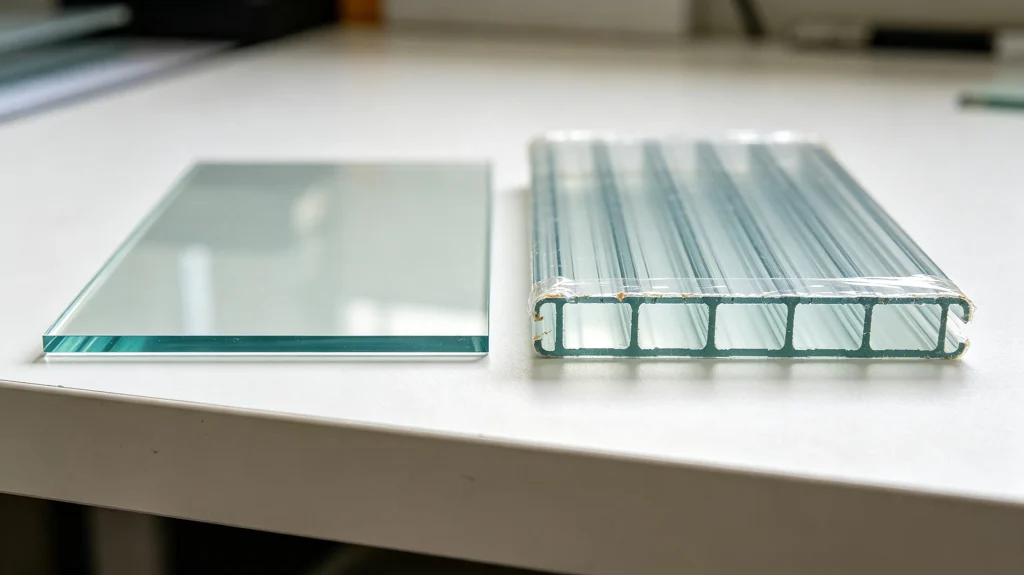
To understand test results of PC sheet sound insulation and thermal insulation, you need to tell apart two mainstream PC-Blatt types: solid polycarbonate solid sheet and hollow multiwall polycarbonate sheet. Their internal structures are totally different, which leads to huge difference in sound and heat insulation performance. This is the top reason for wrong material selection in many projects.
PC-Blatt, full name Polykarbonatplatte, is engineering plastic panel extruded from polycarbonate resin. It features high toughness, impact resistance and weather resistance.
- Solid polycarbonate sheet: monolithic solid structure without hollow air cavities. Available thickness covers 1.5mm,2mm,3mm,5mm,6mm,8mm,10mm,12mm,15mm,20mm. Solid structure delivers high impact strength and better sound insulation, while thermal insulation is weaker than multiwall polycarbonate sheet with equal total thickness.
- Multiwall polycarbonate sheet: internal ribs form one or multiple hollow air chambers, including double-wall, triple-wall, four-wall structure. Static air trapped inside hollow cavities acts as natural thermal barrier, so multiwall polycarbonate sheet thermal insulation performance is outstanding. However, hollow structure shows weaker performance blocking mid-to-high frequency noise compared with solid polycarbonate sheet with the same total thickness.
Key reminder: Many purchasers only check total thickness without checking panel structure. A 10mm solid PC sheet and a 10mm double-wall multiwall polycarbonate sheet show completely different sound insulation and thermal insulation test results, and they cannot replace each other directly.
Yucheng Board Industry supplies solid Polykarbonatplatte and multiwall Polykarbonatplatte as required. Our panels can be co-extruded with UV coating for outdoor anti-aging. We also provide cutting, thermoforming, grooving, drilling and sealing processing. For noise barrier or thermal insulation daylighting projects, customers can provide drawings, and we finish full PC-Blatt fabrication so panels can be assembled directly on construction site.
2. Basic theory of PC sheet sound insulation: what is measured in sound test
2.1 Two noise transmission paths
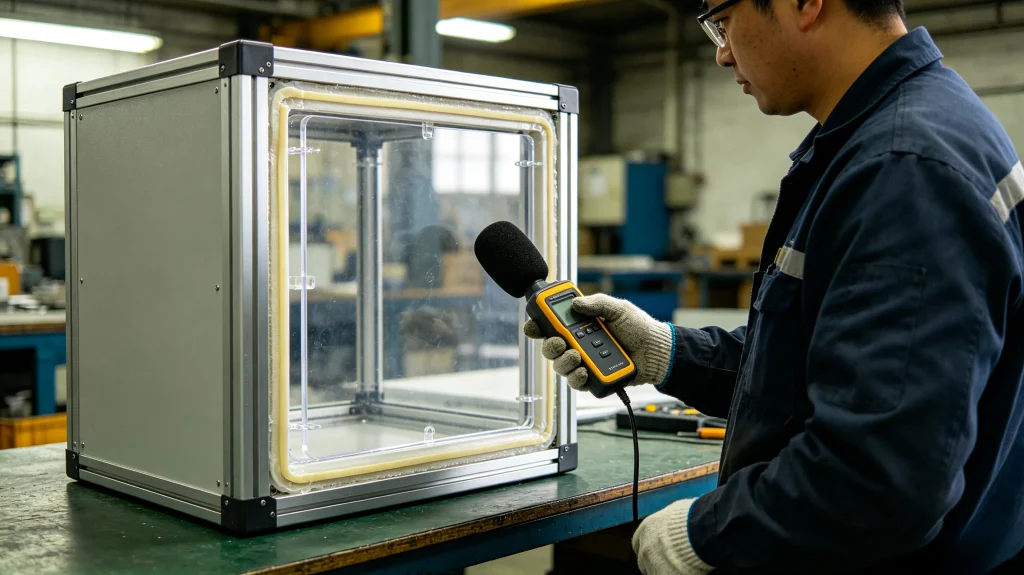
Sound transmits in two ways: airborne sound and structure-borne sound. In PC sheet sound insulation test, most tests focus on airborne sound insulation, such as traffic noise, fan noise and outdoor human voice travelling through air.
- Airborne sound: sound wave travels in air, hits panel surface, makes panel vibrate and transfers noise to the other side.
- Structure-borne sound: vibration transfers through support frame, steel structure and wall. Even if your PC-Blatt has great sound insulation, noise still transfers if there is no vibration damping on steel frames. This is a critical point during field test. Many customers simply choose thicker panels but ignore vibration isolation for brackets, finally finding PC sheet sound insulation fails to meet expectation.
PC sheet sound insulation follows a basic rule: higher surface density of panel brings stronger ability to block airborne noise. In simple words, panels with higher weight per square meter are harder to vibrate under sound wave, delivering better noise reduction. Solid Polykarbonatplatte is monolithic solid material with high surface density, so sound insulation performance is better. multiwall polycarbonate sheet has large total thickness but low weight per square meter, so its ability to block mid-high frequency noise is weaker.
Bold keyword: surface density is one of the core indicators affecting PC sheet sound insulation performance.
2.2 Sound insulation indicator: sound reduction index (dB decibel)
The unit we read from PC sheet sound insulation test report is decibel (dB). Higher dB value means better noise blocking capacity. Reference for intuitive understanding:
- Road traffic noise: 70–85dB
- Normal office environment: 40–50dB
- Quiet bedroom at night: around 30dB
Für PC-Blatt, weighted sound reduction index Rw is widely adopted in industry for cross-material comparison. Many suppliers only publish single-frequency sound insulation data which has limited reference value. When designing large noise insulation engineering projects, engineers from Yucheng Board Industry select proper PC-Blatt according to main noise frequency (low-frequency rumble or sharp high-frequency noise), instead of only relying on single Rw value.
Noise can be divided into low frequency, mid frequency and high frequency:
- Low-frequency noise: vibration from large fans, heavy trucks, air compressors. Low-frequency sound has strong penetration, only heavy solid wall can block it effectively. Thin PC-Blatt has limited effect suppressing low-frequency noise.
- Mid-frequency noise: human voice, small equipment running sound. PC-Blatt can reduce this noise effectively.
- High-frequency noise: screaming sound, airflow whistle, cutting noise. PC-Blatt performs well blocking high-frequency noise.
Industry myth correction: There is no universal PC-Blatt that can block all frequency noise perfectly. PC-Blatt of different thickness and structure delivers different noise reduction for different sound frequencies. This is the main reason why field test data differs from laboratory test result.
3. Basic theory of PC sheet thermal insulation, key indicators in heat preservation test
3.1 How PC sheet blocks heat transfer
PC sheet thermal insulation is essentially blocking heat transfer. Heat transfers in three forms: heat conduction, heat convection and thermal radiation.
- Heat conduction: heat transfers through solid material molecules. Solid polycarbonate sheet blocks heat conduction via solid material; multiwall polycarbonate sheet relies on static air trapped inside hollow cavities. Air has low thermal conductivity and acts as natural thermal layer. This is why multiwall polycarbonate sheet has outstanding PC sheet thermal insulation performance.
- Heat convection: air circulation inside cavity carries heat away. High-quality multiwall polycarbonate sheet adopts dense internal ribs to restrict large-scale air convection inside cavity and improve PC sheet thermal insulation. Low-cost multiwall panels have sparse ribs, strong air convection inside cavities, leading to poor heat preservation.
- Thermal radiation: infrared heat from sunlight. Ordinary PC-Blatt can partially block infrared heat; panels with UV coating or infrared barrier coating reflect solar radiant heat, reduce panel temperature rise and further improve PC sheet thermal insulation.
3.2 Core thermal indicator: U-value (thermal transmittance)
The key parameter in PC sheet thermal insulation test is thermal transmittance U-value, unit W/(㎡·K).
✅ Lower U-value means better heat preservation performance.
- Solid polycarbonate sheet: higher U-value, average thermal insulation, advantages are light transmission, impact resistance and sound insulation.
- Multiwall polycarbonate sheet: lower U-value, excellent PC sheet thermal insulation, ideal for greenhouse and skylight projects requiring heat preservation.
Bold key point: static hollow air layer is the core reason for excellent thermal insulation performance of multiwall polycarbonate sheet.
We still need to distinguish lab U-value and on-site measured U-value. Lab environment is fully sealed and ideal. In real projects, panel joint gap, aging sealant, ventilation and thermal bridge of frame structure will make real PC sheet thermal insulation worse than lab sample data. In supporting processing service, we recommends matching sealing strips, sealant and thermal break accessories to reduce heat leakage from gaps and maximize PC sheet thermal insulation performance.
4. PC sheet sound & thermal insulation test setup (our field test method)
Most parameters online are lab small sample data, far different from real engineering site. To provide reliable selection reference for customers, we built test chamber simulating real engineering environment for PC sheet sound insulation and thermal insulation basic performance test. Below is our test method for you to understand the following data.
4.1 PC sheet sound insulation test setup
- Build sealed test box with reserved opening for panel installation. Test PC-Blatt is fixed on the opening, sealed with rubber sealing strip around panel edge to reduce sound leakage through gaps. Gap sound leakage is the main failure cause of many noise reduction projects. Even if panel has great sound insulation, noise leaking from gaps will greatly reduce overall noise reduction performance.
- Place sound source inside box, simulating low-frequency fan noise, mid-frequency human voice and high-frequency airflow noise respectively. Professional decibel detector is placed outside the box at fixed distance to collect noise reading.
- Test blank noise level without panel installed first. Then install PC-Blatt of different specifications, keep sound source unchanged, read outside decibel value and calculate sound reduction difference.
- Replace solid polycarbonate sheet of different thickness, double/triple/four-wall multiwall polycarbonate sheet, record groups of PC sheet sound insulation test data.
Controlled variable: sealing strip and frame remain unchanged in all tests, only test panel is replaced to guarantee fair comparison.
4.2 PC sheet thermal insulation test setup
We use the same test box with constant heat source inside simulating solar heating.
- Heat source inside box provides stable heat, install test PC-Blatt on box opening and seal gaps.
- Record inner panel temperature and outer ambient temperature continuously, track temperature change.
- Calculate heat transfer rate through panel and convert to field U-value, record heat preservation performance of different panels.
- Two groups of tests: heat conduction test without light, and radiation heat test simulating sunlight irradiation, closer to real outdoor skylight working condition.
⚠️ Test note: Our measured data comes from field simulation test, slight deviation exists compared with national standard lab specimen test. Suitable for engineering material selection reference, not formal third-party inspection certificate. If bidding project requires official inspection report, we can help customers deliver panel samples to third-party testing institute for formal certificate.
5. PC sheet sound insulation test data comparison, sound reduction of different thickness & panel structure
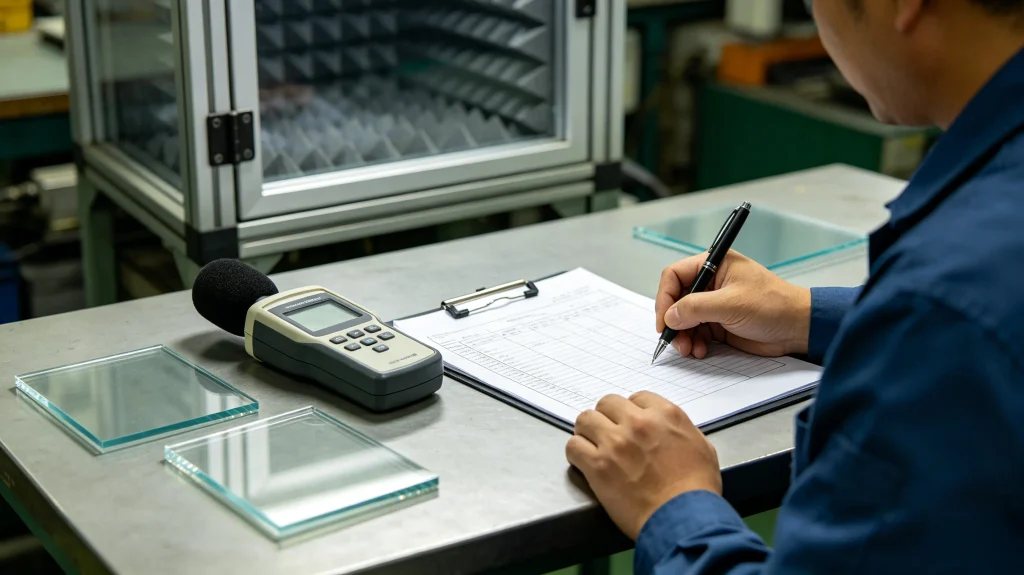
Below is summarized data of repeated PC sheet sound insulation test, all measured under identical test environment.
Hinweis: value is airborne sound reduction difference, higher value = better sound insulation.
5.1 Solid polycarbonate sheet sound insulation test
- 2mm solid PC sheet: sound reduction around 18–21dB, simple noise reduction, equipment protective housing, low noise reduction requirement. Thin PC-Blatt has low surface density, poor blocking effect for low-frequency noise, works for high-frequency noise attenuation.
- 3mm solid PC sheet: sound reduction around 22–25dB, equipment guard, small noise barrier, regular stock specification of Yucheng Board Industry.
- 5mm solid PC sheet: sound reduction around 26–29dB, simple factory noise barrier, machine acoustic enclosure, widely selected by our customers.
- 8mm solid PC sheet: sound reduction around 30–33dB, outdoor daylighting noise shelter, traffic noise barrier, medium noise reduction demand.
- 10mm solid PC sheet: sound reduction around 33–36dB, heavy noise barrier, high-noise equipment housing. Thick solid sheet delivers obvious improvement of PC sheet sound insulation.
- 15mm solid PC sheet: sound reduction around 37–40dB, high-standard noise reduction project, large noise barrier.
Summary rule: For solid Polykarbonatplatte, thicker panel brings higher surface density and steady improvement of PC sheet sound insulation. But there is a feature: when thickness keeps increasing, the increment of sound reduction gradually decreases. In short, upgrading thickness from 2mm to 5mm brings obvious noise reduction improvement; upgrading from 10mm to15mm only gains small sound insulation improvement while cost rises sharply. You need to balance budget and noise target during selection.
5.2 Multiwall polycarbonate sheet sound insulation test (same total thickness comparison)
- 6mm double-wall multiwall polycarbonate sheet: sound reduction around17–20dB
- 8mm double-wall multiwall polycarbonate sheet: sound reduction around19–22dB
- 10mm double-wall multiwall polycarbonate sheet: sound reduction 21–24dB
- 10mm triple-wall multiwall polycarbonate sheet: sound reduction 22–25dB
- 16mm four-wall multiwall polycarbonate sheet: sound reduction 24–27dB
The data clearly shows: with equal total thickness, multiwall polycarbonate sheet sound insulation performance is weaker than solid polycarbonate sheet. Hollow cavity causes resonance effect, attenuating blocking for mid-frequency noise. But multi-layer multiwall sheet gains slight promotion of PC sheet sound insulation compared with double-wall sheet of same thickness.
Bold keyword: multiwall polycarbonate sheet, advantage in thermal insulation, sound insulation performance worse than solid polycarbonate sheet of same thickness.
5.3 Cross material comparison: PC sheet vs acrylic sheet, tempered glass sound insulation reference
We also run simple comparison test for customer reference:
- 5mm acrylic sheet: sound reduction 25–28dB, close to 5mm solid PC sheet. Disadvantage: acrylic is brittle, easy to crack under impact, poor outdoor weather resistance.
- 5mm tempered glass: sound reduction about27–30dB, slightly better than 5mm solid PC sheet. But glass is heavy, fragile, high installation risk, hard construction for large panel size.
- 5mm solid PC sheet: sound reduction 26–29dB, sound insulation close to glass, half weight of glass, outstanding impact resistance. It will not splash sharp fragments under impact, much safer.
This comparison explains why many engineering projects choose PC-Blatt for noise barrier, combining sound insulation, safety and daylighting.
5.4 Key factors affecting PC sheet sound insulation test reading
- Panel sealing gap: the biggest influencing factor found in our test. Tiny gaps directly let noise pass through. During our test, without sealant, sound reduction of same 10mm solid PC sheet drops 6–10dB directly. For noise insulation projects, Yucheng Board Industry can groove panels during processing to fit rubber EPDM sealing strip for tight sealing and reduce sound leakage.
- Panel fixing method & structure-borne sound: hard mounting PC-Blatt directly on steel frame transfers steel vibration to panel, introducing structure-borne noise. High-standard noise reduction projects need rubber vibration isolator pad to separate vibration between panel and steel frame.
- Noise frequency: thin PC sheet works well for high-frequency noise, limited effect for low-frequency rumble. If your project is dominated by low-frequency noise, simply thickening PC sheet is low cost-performance. Composite structure combining sound insulation cotton and damping film is required. Yucheng Board Industry provides PC sheet laminated with damping sound insulation film processing service to improve low-frequency noise reduction.
- Oberflächenbeschichtung: standard UV coating barely changes PC sheet sound insulation. Coating only provides UV protection without changing panel weight and sound reduction property.
6. PC sheet thermal insulation test data comparison, heat preservation of different thickness & panel structure
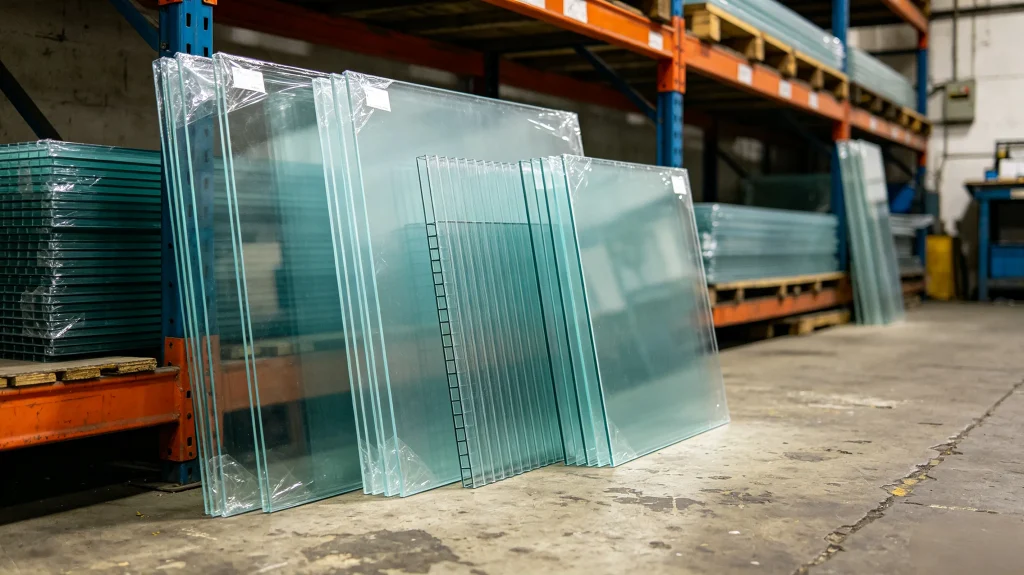
Below is PC sheet sound insulation and thermal insulation basic performance test measured U-value result (lower U-value = better thermal insulation)
6.1 Solid polycarbonate sheet thermal insulation test
- 2mm solid PC sheet: U-value 5.4~5.8 W/(㎡·K)
- 3mm solid PC sheet: U-value 5.1~5.5 W/(㎡·K)
- 5mm solid PC sheet: U-value 4.7~5.1 W/(㎡·K)
- 8mm solid PC sheet: U-value 4.2~4.6 W/(㎡·K)
- 10mm solid PC sheet: U-value 3.9~4.3 W/(㎡·K)
For solid polycarbonate sheet, thicker panel brings slow drop of U-value and slight improvement of PC sheet thermal insulation. But solid panel relies on material conduction, limited room for heat preservation upgrade, not suitable for high insulation demand.
6.2 Multiwall polycarbonate sheet thermal insulation test
- 6mm double-wall multiwall polycarbonate sheet: U-value3.3~3.7 W/(㎡·K)
- 8mm double-wall multiwall polycarbonate sheet: U-value2.9~3.3 W/(㎡·K)
- 10mm double-wall multiwall polycarbonate sheet: U-value2.6~3.0 W/(㎡·K)
- 10mm triple-wall multiwall polycarbonate sheet: U-value2.2~2.6 W/(㎡·K)
- 16mm four-wall multiwall polycarbonate sheet: U-value1.7~2.1 W/(㎡·K)
Data is straightforward: multiwall Polykarbonatplatte has much better PC sheet thermal insulation than solid PC sheet. 16mm four-wall multiwall sheet has low U-value with excellent heat preservation, ideal for greenhouse and skylight requiring warm winter and cool summer. Multi-layer static air cavities block heat transfer layer by layer.
Bold keyword: more layers of multiwall polycarbonate sheet bring stronger PC sheet thermal insulation performance.
6.3 Sunlight heating simulation test (outdoor reference)
We simulate strong summer sunlight irradiation and test rear panel temperature: ambient temperature 32℃, continuous irradiation for 3 hours
- 5mm solid PC sheet rear temperature:52~55℃
- 10mm double-wall multiwall polycarbonate sheet rear temperature:44~47℃
- 16mm four-wall multiwall polycarbonate sheet rear temperature:38~41℃
We can see multiwall polycarbonate sheet obviously reduces rear panel temperature under strong sunlight, cutting indoor heat gain and realizing good thermal insulation. If you choose multiwall polycarbonate sheet with infrared barrier coating, solar radiant heat can be further blocked, rear temperature can drop another 3–5℃. Yucheng Board Industry customizes infrared thermal barrier coated multiwall polycarbonate sheet for high-temperature area skylight to reduce air conditioning consumption.
6.4 Key factors affecting PC sheet thermal insulation test result
- Air convection inside cavity: low-cost multiwall sheet has sparse ribs, large cavity and strong internal air convection accelerating heat transfer, greatly reducing PC sheet thermal insulation. Multiwall panels supplied by Yucheng Board Industry adopt dense rib structure to restrain cavity convection and stabilize thermal indicator.
- Heat loss through panel joint gap: gap creates air convection and heat exchange between cold and hot air, damaging heat preservation. Joint of panels for thermal insulation project must be fully sealed.
- Thermal bridge effect: metal profile has high thermal conductivity. Heat transfers along steel frame directly connected to panels, lowering overall thermal insulation. Yucheng Board Industry can recommend thermal break aluminum profile to reduce thermal bridge and improve whole enclosure thermal performance.
- Panel aging: long-term outdoor exposure causes yellowing, which does not change basic U-value obviously, but reduces light transmittance and absorbs more solar heat. Perceived thermal insulation effect declines in long run. Outdoor projects prefer UV co-extruded PC sheet to slow aging. Yucheng Board Industry supplies single-sided or double-sided UV coated PC sheet as option.
7. Comprehensive PC sheet selection guide for sound & thermal insulation, how to choose PC sheet for different application
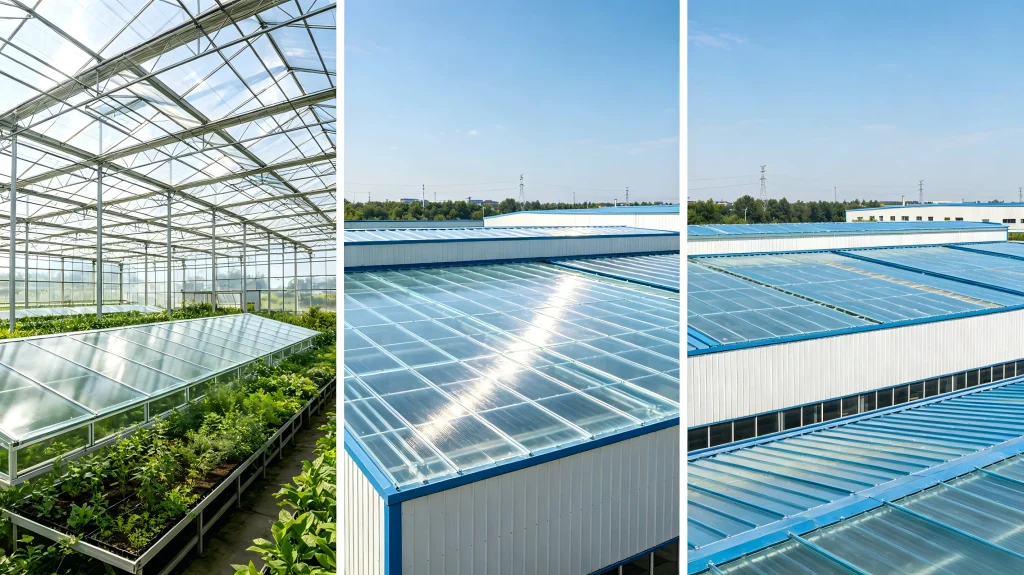
Many projects require daylighting, sound insulation and thermal insulation at the same time. Trade-off must be made, no single panel can maximize both sound and heat insulation.
Scenario 1: Factory equipment acoustic protective cover, minor daylighting demand
Core priority: PC sheet sound insulation, thermal insulation secondary. Recommend: 3mm–10mm solid polycarbonate sheet. Choose thicker solid sheet for sharp and high noise. Yucheng Board Industry can CNC cut, bend and drill solid PC sheet to fabricate finished equipment housing components.
Scenario 2: Greenhouse, daylighting + heat preservation priority, low sound insulation requirement
Core priority: PC sheet thermal insulation, sound insulation secondary. Recommend triple-wall or four-wall multiwall polycarbonate sheet. Reduce heat loss in winter and restrain greenhouse overheating in summer.
Scenario3: Building skylight for shopping mall or station canopy, balance thermal insulation and noise reduction
Recommend double-wall or triple-wall multiwall polycarbonate sheet. Balance daylighting and thermal insulation, reduce ambient noise moderately. If strict noise reduction is required under skylight, composite structure solid PC sheet + air gap + multiwall polycarbonate sheet can be adopted for both sound and heat insulation.
Scenario4: Outdoor traffic noise barrier, noise reduction priority plus weather resistance
8–15mm solid polycarbonate sheet is preferred, high impact resistance and sound insulation, no sharp fragment splash under vehicle impact, high safety grade. Yucheng Board Industry undertakes bulk processing of PC sheet for noise barrier, cutting and grooving panels according to engineering dimension.
Scenario5: Indoor partition, office daylight divider
3–5mm solid PC sheet or thin double-wall multiwall sheet depends on heat preservation demand.
Important reminder: If your project requires both high sound insulation and high thermal insulation, single-layer PC sheet can hardly meet demand. Composite panel structure: solid PC sheet + air gap + multiwall polycarbonate sheet, the combined wall achieves dual performance. Yucheng Board Industry can help design composite panel solution and provide samples for customers to run PC sheet sound insulation and thermal insulation basic performance test.
8. Common misunderstandings in PC sheet sound & thermal insulation test
Myth 1: thicker panel brings synchronous better sound insulation and thermal insulation
❌ Wrong. Thicker solid sheet greatly improves sound insulation, only slightly lifts thermal insulation. Thicker multiwall sheet greatly improves thermal insulation but gains limited sound insulation improvement. Material selection should not only judge by thickness, panel structure must be considered.
Myth2: More hollow cavities of multiwall polycarbonate sheet, better sound insulation
❌ Wrong. Multi-layer cavities mainly improve PC sheet thermal insulation. Hollow cavity brings acoustic resonance, only small promotion of sound insulation for certain frequency noise. Do not expect multiwall sheet to realize heavy noise reduction.
Myth3: Lab parameter equals field test performance
❌ Wrong. Lab specimen is fully sealed without structure-borne vibration. On-site gaps, steel thermal bridge and vibration will make real PC sheet sound insulation and thermal insulation worse than lab sample data. When designing project solution, Yucheng Board Industry reserves safety margin instead of only promising performance by lab datasheet.
Myth4: If PC sheet has enough sound insulation, whole room noise reduction will reach standard
❌ Wrong. Gap of doors and windows, wall, air vent and steel structure-borne sound leak noise. Panel is only part of enclosure system, whole system determines final noise reduction result.
9. PC sheet fabrication process to optimize on-site sound & thermal insulation (Yucheng Board supporting service)
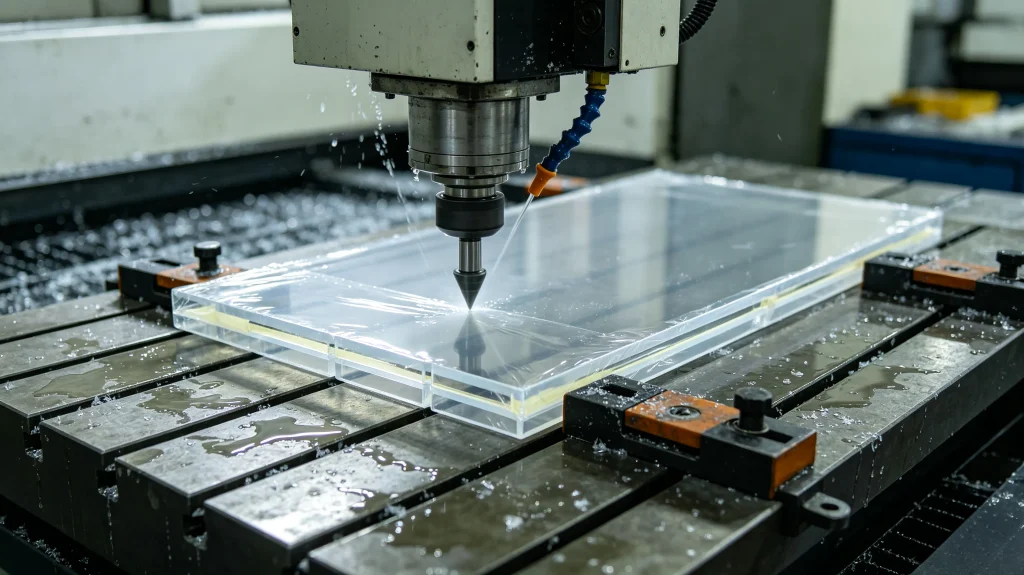
Even if you select the correct PC-Blatt specification, improper fabrication and installation will weaken PC sheet sound insulation and thermal insulation. Yucheng Board Industry is more than panel supplier, our full processing service is designed to secure sound and heat insulation performance.
- Precision cutting: High-precision CNC cutting delivers neat panel edge, minimizing panel joint gap to reduce sound and heat leakage. Hand cutting leads to irregular edge and large gap, directly destroying PC sheet sound insulation and thermal insulation.
- Grooving processing: Groove panel edge to fit sealing strip for tight sealing, a critical processing step for noise and heat preservation projects. Many customers self-process with uneven groove depth leading to poor sealing.
- Bending forming: One-piece bending for curved enclosure reduces joint seams. Fewer seams mean less heat and sound leakage. Yucheng Board Industry supports Kaltbiegen und Thermoformung for curved sound and heat insulation components.
- Custom UV co-extruded panel: For outdoor project, custom double-side UV layer PC sheet slows aging, maintaining stable panel performance without fast yellowing which damages daylighting and thermal insulation.
- Composite panel processing: Laminating PC sheet with damping sound film or infrared thermal film to upgrade PC sheet sound insulation or infrared heat resistance, custom composite panel samples available.
- Sample service: For large engineering project, Yucheng Board Industry sends samples so customers can run self PC sheet sound insulation and thermal insulation basic performance test, verify performance before bulk order to reduce project risk.
- Technical support: Our engineers connect with your design team, evaluate on-site environment, recommend panel specification, sealing scheme and vibration isolation plan, help estimate PC sheet sound insulation and thermal insulation performance and avoid engineering pitfalls.
10. Long-term performance attenuation of PC sheet sound & thermal insulation
Many customers care whether PC sheet sound insulation and thermal insulation will decline after years of usage.
- Acoustic performance: As long as panel keeps intact without crack, sound insulation property of panel material does not decay over time. Yellowing from aging barely changes sound reduction value. The real factor breaking sound insulation is panel crack and aging sealant causing gap sound leakage.
- Thermal insulation performance: Aging and cracking of sealant allows moisture and dust entering multiwall panel cavity. Static air inside cavity is replaced by water vapor and dust, damaging PC sheet thermal insulation. So multiwall polycarbonate sheet must have proper end sealing to prevent water and dust entering cavity. When processing multiwall sheet, Yucheng Board Industry can handle end sealing to extend panel service life and stabilize long-term thermal insulation.
Maintenance suggestion: Inspect sealing strip and sealant regularly, replace cracked accessories timely to maintain stable PC sheet sound insulation and thermal insulation.
11. Conclusion
After reading this PC sheet sound insulation and thermal insulation basic performance test analysis, you can remember core takeaways:
- Solid polycarbonate sheet, solid structure, excellent PC sheet sound insulation, suitable for noise reduction priority projects; average PC sheet thermal insulation.
- Multiwall polycarbonate sheet, multi-layer hollow structure, outstanding PC sheet thermal insulation, ideal for daylighting heat preservation projects; PC sheet sound insulation is weaker than solid sheet of same thickness.
- PC sheet sound insulation and thermal insulation is not only determined by panel itself. Panel sealing, vibration isolation fixing, frame thermal bridge and gap treatment greatly change measured performance. Do not only rely on datasheet parameter for selection, run sample test if possible.
- To combine daylighting, safety, sound insulation and thermal insulation, select proper PC-Blatt structure and thickness according to on-site noise, temperature difference and budget. Composite panel solution is available for strict requirement.
If you are preparing factory protective housing, skylight canopy, noise barrier or greenhouse project, and need PC sheet sound insulation and thermal insulation selection proposal, samples or custom fabrication, welcome to contact Yucheng Board Industry. With years of PC-Blatt extrusion and processing experience, we provide full service from panel production, cutting bending, sealing matching to sample test support. We deliver OEM manufacturing for solid polycarbonate sheet and multiwall polycarbonate sheet, helping stable implementation of PC sheet sound insulation and thermal insulation performance in your engineering projects.