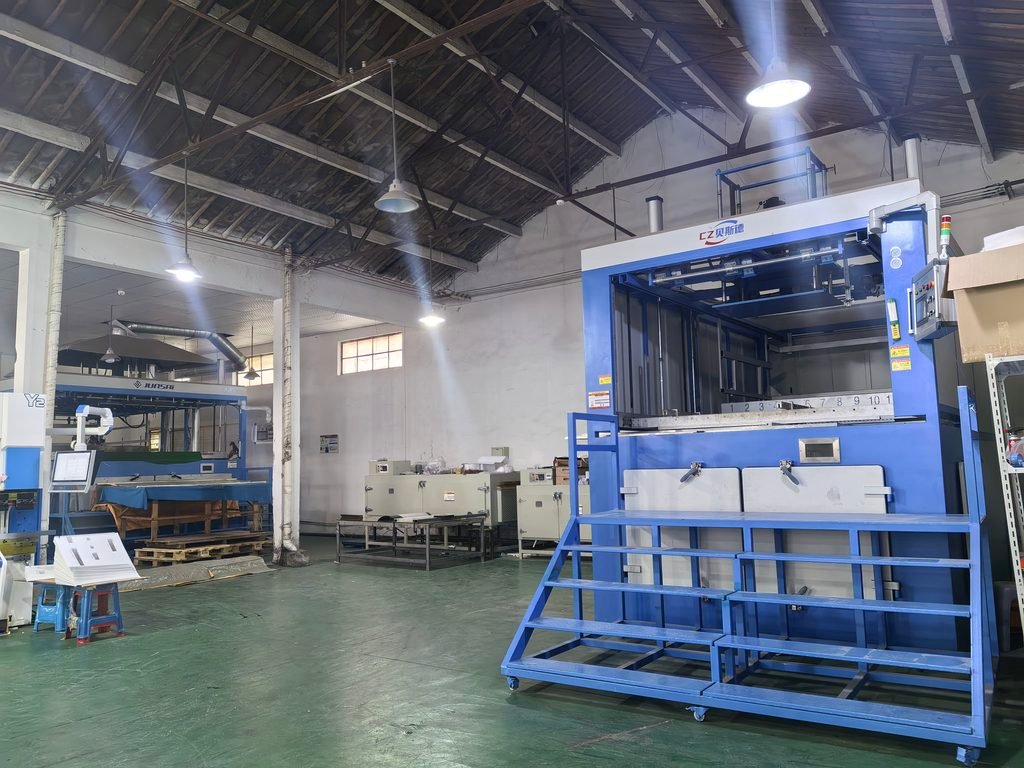





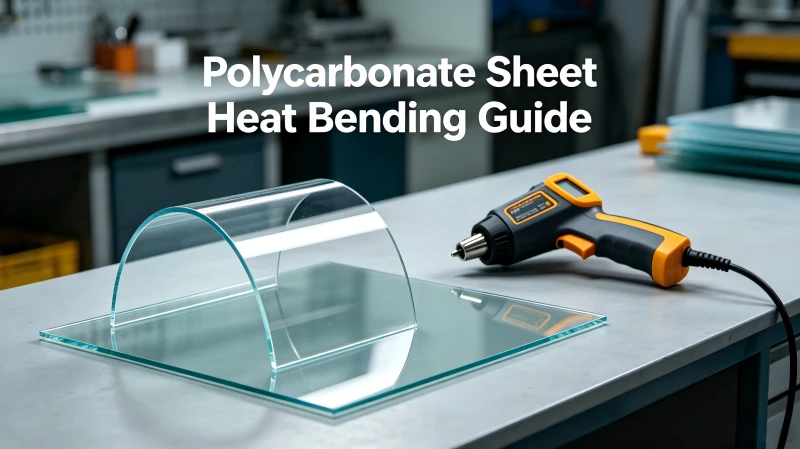
When working with polycarbonate sheet (PC sheet) for equipment guards, light-transmission hoods, display cabinets, machine housings, rail-transit components and outdoor canopy structures, fabricators and buyers often need to turn flat polycarbonate panels into curved shapes. Folha de PC hot arc bending is the common forming solution for these curved parts. So,How to Hot Bend Polycarbonate Sheet into a Curved Shape?
Polycarbonate sheet features outstanding impact resistance, far stronger than acrylic sheet. At room temperature, you cannot bend rigid PC sheet by cold-forcing. Cold bending will directly cause surface whitening, stress cracks or total breakage. The core principle of chapa de policarbonato hot bending is hot softening, mould shaping and cooling to lock the final geometry. Many people believe curved polycarbonate parts can only be produced with huge industrial machines. In fact, with proper skills, you can complete PC sheet hot arc bending using a heat gun plus basic curved moulds for prototyping and small-batch jobs.
However, countless beginners run into typical failures during chapa de policarbonato hot bending: surface burning, bubbles, heavy spring-back, invisible internal stress leading to delayed cracking, uneven curved surface and whitening bending zones. In most cases, it is not poor sheet quality, but wrong heating temperature, uneven heating range, incorrect cooling method or mismatched bending radius for sheet thickness.
In this article, we will walk you through every detail of arc bending operation method for polycarbonate sheet. We will cover suitable PC sheet grades, full tool checklist, the best temperature range for polycarbonate sheet hot bending, complete step-by-step workflow, bending-radius reference for different sheet thicknesses, root causes & fixes for common defects, comparison between manual bending vs industrial machine hot bending. We will also explain when you should perform on-site manual bending and when you should outsource custom fabrication to professional manufacturers.
⚠️Important note: This guide focuses on manual hot arc bending, mainly for prototyping, sampling and small-volume on-site modification. For mass production, large-size workpieces or high-precision parts, manualhot-bending is not recommended; industrial machine-assisted hot forming is preferred.
1. Which polycarbonate sheet is suitable for hot arc bending
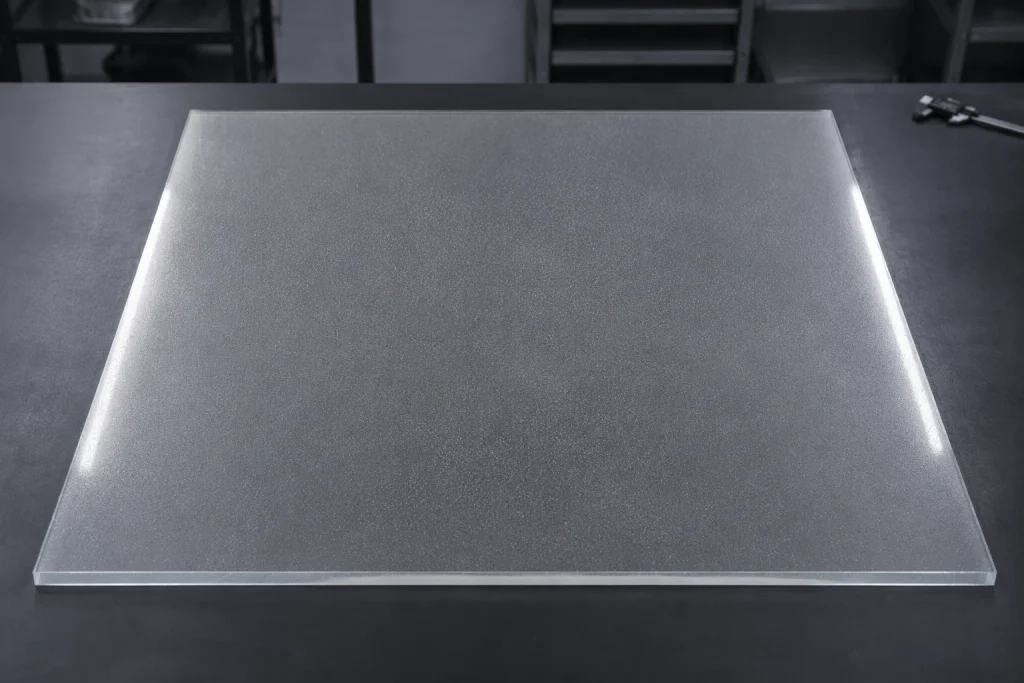
Not every polycarbonate sheet grade works well for Folha de PC hot arc bending. If you select the wrong material, even perfect operation steps will result in defective outputs.
1. Extruded solid polycarbonate sheet (solid PC sheet)
Solid extruded polycarbonate sheet is the most widely used material for hot bending. Extrusion-manufactured solid polycarbonate sheet delivers consistent molecular distribution, uniform softening under heat, stable cooling performance and controllable spring-back. Usable thickness ranges from 1.5 mm to 12 mm for manual hot bending. Thicker PC sheet requires longer heating time and larger minimum bending radius; bending difficulty rises sharply as thickness increases.
2. UV–coated polycarbonate sheet for outdoor usage
Most outdoor-grade chapas de policarbonato come with single-side or double-side UV protective coating. Critical reminder: Never expose the UV–coated surface to direct high–temperature hot–air blasting for long periods!
UV protective coating has lower heat resistance compared with pure polycarbonate substrate. If the heat gun blasts the UV layer directly for an extended time, the coating will turn yellow, blister and peel off. During chapa de policarbonato hot bending, keep the non-UV substrate side facing the heat source, and place the UV-protected surface away from hot airflow. If you cannot tell which side carries UV coating: the side with printed text on protective film is normally the UV-treated face.
3. Sheet grades NOT recommended for manual hot bending
① Polycarbonate hollow multi-wall sheet (polycarbonate sun sheet): Hollow structure can only form very gentle large-radius arcs. Sharp small-radius bending will collapse hollow ribs easily. Multi-wall sheet is better suited for cold bending instead of manual hot-air heat forming.
② Low-grade PC sheet made from high-content recycled material: Impurities inside recycled polycarbonate cause frequent bubbling and cracking under heating; failure rate stays extremely high for hot bending.
③ Flame-retardant modified PC sheet & glass-fiber filled PC sheet: Glass-fiber reinforced polycarbonate becomes brittle; manual hot bending easily triggers cracks. Some high-UL-94 flame-retardant PC grades show changed thermal-expansion properties; stable manual bending results are hard to achieve. Machine-based factory processing is suggested.
④ Pre-drilled or pre-CNC-routed PC sheet: Holes and notches create stress-concentration zones. Cracks tend to spread from hole edges during heat softening. Best practice: Finish hot-bending & full cooling first, then conduct drilling, cutting and routing afterwards. This is one of the most practical key tips for real-world fabrication.
2. What tools do you need for polycarbonate folha hot bending
Para arc bending operation method for polycarbonate sheets, expensive large-scale production machines are not mandatory. A basic tool kit is enough for manual jobs. Many failed bending cases are caused by insufficient or improper tools.
✅ Industrial heat gun (core heating equipment)
Do NOT use household hair dryers! Household blowers cannot reach the required softening temperature for polycarbonate. You need an adjustable-temperature, adjustable-air-volume industrial heat gun.
✅ Infrared thermometer (highly recommended)
You cannot judge real sheet temperature by eyesight or touch. This is the top reason for beginner failures. An infrared thermometer reads the real surface temperature of PC sheet, helping you stay within a safe processing window, avoiding insufficient-temperature hard-bending or overheating burnt parts.
✅ Custom curved forming mould
The mould inner curvature defines the final outer arc shape of your polycarbonate workpiece. For prototyping, you can build a mould from solid wood or multi-layer plywood. The mould surface must be fully sanded and smooth. Sharp burrs or bumps will leave permanent indentations on softened hot PC sheet.
Quick tip: For occasional sampling, large-diameter tubes or cylinders can serve as temporary moulds. Wrap soft felt over mould surface to prevent scratching hot polycarbonate.
✅ Quick clamps / G-clamps
After the PC sheet softens under heat, clamps hold the sheet tightly against the curved mould during the full cooling cycle. Do NOT release clamps before workpiece reaches full room temperature. Holding by hand is unreliable; spring-back deformation will happen while cooling. Prepare enough clamps in advance before heating starts.
✅ Hot-resistant high-temperature gloves
Hot softened chapa de policarbonato can cause burns upon skin contact. Finger pressure marks will stay on the soft polycarbonate surface without proper gloves. Ordinary cotton gloves cannot resist high heat and may melt and stick onto the hot sheet.
✅ Flat stable workbench
Keep bench surface fully clean. Tiny sand grains or metal chips will embed into hot soft polycarbonate and create permanent pits.
✅ Auxiliary supplies: Original protective film, thin felt padding
Keep original protective film on PC sheet during hot-bending process. The film protects the surface against scratches and mould indentation. Only remove local film on the exact bending zone; leave protective film on the rest of the sheet area. Place thin felt layer between the mould and polycarbonate surface for extra surface protection.
❌ Strictly avoid: Open flame/blowtorch direct firing onto polycarbonate sheet. Open flame creates instant local overheating, burning the sheet, generating internal bubbles and ruining workpieces.
3. Best temperature range for polycarbonate sheet hot bending
Temperature is the No.1 factor in PC sheet hot arc bending. The glass-transition temperature of pure polycarbonate is approximately 145℃; above this threshold polycarbonate material gradually turns soft and formable.
Real-world practical temperature reference (read from sheet surface via infrared thermometer, NOT heat-gun setting value):
- Optimal working temperature window: 150℃-170℃
- Within this range, solid polycarbonate sheet gains good ductility. You can press the sheet onto the mould without heavy force. Spring-back stays low; bubbling or burning risk is minimal. This is the golden temperature zone for manual chapa de policarbonato hot bending.
- Temperature below 140℃: insufficient softening
- PC sheet remains rigid. Forcing bending creates massive residual internal stress. Parts may look fine right after shaping, but whitening stress lines or cracks will appear days later. Many field complaints about delayed cracking root back to insufficient heating and cold-forcing.
- Temperature exceeds 180℃: high-temperature damage risk
- When sheet surface temperature stays above 180℃, chapa de policarbonato will easily develop blisters, bubbles and yellow discoloration. Further overheating causes local melting and total scrap.
Important note: Display temperature reading on heat gun ≠ real polycarbonate sheet temperature. Gun-to-sheet distance and blowing duration change actual surface temperature. Always trust infrared thermometer readings taken directly on the PC sheet surface.
Approximate heating-time reference (indoor ambient temperature ~25℃, for manual bending only):
- 2mm solid polycarbonate sheet: Scan-heating each side around 40-70 seconds. Keep the heat gun moving continuously, never stay fixed at one spot.
- 3mm solid polycarbonate sheet: 60-100 seconds heating per pass. Alternate heating the front side and back side to achieve thorough through-thickness softening. Do not heat only a single surface. An outer layer soft while the inner core remains hard will produce heavy residual stress.
- 5mm solid polycarbonate sheet: Heat penetrates slowly for thick material. Alternate front-back heating for a total of 120-200 seconds. Thick sheets require bi-directional heating, or stress-related defects will occur.
- 8mm polycarbonate sheet or thicker: Manual hot-bending becomes extremely challenging. Manual hot-air hardly achieves even temperature through full sheet thickness. Uneven thermal conditions lead to spring-back and cracking. Factory professional hot-bending service is strongly recommended.
Ambient temperature matters: In cold winter workshop, extend heating duration for an equal-thickness sheet. In hot summer environment, shorten heating time appropriately. Do not rely purely on fixed time setting; judge by combination of thermometer reading and visual softening status.
4. Step-by-step hot bending process for Policarbonato folha
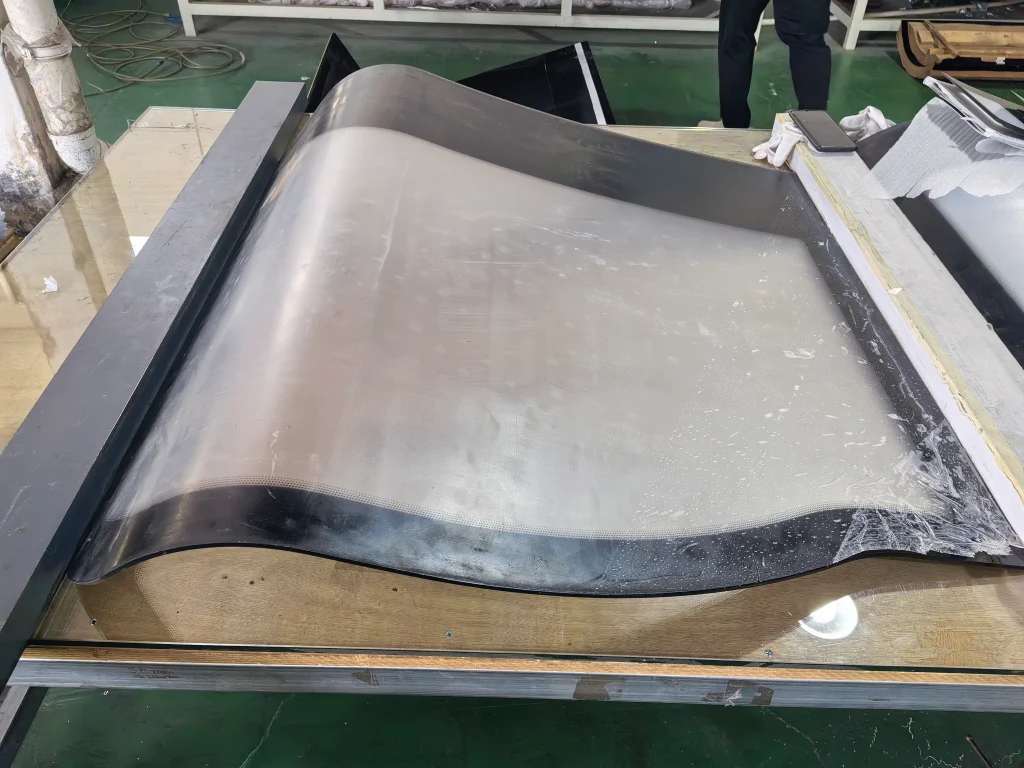
We break down full workflow of arc bending operation method for polycarbonate sheet: pre-processing, heating, mould lamination & clamping, cooling and post-treatment. Every practical detail is listed below.
Step1: Pre-processing: prepare sheet and mould
First, verify your raw material: confirm you are using solid extruded polycarbonate sheet suitable for hot forming; double-check UV coating orientation; finish cutting outer dimensions before bending.
Critical rule: Cut sheet to final outline first. Complete hot-bending and full cooling, then perform drilling e grooving operations. Avoid pre-drilling before hot bending. Hole edges create stress concentration and easily crack under hot-bending force.
Second, clean the sheet surface, workbench and curved mould. Wipe dust and particles off polycarbonate panel. Sand the mould surface smooth, attach felt padding on the contact zone. Retain original protective film; peel film only over the exact bending strip.
Third, position the sheet against the mould, mark the bending reference line, and align polycarbonate flat panel precisely with the target curved profile. Place all G-clamps in ready position. After heating completes, you need fast clamping action; do not waste time searching for clamps while the PC sheet cools down rapidly.
Step 2: Evenly heat the bending zone (most error-prone stage)
Switch on the adjustable heat gun, set airflow and temperature. Never keep the heat-gun nozzle stationary on a single spot! Move gun horizontally back-and-forth continuously across the bending zone.
Scan back and forth over target bending area, alternate heating the front and reverse sides of PC sheet. Keep measuring real-time surface temperature with infrared thermometer, bring sheet temperature steadily to 150-170℃ working window.
⚠️Common mistake: Hold the heat gun too close to the sheet surface, fix the nozzle at one position. Local overheating creates instant blisters. For thick sheet, alternate front-back heating to drive heat through full thickness. When PC sheet shows slight sagging and loses stiffness, it reaches ready-to-bend soft condition.
Step 3: Quickly attach softened sheet onto curved mould and apply clamping force
Once sheet reaches target temperature range and fully softens, stop heating immediately. Move fast, polycarbonate cools and rigidifies quickly.
Wear heat-resistant gloves, lay the softened polycarbonate sheet closely onto the curved mould face, and make full contact between the sheet and the mould curvature. Fasten pre-arranged clamps evenly, press entire arc segment tightly against mould without gaps or bulges.
One easy-to-miss tip: Minor thermal shrinkage and spring-back happen during polycarbonate cooling. If you need a finished arc radius of R=100 mm, build your mould radius slightly smaller than the target dimension to compensate for the spring-back effect. Spring-back value varies by sheet thickness, raw-material formulation and heating condition. Run 1-2 test pieces during the sampling phase to measure the real spring-back rate before formal batch processing.
Step 4: Natural air cooling: keep clamps locked until the sheet fully drops to room temperature
This step directly determines whether the finished workpiece will spring back or deform. Keep clamps firmly tightened, let the workpiece cool passively under normal room-temperature air.
Never pour cold water over hot polycarbonate sheet for fast cooling! Quenching hot polycarbonate with cold water creates massive internal residual stress. The workpiece may look okay visually, but whitening and cracking will appear under later service conditions. Water-quenching is strictly forbidden.
Thicker polycarbonate workpieces require longer cooling duration. Keep clamps fully locked until sheet feels completely cool to human touch. Do not release clamps halfway during cooling cycle. Un-clamping early causes softened polycarbonate to spring back toward flat shape and ruin parts.
Step5: Demoulding, post-processing and finished-part inspection
Only after full room-temperature cooling, release clamps and carefully take the curved polycarbonate workpiece out. Peel off remaining protective film and inspect the finished arc component.
Inspection checklist: Smooth arc profile without local bump or dent; no bubble or burn mark on surface; no whitening stress lines on bending inner side; no obvious spring-back deformation. If further fabrication such as drilling, CNC routing or engraving is needed, perform these operations after hot-bending and full cooling cycle.
5. Hot-bending differences for different thickness Policarbonato sheets & minimum bending-radius reference
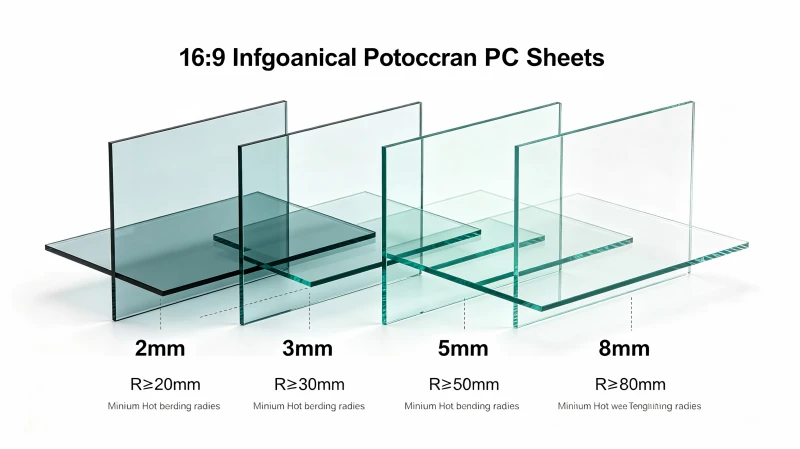
Para PC sheet hot arc bending, sheet thickness governs minimum feasible arc radius, heating time and overall forming difficulty. Minimum bending radius means the smallest arc radius you can achieve without inducing cracks. A smaller radius creates sharper curve; larger radius delivers gentle wide arc.
Key point: Thicker polycarbonate sheet needs larger minimum bending radius. Trying sharp tight radius for thick PC sheet will produce heavy inner-side whitening and cracks.
Reference minimum hot-bending arc radius for solid extruded PC sheet: -2mm PC sheet: Minimum hot-bending radius R≥20mm. Good candidate for manual hot-bending for relatively tight arcs. -3mm PC sheet: Minimum hot-bending radius R≥30mm. Most popular specification for sampling and small-batch manual jobs. -4-5mm PC sheet: Minimum hot-bending radius R≥50mm. Longer heating is required; manual operation difficulty increases. -6-8mm PC sheet: Minimum hot-bending radius R≥80mm. Sharp-radius manual hot-bending is not advised. -10mm+ solid polycarbonate sheet: Manual hot-gun bending is strongly discouraged. Factory professional hot forming service is highly recommended.
Distinguish cold bending VS hot bending for PC sheet: Cold bending works for large-radius multi-wall sun-sheet canopy installation. This article covers hot arc bending, which enables tighter arcs than room-temperature cold bending.
6. Troubleshooting: whitening, cracking, bubbles, spring–back, surface defects
Even experienced operators encounter defects during arc bending operation method for polycarbonate sheet. Below we list the most frequent real-world failures, root-cause analysis and practical countermeasures.
Defect 1: Whitening foggy stress lines on inner bending surface
Symptom: Workpiece looks acceptable right after forming; whitish haze lines appear on the inner bending radius after cooling or days later. Root cause: Insufficient heating temperature, sheet not fully softened before forced bending, resulting in high residual internal stress. Another cause: releasing clamps before the sheet fully cools down to ambient temperature.
Solution: Use an infrared thermometer, ensure the sheet surface hits 150-170℃ for full softening before mould shaping. Heat thick sheet from both sides. Always cool completely to room temperature before removing clamps. If heavy whitening already exists on the workpiece, residual-stress risk stays high; such a piece is not suggested for end-product application.
Defect 2: Cracks or fractures at bending location
Symptom: Parts crack during forming or crack after storage period. Trigger factors:
- Under-heated sheet forced into bend, extreme residual stress built-up;
- Pre-drilled or pre-notched sheet; cracks propagate from stress-concentration hole edges under hot-bending;
- Bending radius smaller than minimum allowable radius for corresponding sheet thickness;
- Low-quality recycled-content PC sheet or glass-fiber-filled polycarbonate grade;
- Cold-water quenching after hot forming.
Solutions: Move drilling & grooving procedure post hot-bending; enlarge arc radius; strictly follow temperature window; prohibit water quenching; select virgin-material extruded solid polycarbonate sheet.
Defect 3: Surface blisters and bubbles
Symptom: Bubble bulges visible on PC sheet surface. Cause: Local overheating from stationary heat-gun nozzle, surface temperature exceeds 180℃; long-time direct hot-air blowing onto UV coating; trapped moisture inside sheet vaporizes under heat.
Solutions: Keep heat-gun moving continuously; keep UV-coated face away from direct hot airflow; dry damp sheet before hot-bending; cap sheet surface temperature below 170℃.
Defect 4: Severe spring-back, curved part tends to flatten after demoulding
Symptom: After removing from mould, finished arc gradually springs back toward flat panel shape.
Root reasons: Insufficient heating and incomplete softening; clamps released before full cooling; mould geometry without spring-back compensation allowance.
Countermeasures: Bring heating temperature into optimal working range; keep clamps locked until full room-temperature cooling; run test samples to measure spring-back ratio, adjust mould curvature accordingly.
Defect 5: Surface indentations, pits and scratches on curved surface
Symptom: Dents and scratch marks appear on finished curved face. Cause: Burrs or solid particles on mould surface; hot softened polycarbonate directly contacts hard bare mould; removing full protective film during forming.
Solutions: Polish mould surface, add thin felt padding between mould and sheet; retain original protective film except local bending strip.
7. Hand bending vs machine hot bending for polycarbonate: which one fits your project
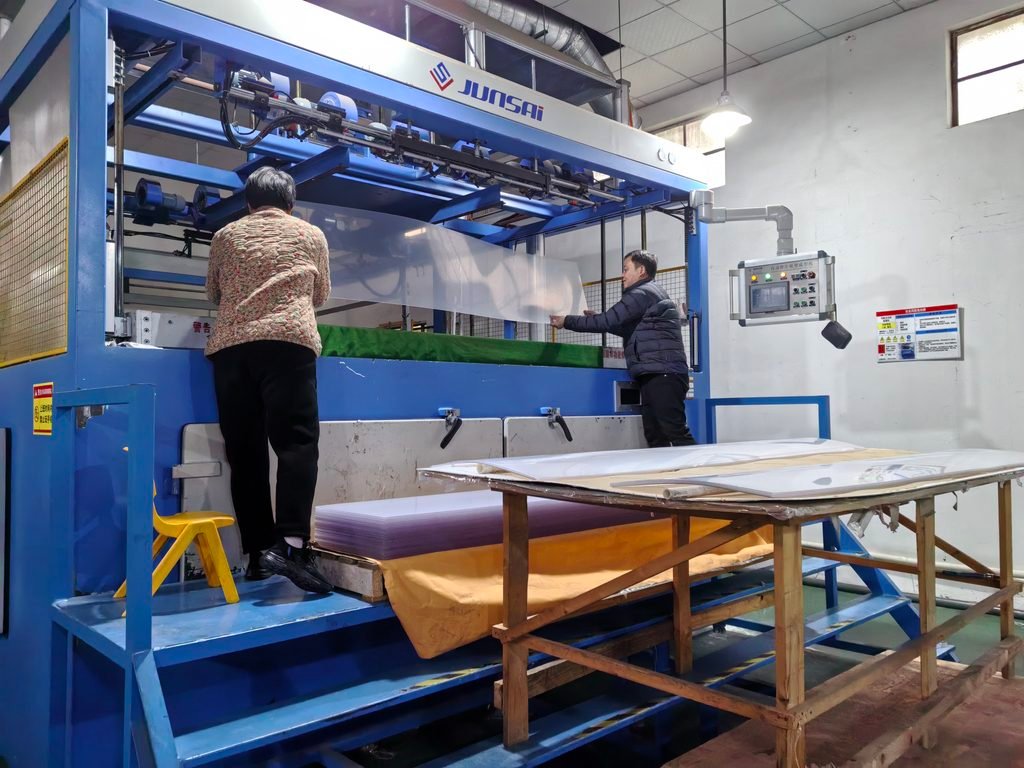
Many buyers wonder whether they should perform on-site PC sheet hot arc bending or outsource fabrication to a professional sheet processor. Each method fits different application scenarios.
✅ When manual hot-gun hot-bending works well
- New-product prototyping, only small-quantity samples for shape verification;
- Small-batch orders with non-ultra-tight tolerance requirements;
- On-site modification or secondary adjustment for existing curved components;
- Limited budget without investment on large forming equipment.
Limitations of manual hot-bending: – Heavy human-factor influence, arc-radius tolerance variation between pieces; – Poor performance for thick sheet ≥8mm or sharp small-radius arcs; – Hard to achieve uniform heating for extra-long large-size panels; – Low throughput for mass-production, higher defect ratio.
✅ When factory machine-assisted hot-bending service is a better choice
- Mass-volume orders requiring high-consistency geometry and strict dimensional tolerance;
- Thick PC sheet parts 5mm, 6mm, 8mm and above;
- Oversize long curved structural components;
- End-products for machine guards, rail-transit parts, new-energy equipment housings with high reliability requirements; residual-stress-related delayed cracking risk must be avoided;
- Need one-stop workflow including hot-bending, CNC routing, precision hole drilling, UV printing, flame-retardant PC sheet fabrication.
Company service introduction: Suzhou Yucheng board Industry is an experienced polycarbonate sheet processor. We supply virgin solid polycarbonate sheet, UL-grade flame-retardant PC sheet, and UV-protected outdoor PC sheet. Meanwhile, we provide full-range custom fabrication services: PC sheet professional hot bending, cutting, CNC milling & grooving, drilling, formação de vácuo, UV printing and lamination– an all-in-one solution.
If you lack sufficient hands-on processing experience, handle large-volume orders, or produce industrial equipment components, rail-transit and new-energy housings where cracking and residual-stress risks cannot be accepted, you may send technical drawings directly to us. Our factory equipment delivers high-precision, consistent polycarbonate hot-bent curved parts. Post-bending stress-relief treatment is available to minimize whitening & delayed cracking risk. We accept small sample orders as well as large export-oriented mass production, complying with international export-quality standards.
If you prefer purchasing raw PC sheets and complete hot-bending prototyping in-house, we can supply high-quality virgin extruded PC sheet, optional outdoor UV coating, UL94 V-0 / V-2 flame-retardant polycarbonate grades. Our technical team can also offer free processing-technique advisory support.
8. Safety & practical tips for polycarbonate sheet hot-bending
- Maintain good workplace ventilation. Normally heated polycarbonate releases negligible odor. If severe local over-decomposition happens, slight irritant fumes are generated; keep air circulating in the working area.
- High-temperature protection: Heat-gun nozzle and softened PC sheet run hot. Wear heat-resistant gloves to prevent skin burns.
- Do not re-hot-bend old PC sheet already containing existing stress cracks; heating will aggravate fracture risk.
- Pre-printed ink-decorated PC sheet: Keep printed surface away from direct hot-air blast; high heat causes ink discoloration or peeling. Printed-part forming is better handled in a factory environment.
- For storage after hot-bending: Keep curved polycarbonate workpieces laid flat or supported with curved racks. Avoid heavy squeezing or stacking, which induces secondary deformation.
- If hot-bent manual-processed polycarbonate parts will go through adhesive bonding afterwards: Watch residual-stress risk. Solvent-based glue may trigger solvent-cracking on stress-remaining PC surfaces. For high-precision bonding applications, choose factory-produced hot-bent parts with annealing stress-relief treatment.
9. Final summary: choose between manual hot-bending or professional custom fabrication
arc bending operation method for polycarbonate sheet using portable heat gun is a practical, low-cost prototyping & small-batch manufacturing solution. Master 5 core factors: correct sheet material selection, precise heating-temperature control, uniform through-thickness heating, tight mould lamination and slow natural cooling, you can produce qualified curved polycarbonate components.
Nevertheless, manual hot-bending comes with inherent drawbacks: difficulty rises sharply with sheet thickness; consistency is hard to guarantee for mass production; invisible residual internal stress may cause whitening and cracking under real-world service conditions.
-For thin-sheet sampling & small-batch prototyping: manual hot-bending following this guide is workable. -For thick-gauge material, mass-volume production and high-reliability industrial end-products: strongly recommend custom machine hot-bending service from a professional fabricator like Suzhou Yucheng board Industry, to avoid costly field-failure risk.
Many clients got acceptable manual-bent samples, yet suffered mass-part cracking after delivering to end-customers. Proper early-stage process selection helps you prevent avoidable project losses.