






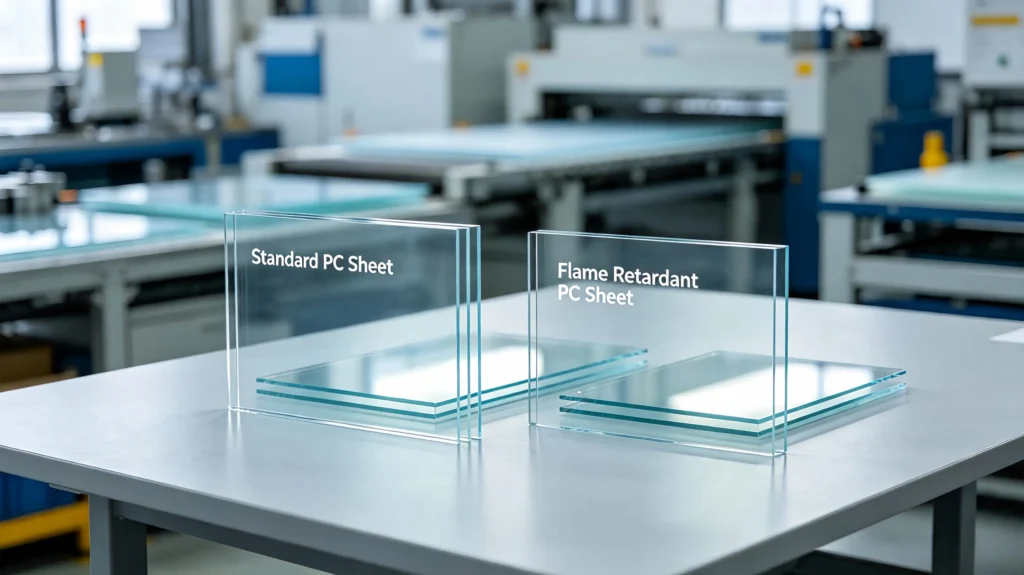
Many procurement specialists and product designers get stuck when choosing polycarbonate sheet (PC sheet): should they pick standard polycarbonate sheet, ou flame retardant polycarbonate sheet?
A simple understanding goes like this: flame retardant polycarbonate sheet does not catch fire easily, while standard Polycarbonate sheet will burn. This statement is partially true but far from complete. In real-world projects, if material selection is only based on “whether it burns”, you will face serious troubles later: failed third-party testing, unqualified product certification, hidden safety hazards, or even full-batch rework and scrap, bringing huge losses of time and capital.
Standard polycarbonate sheet, also known as regular polycarbonate sheet, is the most widely used Polycarbonate material on the market. It delivers outstanding impact resistance, light transmission and low-temperature performance with competitive price.
Flame retardant polycarbonate sheet is modified polycarbonate material blended with special flame-retardant additives during the extrusion process. It meets different UL94 fire safety grades, including UL94 V-2, UL94 V-1 and UL94 V-0 flame retardant polycarbonate sheet. Different fire-rating levels fit totally different working conditions and application limits.
From real project cases handled by YUCHENG (Suzhou Yucheng Board Industry), we have seen many typical mistakes. Some customers tried to cut costs and used standard Polycarbonate sheet for equipment housings where flame resistance was mandatory. Samples looked fine, yet the whole batch failed a third-party fire test. Thousands of finished housings became dead stock. Some other customers blindly purchased full-spec UL94 V-0 flame retardant polycarbonate sheet for every project, which pushed material budget up by more than 30%. They paid extra cost for many applications that actually require no flame-retardant property at all.
This article will break down everything you need to know about flame retardant polycarbonate sheet and standard polycarbonate sheet. We will cover raw material basics, full performance comparison, pros & cons, suitable application scenarios, forbidden misapplication, certification requirements, fabrication notes, cost difference and practical selection tips. You will learn when standard Polycarbonate sheet works perfectly well, and which applications strictly require flame retardant polycarbonate sheet.
Note: All cases shared in this article are summarized from YUCHENG’s over-ten-year practical experience in fabrico de chapas de policarbonato, custom extrusion, CNC cutting, grooving, vacuum thermoforming and UV printing, not just theoretical knowledge. This guide is suitable for factory buyers, structural designers and foreign trade sales teams.
Table of Content
- What is Standard Polycarbonate Sheet? Basic Properties Overview
- What is Flame Retardant Polycarbonate Sheet? Understand UL94 V-2 / V-1 / V-0
- Detailed Performance Comparison: Flame Retardant Polycarbonate Sheet VS Standard Polycarbonate Sheet
- Suitable Applications for Standard Polycarbonate Sheet (Where Standard Polycarbonate Works Well)
- Mandatory Scenarios for Flame Retardant Polycarbonate Sheet — Never Replace with Standard Polycarbonate Sheet
- Confusing Application Cases: Common Wrong Selections Causing Heavy Loss
- How Environmental Conditions Affect Fire Performance of Polycarbonate Sheet (Thickness, Temperature, UV Aging)
- Fabrication Differences Between Flame Retardant Polycarbonate Sheet and Standard Polycarbonate Sheet: Thermoforming, CNC Grooving, Printing, Bending
- Cost, Lead Time & Stock Comparison
- Common Misconceptions About PC Sheet Fire-Rating
- How To Verify If Your PC Sheet Is Real Flame-Retardant Grade
- Custom Polycarbonate Sheet Service Provided by YUCHENG
- Quick Selection Summary Table
1. What is Standard Policarbonato Sheet? Basic Properties Overview
Standard PC sheet (standard polycarbonate sheet) is extruded from pure Polycarbonate resin pellets without large amount of flame-retardant modifiers. It is the most mainstream polycarbonate material in the global market.
✅ Core advantages of standard Polycarbonate sheet:
- Superior impact resistance: At equal thickness, the impact performance of standard Polycarbonate sheet is 20-30 times higher than acrylic sheet. It deforms rather than shatters under heavy impact, delivering excellent toughness and safety.
- Good light transmission: Clear version reaches 85-90% light transmittance, close to glass while only half the weight of glass.
- Excellent low-temperature resistance: Remains tough at -40℃ without brittle fracture, fits cold outdoor environments.
- Great thermoforming performance: Wide processing window for hot bending and deep vacuum thermoforming. Less whitening or cracking for irregular covers and guards.
- Lower material cost: Compared with equal-thickness flame retardant polycarbonate sheet, standard Polycarbonate sheet costs less, with abundant stock and short lead time.
- Surface UV-coating option available for scratch resistance and outdoor anti-aging performance.
❌ Key drawbacks especially fire-related performance: Pure resin standard Polycarbonate sheet belongs to slow-burning plastic, NOT non-combustible. It can be ignited by continuous open flame. After removing the fire source, it keeps burning with burning drips, which may ignite surrounding materials. Standard Polycarbonate sheet can only reach UL94 V-2 rating and cannot pass UL94 V-1 or UL94 V-0 standard.
Important reminder: UL94 V-2 allows burning drips that can ignite cotton underneath. Much electrical equipment and public indoor projects reject V-2 grade. That explains why standard Polycarbonate sheet cannot be adopted in many projects.
Standard polycarbonate sheet comes in clear, frosted, black and custom colors. Thickness ranges from 0.8 mm to 20 mm, including solid sheet and multi-wall Polycarbonate sheet. Widely used for projects without mandatory fire-safety certification.
We keep a large stock of standard polycarbonate sheets, both flat sheets and roll material. We provide full-range fabrico de chapas de policarbonato: CNC cutting, grooving, hot bending, vacuum thermoforming, screen printing and UV coating. We support small-batch sampling and mass-volume production.
2. What is Flame Retardant Polycarbonate Sheet? Understand UL94 V-2 / V-1 / V-0
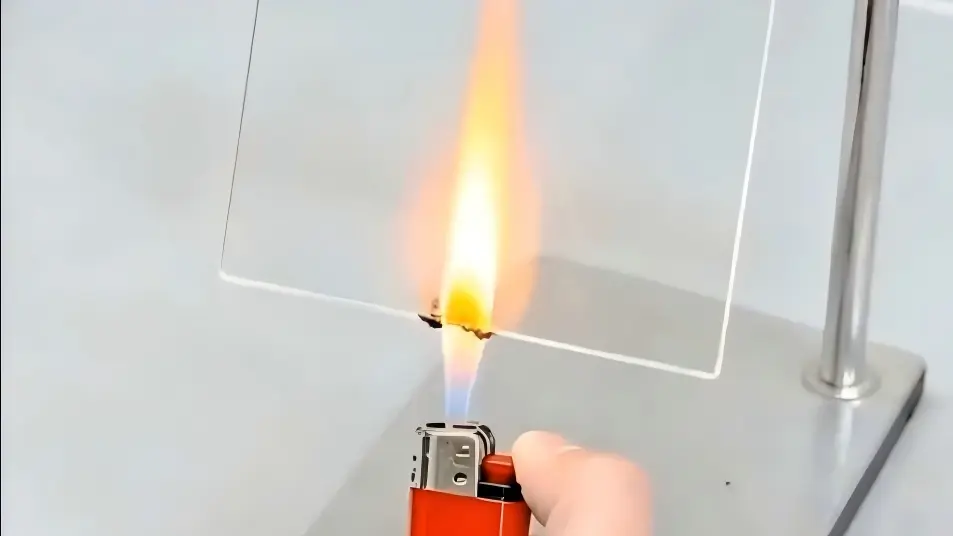
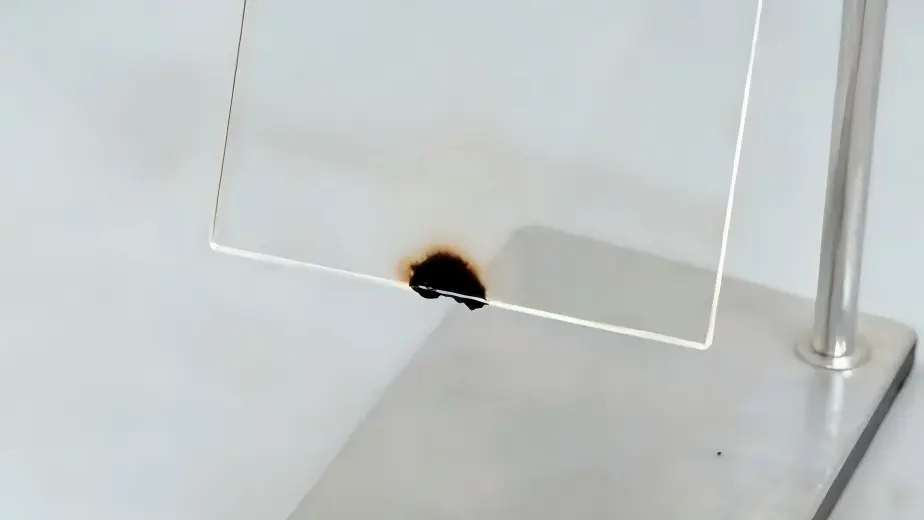
Flame retardant polycarbonate sheet is modified polycarbonate sheet. Based on polycarbonate resin matrix, halogen-free or halogen-containing flame-retardant additives are blended before extrusion. The modification changes burning behavior: the material self-extinguishes after the fire source is removed, reduces burning drips and slows flame spread.
UL94 standard is the most widely recognized global testing system for plastic fire safety. Almost all export projects for Europe, America and the Middle East require UL94 test report. Three major grades from low to high: UL94 V-2 < UL94 V-1 < UL94 V-0 flame retardant Polycarbonate sheet
- UL94 V-2 (Basic fire-rating): After ignition and fire removal, the sample stops burning, yet burning drips are permitted. Those drips can ignite cotton below. Most pure standard polycarbonate sheet achieves UL94 V-2. V-2 grade only offers basic fire resistance, not acceptable for high-risk electrical applications.
- UL94 V-1: Sample self-extinguishes quickly once the flame is removed. Limited dripping allowed, but drips cannot ignite cotton. No long-term smoldering. Suitable for certain indoor equipment housings.
- UL94 V-0 flame retardant polycarbonate sheet (Most popular high fire-rating grade): It is the most specified grade by buyers. The material self-extinguishes within short time after removing the ignition source. Almost no flaming drips and no sustained smoldering. Most electrical cabinets, new-energy products, rail transit and public indoor projects require UL94 V-0 flame retardant polycarbonate sheet as a mandatory standard.
⚠️ Critical trap to avoid: Fire rating strongly depends on sheet thickness! One type of UL94 V-0 flame retardant polycarbonate sheet may pass the V-0 test at 3mm thickness, yet fail V-0 when processed into 1.5mm thin sheet. Many suppliers only provide test reports for thick sheets and hide poor performance on thin gauges. When reviewing UL documents, double-check the qualified thickness range listed on the official report.
Flame retardant polycarbonate sheet is divided into halogen-free and halogen-containing types. Halogen-free flame retardant polycarbonate sheet releases low-toxicity smoke during combustion, is widely used for medical devices, enclosed indoor spaces, and rail transit cabins, with higher price. Halogen-containing flame retardant polycarbonate sheet delivers stable fire performance at a relatively lower cost, while restricted in certain export markets.
We supply multi-grade flame retardant polycarbonate sheet: UL94 V-2 / V-1 / UL94 V-0 flame retardant polycarbonate sheet, both halogen-containing and halogen-free versions. We provide complete UL test reports that match actual-use thickness, along with a full set of polycarbonate sheet fabrication services.
3. Detailed Performance Comparison: Flame Retardant Polycarbonate Sheet VS Standard Polycarbonate Sheet
Most buyers assume the only difference lies in fire resistance. In fact, modified flame–retardant PC sheet shows differences in toughness, fabrication, chemical resistance, color and total cost.
1.🔥 Fire-retardant performance
- Standard PC sheet: Only UL94 V-2 grade. Burning drips exist; the flame keeps spreading; no self-extinguishing capability.
- Flame-retardant PC sheet: Achieves UL94 V-1 / UL94 V-0. Fast self-extinguishing after the fire source is removed, suppresses drips and slows flame propagation.
2.💥 Impact toughness
- Standard PC sheet: Optimal toughness, best impact resistance, excellent low-temperature performance.
- Flame-retardant PC sheet: Toughness decreases because of flame-retardant modifiers. Especially thin-gauge halogen-free UL94 V-0 flame-retardant PC sheet is comparatively more brittle than standard PC sheet. It will not break easily, yet impact performance is compromised. If your project requires both high impact and V-0 fire-rating, select a high-toughness modified flame-retardant Polycarbonate formulation.
3.☀️ UV weathering resistance
- Standard PC sheet: Can be coated with a premium UV protective layer to control the yellowing rate for long-term outdoor usage. Most multi-wall Polycarbonate roofing panels adopt a standard polycarbonate substrate.
- Flame-retardant PC sheet: Some flame-retardant additives negatively affect UV stability. For outdoor exposed applications, you have to choose a special UV-stabilized flame-retardant PC sheet. Ordinary indoor-grade flame-retardant Polycarbonate will turn yellow and brittle fast under sunlight.
4.🔥 Heat deflection temperature Difference is limited. The heat deflection temperature of standard PC sheet sits around 120℃; most flame-retardant PC sheet ranges from 110-125℃, varying by formulation.
5.🔧 Fabrication performance
- Standard PC sheet: Wide processing window for hot bending and deep thermoforming, low risk of stress cracking. High tolerance for forming parameters.
- Flame–retardant PC sheet: Narrow thermoforming window. Over-stretching may cause whitening and micro-cracks. Cooling and heat dissipation must be well controlled during CNC machining to avoid residual stress.
6.🧪 Chemical resistance & stress cracking risk: Compared with standard PC sheet, flame-retardant PC sheet is more vulnerable to stress cracking. When contacting certain cleaning agents, grease or adhesive glue, micro-cracks tend to appear if residual stress exists after fabrication. Pay close attention during the housing assembly and gluing process.
7.💰 Material cost Under the same thickness and transparency: UL94 V-0 flame-retardant PC sheet > UL94 V-1 flame-retardant PC sheet > Standard PC sheet. Generally speaking, the material cost of V-0 flame-retardant PC sheet is 20-45% higher than standard PC sheet at equal thickness. The halogen-free version brings an extra cost premium.
8.🎨 Appearance & light transmission: Clear flame-retardant PC sheet shows slightly lower light transmittance than clear standard PC sheet. Some flame-retardant grades carry faint yellow tint. High-clarity V-0 flame-retardant PC sheet costs more to produce. Frosted and black sheets show minor visual differences between the two materials.
9.📦 Stock & lead time
- Standard PC sheet: Mass stock available for regular thickness and colors; shipment within 1-3 working days.
- Flame-retardant PC sheet, especially halogen-free UL94 V-0 flame-retardant PC sheet: Many sizes are non-stock items and require custom extrusion. Production lead time ranges from 7-20 days. Plan orders in advance for small-volume procurement.
Summary: Flame–retardant PC sheet is NOT superior in every performance index. It sacrifices partial toughness and fabrication tolerance to obtain reliable fire–safety performance. Using flame–retardant PC sheet for non–fire–required scenarios causes unnecessary budget waste; applying standard PC sheet for fire–mandatory projects brings potential safety risk.
4. Suitable Applications for Standard PC Sheet (Where Standard PC Works Well)
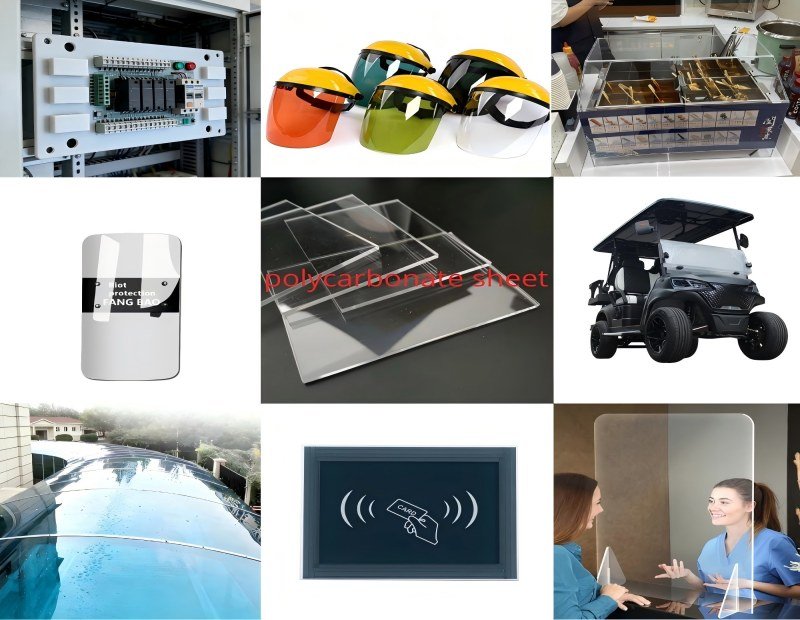
When your project has no mandatory fire-safety regulation, no UL94 requirement from the client, and no continuous high-temperature component or short-circuit ignition source inside equipment, standard PC sheet is preferred for balanced performance and cost. Below are major application fields for standard PC sheet.
4.1 Outdoor daylighting & construction application
Multi-wall polycarbonate sheet for carport, awning, skylight, greenhouse; outdoor fence panel, sun shield. These products focus on light transmission and weather protection, without an electrical ignition source and no mandatory fire code. UV-coated standard PC sheet delivers the best cost-performance. Buying flame-retardant multi-wall PC sheet blindly leads to higher cost without practical benefit.
4.2 Mechanical safety guard (Non–heating mechanical guards only)
Production line transparent barrier, machine protective panel, equipment observation window.
Note: this excludes housings wrapping powered or heating electrical components. There is no overheating or short-circuit risk inside machinery. Standard PC sheet takes full advantage of high impact resistance, anti-breakage and easy heat-bending fabrication.
Important distinction: If guard covers power supply, transformer or high-power heating module, flame-retardant PC sheet should be adopted instead.
4.3 Non–powered interior decoration parts for rail transit
Decorative cover, partition panel, luggage compartment trim board without proximity to electrical cabinet or battery compartment. Standard PC sheet works when no fire-rating is required by specification.
Parts close to the electrical box and battery compartment in rail transit require flame-retardant PC sheet, explained in the next chapter.
4.4 Medical device housing (Non–powered manual equipment)
Protective cover and shield for manual medical tools without built-in power supply or circuit board; no short-circuit risk. Standard PC sheet is acceptable.
⚠️ Once equipment integrates a battery, motor or circuit board, fire-rating evaluation becomes necessary.
4.5 Retail display, advertising & decoration
Cold-source LED light box, commodity display stand, transparent storage box, isolation barrier. Low-power cold LED generates minimal heat without fire risk. Standard PC sheet is impact–resistant, shatter–proof and easy to fabricate with controlled cost.
4.6 Security viewing window, protective face shield
Protective visor, machine observation panel, anti-shatter window. The core requirement is impact resistance rather than fire safety. Large-volume projects select standard PC sheet.
4.7 Outer protective panel for new–energy equipment (Physical shielding only, no contact with battery or circuit board)
For example, physical protective baffle for solar panel system, with no direct contact with the battery module or inverter. Standard PC sheet is acceptable. Never use standard PC sheet as battery housing or battery separator.
4.8 Deep–draw vacuum thermoforming components
Large irregular protective cover produced by deep thermoforming. Standard PC sheet owns wider forming window, with less cracking and whitening. WE receives many thermoforming orders: without mandatory fire requirement, standard PC sheet achieves a higher yield rate compared with flame-retardant PC sheet.
5. Mandatory Scenarios for Flame–Retardant PC Sheet — Never Replace with Standard PC Sheet
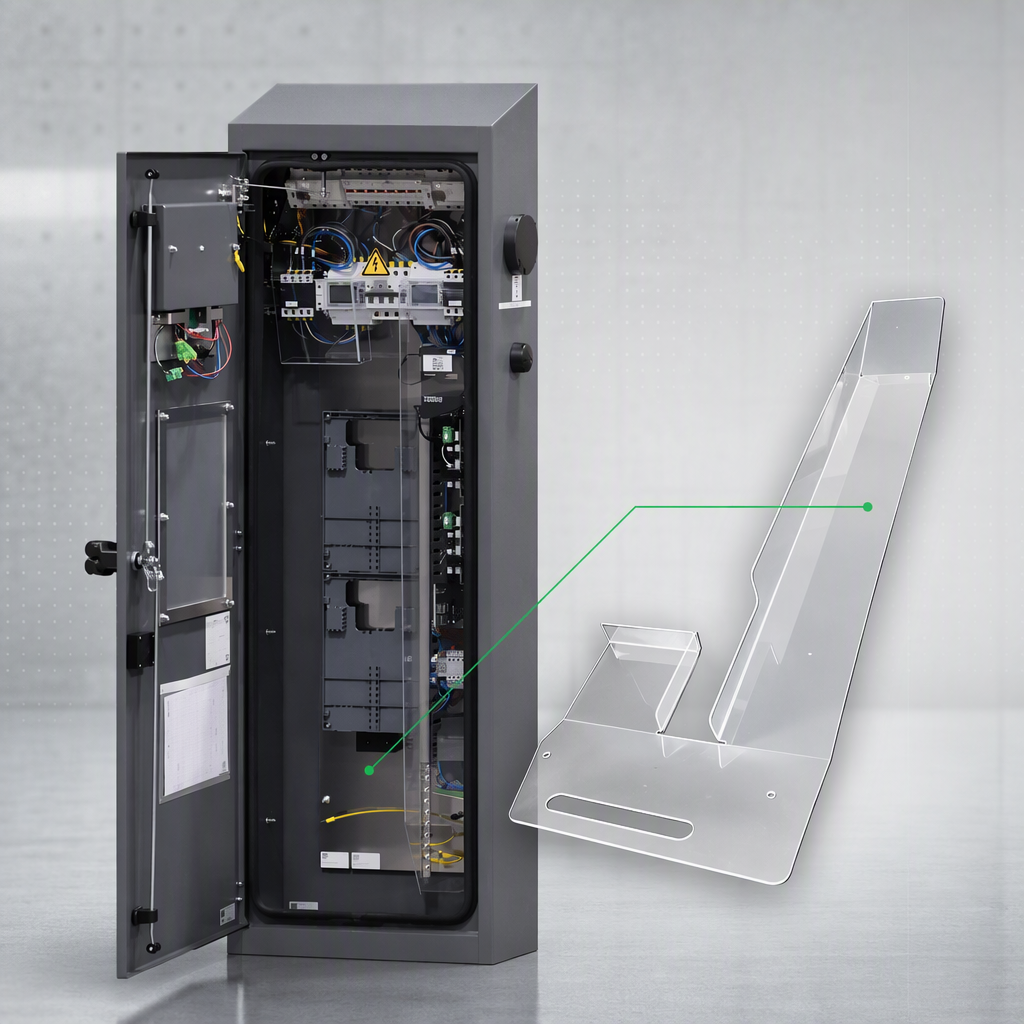
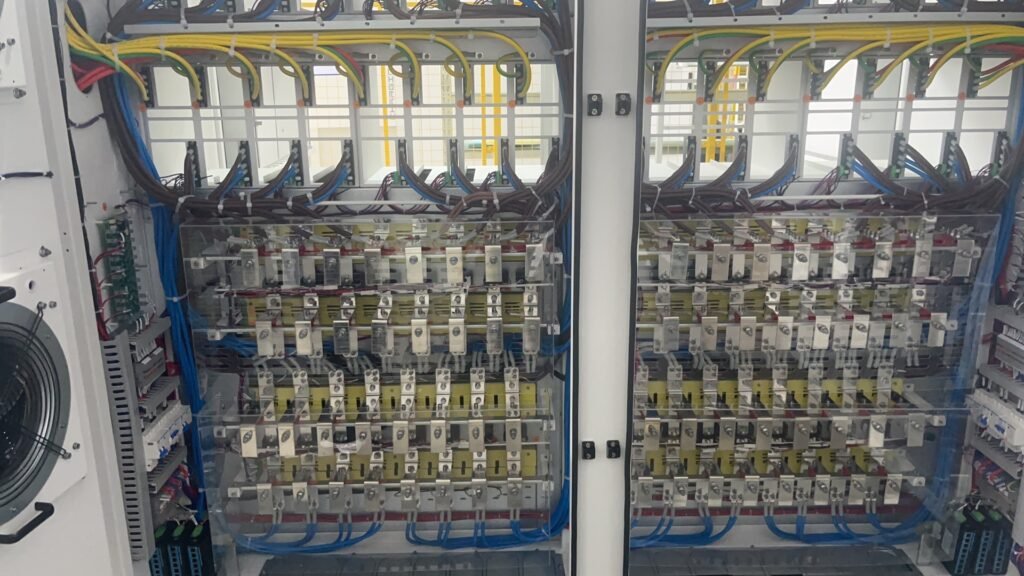
If your project matches any of below conditions, flame-retardant PC sheet (mainly UL94 V-0) is required by regulation or safety standard. Standard PC sheet cannot be used as replacement. Wrong material selection will trigger safety accidents, failed third-party tests, rejected export certification and full-goods rejection by clients.
Core judgement logic: Whether the sheet contacts powered components, lithium-ion battery, high-power heating element; whether it installs in enclosed public space; whether local fire code applies; whether burning material accelerates flame spread in emergency.
5.1 Electrical equipment housing, cabinet & power enclosure
Switch power supply cover, industrial control chassis, internal barrier of charging pile, inverter housing, observation panel for electrical cabinet. Circuit board, capacitor and transformer inside equipment may overheat and short-circuit under failure conditions. If made from standard PC sheet, the housing will catch fire, and burning drips accelerate fire spreading. UL & CE certification for most electrical products explicitly require UL94 V-0 flame-retardant PC sheet. Standard PC sheet fails certification directly.
5.2 Lithium–battery related components (High–frequency new–energy application)
Separator for energy-storage battery compartment, insulating protective sheet for battery module, housing for lithium-battery equipment, protective parts surrounding power battery. Thermal runaway risk exists for lithium batteries under fault conditions. UL94 V-0 flame-retardant PC sheet slows flame propagation and buys time for safe disposal. This is one of the most frequent requirements received by YUCHENG. Many new-energy customers made an early-stage mistake by adopting standard PC sheet as a battery separator and failed the safety test.
Reminder: V-0 flame-retardant PC sheet cannot stop battery fire completely. It slows flame spreading as a safety-enhanced material instead of a pure heat-insulating board.
5.3 Interior components near electrical system in rail transit
Decorative panel and isolation barrier close to electrical cabinet and battery inside high-speed train, metro carriage. Besides UL94 V-0, many rail-transit projects demand low-smoke halogen-free performance, requiring halogen-free flame-retardant PC sheet. In an enclosed passenger cabin, fire and toxic smoke cause huge safety threat; standard PC sheet is forbidden for these positions.
5.4 Interior components inside public buildings
Equipment housing in shopping malls, metro stations, hospitals, back-panel for indoor display screen, decorative panel for indoor cabinet. Domestic fire regulations and overseas project specifications enforce flame resistance requirements for materials used in enclosed public spaces. Outdoor roofing daylighting panel does not belong to this category.
5.5 Powered medical device housing with battery & circuit board
Portable monitoring device and electric medical instrument with built-in motor, battery or PCB. FDA and CE certification for medical equipment set strict standards for electrical safety and material fire-rating. UL94 V-0 flame-retardant PC sheet is mandatory for such housing; standard PC sheet is not allowed.
5.6 Protective guard for continuously high–temperature environment
Equipment working under persistent high-temperature radiation with potential ignition risk. Even without electrical short-circuit risk, standard PC sheet is not suitable. Select flame-retardant PC sheet matching working temperature.
5.7 Charging & battery–swap station housing and internal barrier
Internal separator for EV charging pile, protective component for battery swap station. It belongs to a dual high-risk scenario combining electrical equipment and new-energy battery. Domestic and international standards almost universally require UL94 V-0 flame-retardant PC sheet.
5.8 Internal insulating part for smart home and high-power household appliances
Internal barrier close to the power supply and circuit board for large household appliances and smart devices. UL certification for export products requires flame-retardant PC sheet.
6. Confusing Application Cases: Common Wrong Selections Causing Heavy Loss
Below are typical confusing scenarios where buyers make intuitive but wrong choices leading to project loss.
❌ Confusing case 1: Outer shell of charging pile VS internal separator
- Outer rain-proof shell of charging pile for weather shielding only, no contact with circuit board: Standard PC sheet is permitted for partial projects;
- Internal barrier close to PCB and power module inside charging pile: Must adopt UL94 V-0 flame-retardant PC sheet. Many customers ordered full standard PC sheet, and the internal barrier failed the fire test.
❌ Confusing case 2: Medical device housing
- Manual mechanical shield without circuit: Standard PC sheet acceptable;
- Device with battery, motor or circuit board: Must use flame-retardant PC sheet.
❌ Confusing case 3: Rail-transit interior trim
- Decorative panel far away from battery and electrical box: Standard PC sheet optional;
- Parts adjacent to power and battery compartment: Halogen-free flame-retardant PC sheet mandatory.
❌ Confusing case 4: LED light box
- Low-power cold-source LED open light box with low heat generation: Standard PC sheet works fine;
- High-power high-voltage enclosed light box with high inner temperature: Flame-retardant PC sheet required. A fault in a high-power lamp may trigger a temperature rise and fire hazard inside a sealed box.
❌ Confusing case 5: Thermoformed housing.
Some customers choose flame-retardant PC sheet for all thermoforming jobs.
If no fire-rating certification is required, deep thermoforming with flame-retardant PC sheet brings lower yield rate and higher cost. On the contrary, if CE / UL client specification requires V-0 grade, flame-retardant PC sheet must be used despite higher fabrication difficulty.
7. How Environmental Conditions Affect Fire Performance of PC Sheet (Thickness, Temperature, UV Aging)
Many people hold wrong assumption: once you buy UL94 V–0 flame–retardant PC sheet, it permanently maintains V-0 rating under all conditions. This is not real-world situation.
- Sheet thickness effect (Top priority): Every official UL94 report marks qualified thickness range. For instance, report valid for 3.0mm and 2.0mm does not guarantee V-0 performance for 1mm thin sheet. Thinner sheet faces higher difficulty to maintain fire-rating. When placing an order, inform the supplier of the actual working thickness. WE provides test report matching your actual used thickness instead of supplying a thick-sheet report for a thin-gauge order.
- Long-term high-temperature aging: When UL94 V-0 flame-retardant PC sheet continuously works near heat-deflection temperature, flame-retardant additive performance gradually degrades and fire rating drops. Avoid long-term high-temperature baking for finished design.
- Outdoor UV aging: Indoor-grade flame-retardant PC sheet exposed to sunlight will suffer additive degradation caused by ultraviolet rays. Fire resistance drops; the sheet turns yellow and brittle. Outdoor projects must adopt UV-stabilized flame-retardant PC sheet; never apply indoor-grade flame-retardant PC for outdoor usage.
- Residual stress from fabrication CNC grooving, hot bending and stamping leaves residual stress inside the sheet. Residual stress will not directly lower UL fire rating, yet micro-cracks may be generated. Flame can spread rapidly through cracks, weakening flame resistance in actual application. Therefore, stress relief annealing after PC sheet machining is a critical process for high-end flame-retardant Polycarbonate finished parts.
In actual after-sales cases received by us, many customers passed factory fire tests on new materials, but failed long-term aging tests after 1–2 years of on-site operation. The core reason is ignoring the aging attenuation law of flame-retardant PC sheet under high temperature, UV radiation and processing residual stress.
YUCHENG has been engaged in polycarbonate sheet precision processing for many years. We have summarized mature processing parameters for flame-retardant Polycarbonate and standard Polycarbonate to ensure stable mass production quality.
8. Fabrication Differences Between Flame‑Retardant Polycarbonate Sheet and Standard Polycarbonate Sheet: Thermoforming, CNC Grooving, Printing, Bending
Although both standard PC sheet e flame-retardant PC sheet belong to polycarbonate materials and support secondary processing, their processing tolerance and parameter windows are completely different. Using standard Polycarbonate processing parameters to produce UL94 V‑0 flame-retardant PC sheet products will easily lead to whitening, micro-cracks, burst edges and low yield rate.
YUCHENG has been engaged in PC sheet precision processing for many years. We have summarized mature processing parameters for flame-retardant Polycarbonate and standard Polycarbonate to ensure stable mass production quality.
8.1 Heat Bending Processing Difference
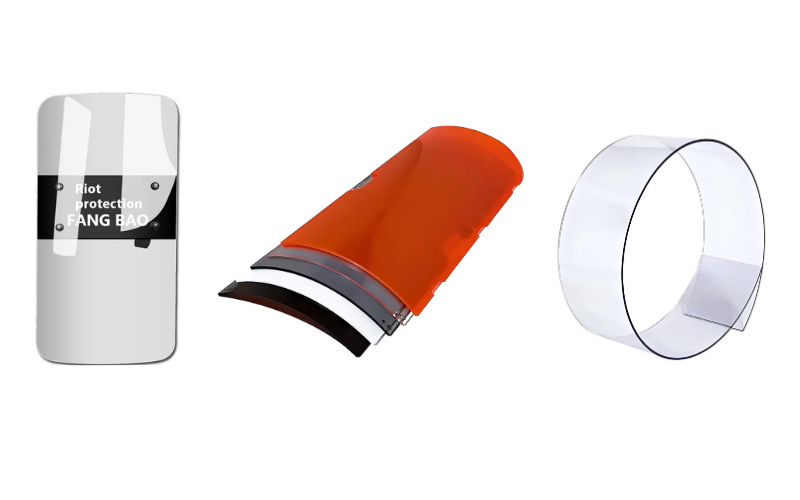
Standard PC sheet has a very wide hot bending temperature window of 130℃–170℃. Even if the temperature fluctuates slightly, the finished product will not rebound or deform obviously, and the yield rate is extremely high.
Flame-retardant PC sheet has a narrow hot bending window. The flame-retardant modifier will reduce the material’s thermal stability. Excessively high temperature will cause surface blistering and internal molecular decomposition; excessively low temperature will lead to serious rebound after bending, making it unable to maintain the forming radius. All thick-gauge V0 flame-retardant PC sheet bending parts need annealing treatment after forming to eliminate internal stress.
8.2 Vacuum Thermoforming Deep Drawing
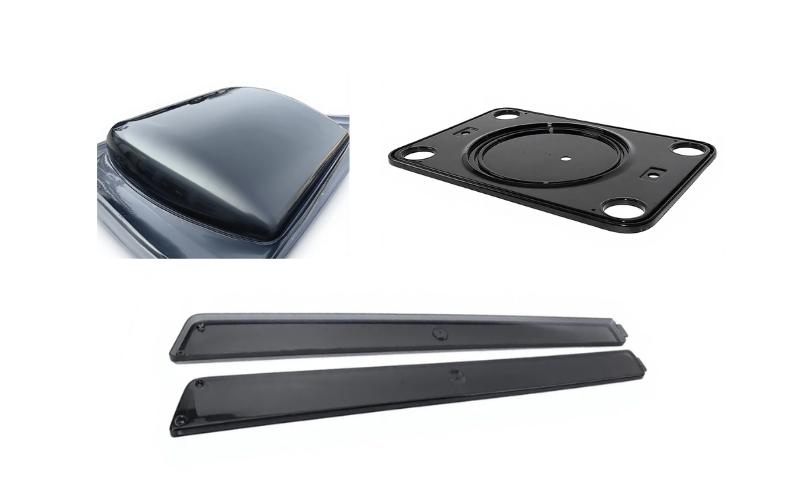
Standard PC sheet is the preferred material for large deep-drawing thermoforming parts. It has strong ductility, no whitening or cracking after stretching, and is very suitable for customized irregular protective covers and equipment housings.
Flame-retardant PC sheet, especially halogen-free UL94 V0 flame-retardant PC sheet, has poor stretching performance. Deep stretching is prone to local stress concentration, resulting in surface fogging, whitening and invisible micro-cracks. These micro-defects will not affect the appearance in the short term, but will crack and fail after contact with glue, disinfectant or long-term aging.
Therefore, for projects requiring both deep thermoforming e V0 flame retardancy, WE will recommend high-toughness modified flame-retardant Polycarbonate formula to balance fire resistance and processing performance.
8.3 CNC Cutting, Grooving and Drilling
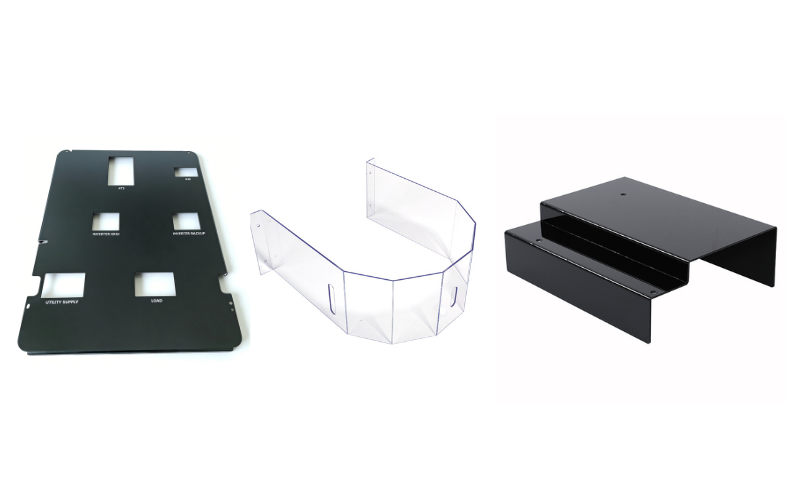
Flame-retardant PC sheet is far more sensitive to processing stress than standard PC sheet.
When CNC grooving and drilling standard PC sheet, the parameter tolerance is large, and minor operational errors will not cause quality problems. However, when processing UL94 V0 flame-retardant PC sheet, excessive tool speed, insufficient heat dissipation and rapid tool feeding will leave a large number of residual internal stresses inside the material.
In the later assembly and gluing link, these residual stresses will be released instantly, resulting in radial cracks around the holes and grooves, leading to batch scrapping.
YUCHENG’s CNC workshop independently optimizes cutting parameters for flame-retardant Polycarbonate and standard Polycarbonate, equipped with high-precision sharp tools and full-process heat dissipation processing, which fundamentally reduces the stress cracking risk of flame-retardant Polycarbonate finished products.
8.4 Screen Printing and UV Printing
The surface printing adhesion of the two materials is basically the same, but the flame-retardant PC sheet with residual stress is extremely prone to solvent cracking after contacting printing ink and diluent.
Our process specification is fixed: all flame-retardant Polycarbonate printing parts must complete stress relief annealing first, and then carry out printing production to ensure zero cracking after finished products are shipped.
8.5 Bonding and Assembly Gluing
Standard PC sheet has stable chemical resistance and can adapt to a variety of Polycarbonate special glues. Flame-retardant PC sheet has strict requirements on glue selection. Universal quick-drying glue and solvent glue will directly corrode the plate surface and cause stress cracking. All bonding processes of flame-retardant Polycarbonate need targeted glue matching and sample testing before mass production.
9. Cost, Lead Time & Stock Comparison
9.1 Material Price Gap
Under the same thickness, transparency and new virgin material standards, the price gradient is very clear:
Standard Policarbonato Sheet < UL94 V2 Flame-Retardant Policarbonato < UL94 V1 Flame-Retardant Policarbonato < UL94 V0 Flame-Retardant Policarbonato < Halogen-Free UL94 V0 Flame-Retardant Policarbonato
The conventional UL94 V0 flame-retardant PC sheet is 20%–45% more expensive than standard PC sheet, and the halogen-free low-smoke flame-retardant Polycarbonate is even 50%–70% higher in cost. For large-batch industrial projects, the material cost gap is huge.
9.2 Spot Inventory and Delivery Cycle
Standard PC sheet is fully stocked in conventional thicknesses of 0.8mm–15mm, with completely transparent, frosted and black colors, supporting instant delivery and an ultra-short delivery cycle, which is very suitable for urgent orders and temporary replenishment.
Flame-retardant PC sheet, especially high-standard halogen-free V0 flame-retardant Polycarbonate, belongs to customized modified materials. Most special thicknesses and special colors have no spot inventory and require professional extrusion production. The production cycle is 7–20 working days.
We reserve conventional common thicknesses of V0 flame-retardant Polycarbonate all year round, which can effectively shorten the delivery cycle of customer orders and solve the problem of the long customization cycle of flame-retardant plates in the market.
9.3 Comprehensive Processing Cost
The processing yield of standard PC sheet is as high as 99%, with almost no scrapping loss. The processing difficulty of flame-retardant Polycarbonate is great, and the yield rate of complex deep-drawing and multi-groove parts is slightly lower. When customers make project budget estimates, they must include the processing loss rate of flame-retardant Polycarbonate to avoid later cost overrun.
10. Common Misconceptions About PC Sheet Fire-Rating (90% Buyers Make These Mistakes)
Misconception 1: Flame-retardant PC sheet is non-combustible
Correction: UL94 V0 flame-retardant PC sheet is flame-retardant and self-extinguishing, not non-combustible.
Under continuous high-temperature open flame and long-term fire roasting, flame-retardant PC sheet will still burn and penetrate. Its core function is to inhibit flame spread, eliminate open flame quickly, reduce dripping ignition risk, gain escape and maintenance time for equipment and personnel, rather than completely resist fire.
Misconception 2: All PC sheets have the same flame retardant grade
Many purchasers think PC sheet is a single material. In fact, pure standard Polycarbonate only has V2 grade, and V1/V0 grades must be realized by adding flame-retardant modifiers. The safety gap between grades is huge and cannot be substituted for each other.
Misconception 3: One V0 report applies to all thicknesses
The UL94 test report is strictly bound to the test thickness. The 3mm V0 qualified plate may fail the V0 test when it is 1 mm thick. Many suppliers use thick plate reports to fool thin plate orders, resulting in customer project inspection failure.
Misconception 4: Ordinary indoor V0 flame-retardant Policarbonato can be used outdoors for a long time
Conventional flame-retardant Polycarbonate has no UV anti-aging formula. Long-term outdoor sunlight will decompose flame-retardant additives, reduce flame-retardant performance, and cause yellowing and brittleness of the plate. Outdoor projects must use UV-stabilized flame-retardant PC sheet.
Misconception 5: Excessive pursuit of full V0 configuration for all projects
Blindly using V0 flame-retardant Polycarbonate for non-flame-retardant scenarios will not improve product safety, but will increase material costs, reduce product toughness and lower processing yield, resulting in unnecessary waste.
Misconception 6: Distinguish flame-retardant Policarbonato and standard Policarbonato by naked eyes
There is almost no difference in appearance between the two. A small number of transparent flame-retardant plates are slightly yellowish, and black and frosted plates are completely indistinguishable. Appearance cannot be used as the basis for judging flame retardancy. Only UL test reports and third-party testing are valid.
11. How To Verify If Your PC Sheet Is Real Flame‑Retardant Grade
To avoid supplier false labeling and material substitution, WE recommends three verification methods for foreign trade and large-batch projects:
1. Verify official UL94 test report: Check the plate brand, model, test thickness and flame retardant grade one by one to ensure that the report corresponds to the actual supplied materials, and reject generic reports of other brands.
2. Third-party sampling inspection: For export orders and high-standard new energy projects, arrange SGS/third-party fire testing to ensure that the materials meet the certification standards of the destination country.
3. Factory standard combustion test: It can be used as a preliminary screening. Standard Polycarbonate will burn continuously with dripping; genuine V0 flame-retardant Polycarbonate will self-extinguish quickly without dripping ignition.
WE provides full batch-compliant UL, RoHS, REACH certification documents, supports third-party random inspection, and never falsifies material reports.
12. YUCHENG Professional PC Sheet Manufacturing & Processing Service Advantage
As an integrated manufacturer of PC sheet extrusion and precision deep processing located in Suzhou, China, we have focused on the production and customization of standard PC sheet and flame-retardant PC sheet (UL94 V2/V1/V0 halogen/halogen-free) for more than ten years, serving global new energy, medical equipment, industrial automation, rail transit and advertising display customers.
Our core service advantages are fully tailored for B2B foreign trade and engineering projects:
✅ Full-grade PC sheet supply: Spot supply of standard PC sheet, customized production of UV-resistant outdoor Polycarbonate, UL94 V0 flame-retardant PC sheet, halogen-free low-smoke flame-retardant PC sheet, with thickness covering 0.5mm–20mm, supporting transparent, frosted, black, matte and special color customization.
✅ Serviço único de tratamento em profundidade: Independent factory supports CNC precision cutting, grooving, countersinking, chamfering, hot bending, vacuum thermoforming, UV printing, screen printing, surface hard coating, UV anti-ultraviolet coating and stress relief annealing processing, eliminating the trouble of multi-supplier coordination for customers.
✅ Professional free material selection guidance: According to the customer’s product use scenario, temperature environment, electrical risk, certification standards and budget, we accurately judge whether to use standard PC sheet ou flame-retardant PC sheet, avoiding over-cost or hidden safety dangers caused by wrong selection.
✅ Strict new virgin material production: All PC sheets are made of 100% new virgin particles, no recycled miscellaneous materials, stable flame-retardant performance, no brittle cracking, no yellowing failure, ensuring consistent quality of bulk goods and samples.
✅ Complete certification documents: Provide batch-matched UL94 flame retardant report, RoHS environmental protection report, REACH report, and material safety data sheet to help customers pass EU CE, US UL and other export certifications smoothly.
✅ Flexible order mechanism: Supports small-batch sample proofing, medium-batch trial production and large-batch foreign trade batch delivery, with a flexible delivery cycle and stable after-sales service.
Whether you need to purchase original PC sheet raw materials or customized finished Polycarbonate processing parts, you can send drawings and parameter requirements to US. Our technical team will provide free solution optimization and quotation service.
13. Final Selection Summary & Application Scenario Table
The core difference between flame-retardant PC sheet and standard PC sheet is a trade-off: standard Polycarbonate prioritizes toughness, processing performance and cost performance; flame-retardant Polycarbonate prioritizes fire safety and certification compliance.
No material is absolutely better. The best material is the one that matches your project scenario, certification requirements and budget.
| Material Type | Flame Retardant Grade | Priority Application Scenarios | Forbidden & Not Recommended Scenarios |
| Standard Policarbonato Folha | UL94 V2 | Outdoor daylighting canopy, non-heating mechanical protective cover, advertising display rack, non-powered medical baffle, deep-drawing thermoformed parts, ordinary observation window | Lithium battery surrounding parts, electrical cabinet shell, enclosed public space electrical equipment, export products requiring V0 certification |
| UL94 V1 Flame-Retardant Policarbonato | UL94 V1 | Indoor ordinary electrical equipment shell, medium fire safety requirement projects | New energy battery components, high-standard UL certified electrical products |
| UL94 V0 Flame-Retardant Policarbonato | UL94 V0 | Power supply shell, charging pile isolation board, energy storage battery partition, powered medical equipment, rail transit electrical accessories | Long-term outdoor UV environment (needs a UV-modified version), ultra-deep stretching parts (easy to whiten) |
| Halogen-Free V0 Flame-Retardant Policarbonato | UL94 V0 (Low smoke & non-toxic) | Rail transit interior, closed medical space, high-standard export fire protection projects | Low-budget projects without low-smoke and halogen-free mandatory requirements |
Final Conclusion
Standard PC sheet is cost-effective, tough and easy to process, which is the best choice for non-fire-proof scenarios; flame-retardant PC sheet is the safety guarantee for electrical, new energy and public facility projects, and is an indispensable material for passing international certification.
Correct material selection can help you reduce costs, avoid certification failures, eliminate safety hazards and reduce after-sales risks. If you are confused about material selection, please feel free to contact YUCHENG’s professional technical team for free one-on-one scenario matching and solution customization.
- One-Piece Forming Process of Polycarbonate Curved Shell|Complete Guide for Solid Polycarbonate 3D Thermoforming
- Polycarbonate Sheet OEM Manufacturing Services: From Drawing to Finished Parts
- Why Polycarbonate Sheets Are Impact-Resistant and Hard to Break — Complete Performance Guide, Selection Tips & Practical Processing Advice
- Polycarbonate Sheet Springback After Cold Bending: Causes, Solutions and Tips
- Differences and Applications of Polycarbonate Sheet Screen Printing and UV Printing
- How to Hot Bend Polycarbonate Sheet into a Curved Shape: A Simple Step-by-Step Guide
- Flame Retardant Polycarbonate Sheet vs Standard Polycarbonate Sheet: Application Scenarios & Selection Guide
- Polycarbonate Sheet vs PETG Sheet: Key Differences & How to Choose
- Folhas de acrílico fosco, opaco, perolizado e transparente: principais diferenças, utilizações e guia de seleção para o comprador
- Defeitos comuns no processamento de chapas de policarbonato: causas e soluções práticas de correção