






Table of Contents
- What is polycarbonate sheet OEM fabrication? Differences between OEM, ODM & simple contract processing
- Why businesses choose polycarbonate sheet OEM fabrication instead of in-house processing
- Full range of manufacturing processes available under polycarbonate sheet OEM service
- Industries & products suitable for polycarbonate sheet OEM fabrication
- Two major cooperation modes for polycarbonate sheet OEM: customer-supplied material & turn-key full-material OEM, pros & cons
- Documents & information you need to prepare before starting a polycarbonate sheet OEM project
- Standard complete workflow of polycarbonate sheet OEM fabrication (inquiry-sampling-pilot-mass delivery)
- Top 8 common pitfalls in polycarbonate sheet OEM fabrication and how to avoid them
- How raw material choice determines OEM finished-part quality: virgin polycarbonate, recycled polycarbonate, functional modified polycarbonate sheet
- Tolerance, surface finish, packaging & lead-time: key terms to write into OEM technical agreement
- Yucheng Board Industry one-stop polycarbonate sheet OEM fabrication service introduction
- How to work with Yucheng Board Industry for sampling, small-batch & mass-volume OEM orders
- Real-world case studies of polycarbonate sheet OEM fabrication across different industries
- Frequently Asked Questions for polycarbonate sheet OEM fabrication
- Final checklist: how to select a reliable polycarbonate sheet OEM fabrication supplier
1. What is policarbonato sheet OEM fabrication? Differences between OEM, ODM & simple contract processing
Many procurement specialists and mechanical engineers easily mix up polycarbonate sheet OEM fabrication, ODM service and basic cutting-only contract processing. Misunderstanding these modes often leads to mismatched finished parts and painful project delays.
Simply put, polycarbonate sheet OEM fabrication means the customer holds complete product design, drawings, samples and performance specifications. The professional manufacturer carries out part or all production and deep-processing work for polycarbonate components strictly according to your design standards. Finished parts can be branded with your own logo. All intellectual property rights for product design belong to you, the client.
Let’s clarify three frequently confused terms:
✅ Polycarbonate sheet OEM fabrication: Customer provides drawings or physical samples. The factory handles raw material sourcing, cutting, CNC routing, bending, printing, bonding and full-part finishing. The OEM manufacturer will not modify your design, only execute manufacturing according to your requirements. Shape, performance and function are fully decided by your team.
✅ Polycarbonate sheet ODM service: Customer only describes functional requirements. The supplier completes structural design, material selection and fabrication. The design solution is created by the factory, and some designs may be reused for other buyers.
✅ Basic customer-supplied-material processing: You buy polycarbonate sheets yourself and send raw stock to the workshop. The factory only performs a single procedure such as cutting or drilling. You take full responsibility for raw-material quality. You need to coordinate multiple workshops for different processes, which brings a heavy communication burden.
Many buyers mistakenly think polycarbonate sheet OEM fabrication equals simple sheet cutting. Real mature polycarbonate sheet OEM fabrication is a complete end-to-end manufacturing solution, not just basic trimming. It covers material recommendation, DFM manufacturability review, multi-step deep fabrication, quality inspection, custom packaging and shipment arrangement.
Real-world example: A new-energy equipment enterprise has finished 3D drawings for polycarbonate protective window for machine cabinet. They do not own CNC routers, thermal bending ovens or UV printing equipment in-house. Purchasing all machinery and hiring skilled operators would require significant capital. Instead, they outsource to polycarbonate sheet OEM fabrication provider. The client submits drawings and technical specifications. The OEM factory selects the appropriate polycarbonate substrate and completes cutting, CNC milling, hole drilling, thermal arc bending, UV printing, protective film handling, and full dimensional inspection. Final ready-to-assemble components are delivered, and the customer installs them directly onto equipment.
Key point: A qualified polycarbonate sheet OEM fabrication supplier must master both polycarbonate material knowledge and multi-process fabrication capability. Many small workshops can only do simple cutting. They struggle to solve bending spring-back, CNC-induced micro-cracks, and poor printing adhesion problems. This is the core gap between real OEM service and simple cutting shop.
2. Why businesses choose policarbonato sheet OEM fabrication instead of in–house processing
More and more domestic and global brands stop building their own plastic-sheet processing workshops and turn to professional polycarbonate sheet OEM fabrication partners. Cost savings are only one factor; there are many practical business considerations.
2.1 High capital investment for equipment with low utilization rate
To realize full-range polycarbonate sheet OEM fabrication, you need an NC cutting machine, laser cutter, multiple CNC routers, thermal-bending oven, cold-bending press, UV printing machine, polishing station and precision measuring tools. Total equipment investment could reach tens or hundreds of thousands of dollars. For most companies, polycarbonate (PC) components are not continuous high-volume output. You may produce several thousand pieces for one project and then face months of zero orders. Buying and maintaining idle equipment is extremely uneconomical. By adopting polycarbonate sheet OEM fabrication, you avoid heavy hardware investment.
2.2 Polycarbonate processing has hidden technical barriers; skilled operators are hard to retain
Polycarbonate looks like simple transparent plastic sheet, yet many hidden risks exist during fabrication. Improper CNC parameters will introduce internal stress and micro-cracks. Wrong thermal-bending temperature causes bubbles and severe spring-back. Poor surface pre-treatment before UV printing results in ink peeling. Wrong drilling settings create edge cracking. Stable qualified output requires experienced technicians familiar with polycarbonate material properties. Recruiting and training these operators costs lots of resources. When production volume fluctuates, maintaining an in-house processing team becomes difficult. With polycarbonate sheet OEM fabrication, you leverage years-accumulated process know-how from contract manufacturer and skip the costly trial-and-error phase.
2.3 Simplify supply–chain management, reduce coordination workload
If you handle fabrication internally: you source raw polycarbonate sheets from material vendor, send sheets to cutting shop, send blanks to bending factory, outsource printing to another printer, and organize inspection by yourself. One single component may require coordination with 3-5 different suppliers. Once defects appear, multiple vendors shift responsibilities to each other, and troubleshooting becomes slow and painful.
One-stop polycarbonate sheet OEM fabrication lets you manage only one supplier. Raw-material procurement, all deep-processing steps, quality inspection and custom packaging are handled by the OEM partner. When quality issues occur, there is single responsible party. Your procurement and engineering team can focus on core R&D and market expansion instead of supply-chain trivial work.
2.4 Flexible capacity for prototype sampling, low–volume pilot and mass–volume production
Many projects start with small prototype batches for validation, then low-volume trial production, and finally large-scale mass production after market confirmation. An in-house workshop cannot flexibly adapt to such volatile order volume. A professional polycarbonate sheet OEM fabrication provider supports small-quantity sampling, hundreds-piece pilot runs, and tens-of-thousands-of-piece mass production. Production capacity scales according to your real-world demand without permanent fixed overhead.
2.5 OEM vendor provides material–selection guidance to prevent field–service failure
Many clients only focus on dimensions on the drawing and ignore material-related risks. For outdoor applications, non-UV-stabilized polycarbonate sheet will turn yellow rapidly. A chemical-contact environment will cause stress cracking on ordinary polycarbonate. Safety equipment needs a flame-retardant-grade polycarbonate substrate. A competent polycarbonate sheet OEM fabrication partner will review your application condition at early project phase, remind you of material risks, and help avoid premature component failure after installation. This professional material insight is often missing within an in-house processing team.
Of course, polycarbonate sheet OEM fabrication is not for every scenario. If your product requires top-level confidentiality, or you maintain extremely stable ultra-high daily output, building an internal workshop may be reasonable. For most industrial projects, OEM fabrication brings much higher overall efficiency.
3. Full range of manufacturing processes available under policarbonato sheet OEM service
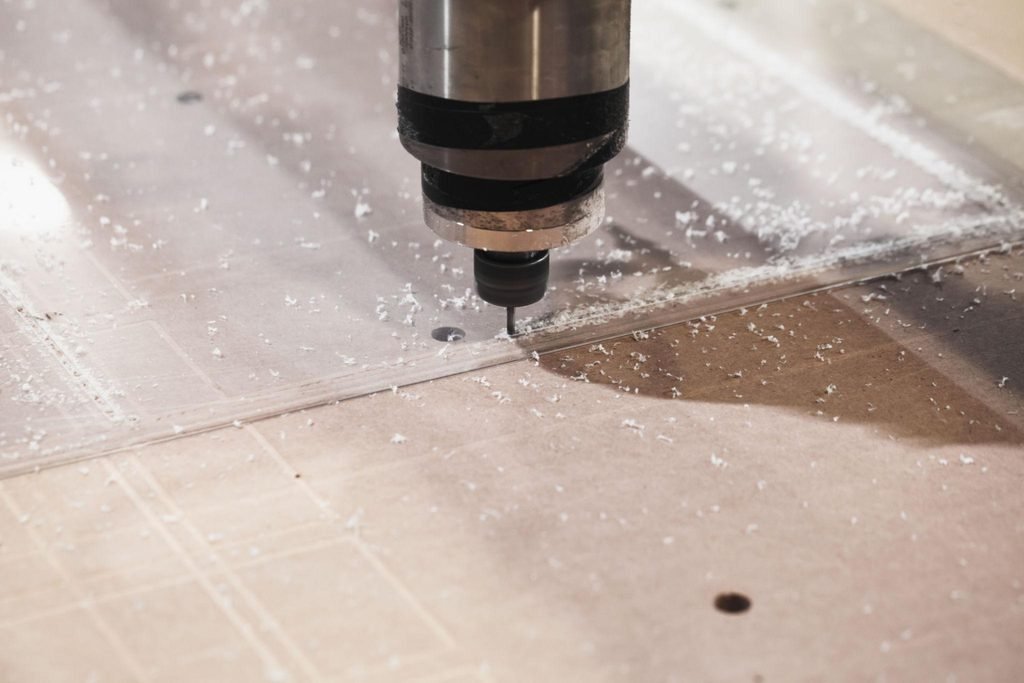
One-stop polycarbonate sheet OEM fabrication covers nearly all procedures from raw polycarbonate sheet to ready-to-assemble finished parts. It can deliver combined multi-process components instead of only performing single-step cutting. Below is full list of common OEM-supported processes for sorting your requirements:
- Raw-material selection & procurement: OEM factory selects polycarbonate sheets per your specification: clear polycarbonate, matte-finish polycarbonate, UL94-V0 flame-retardant polycarbonate, anti-static polycarbonate, hard-coated scratch-resistant polycarbonate, UV-stabilized outdoor-grade polycarbonate, tinted colored polycarbonate. Thickness ranges from 0.5mm to 25mm. Distinguish between virgin-resin sheet and functionally modified sheet. For turnkey OEM orders, incoming material quality check (IQC) will be performed, and COA (certificate of analysis) can be provided.
- Precision cutting & blanking: NC straight cutting, laser contour cutting, CNC routing cutting. Supports rectangular blanks and complex irregular profiles, and hollow-out features. Tolerance range: ±0.05~±0.15 mm. Suitable for mass blanking and complex-shape parts.
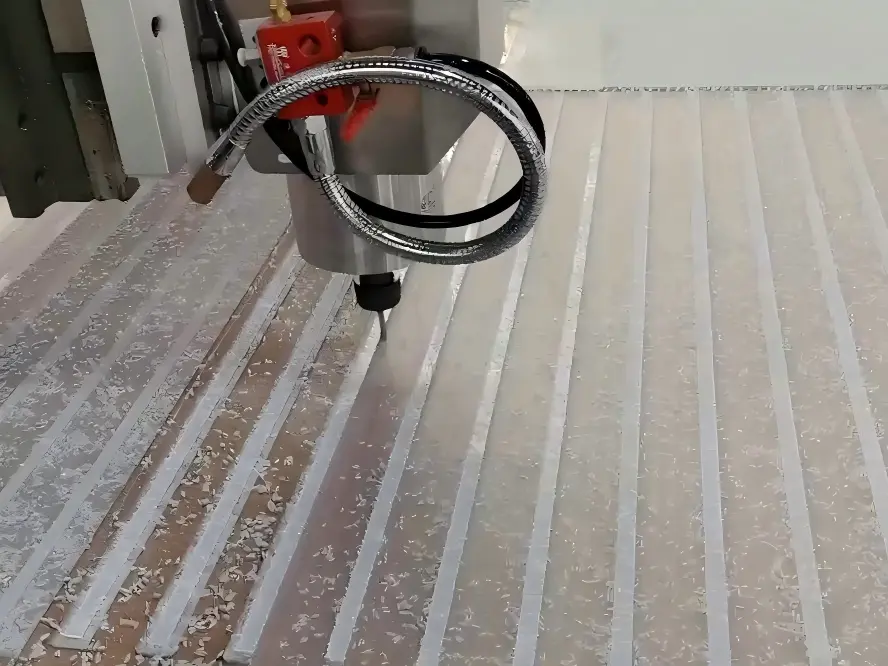
- CNC routing, milling, grooving, chamfering, and countersink hole machining High-frequency procedure in polycarbonate sheet OEM fabrication. Produce countersink screw holes, long-slot openings, step features, chamfer edge for thick-sheet complex geometry. CNC parameters will be optimized to minimize stress whitening and micro-crack risk on polycarbonate.
- Drilling work: round hole, square hole, counterbore hole, elongated slot hole. Aperture from 1mm upward, widely used for mechanical assembly mounting.
- Thermal bending & cold bending: U-shape, Z-shape, arc-shaped polycarbonate components heavily rely on the bending process in polycarbonate sheet OEM fabrication. Thermal-bending oven for large-radius curved parts; cold-bending for simple angular folds. OEM engineers will evaluate spring-back risk according to sheet thickness and bend radius, and apply process compensation.
- Thermoforming/vacuum forming: deep-draw 3D housing, protective cover and enclosure through polycarbonate vacuum thermoforming, widely used for machine outer guard housing.
- Surface printing: silk-screen printing & UV flatbed printing. Panel text, scale marks, and brand logo graphic printing. Polycarbonate sheet OEM fabrication includes surface degreasing pre-treatment to guarantee ink adhesion and prevent ink peeling in service. Single-side printing, double-side printing and partial masking printing are supported.
- Polishing & flame polishing, edge sanding & deburring: Remove burr on the cutting edge, improve optical clarity for visible-surface window components.
- Bonding & partial assembly: Glue-bond multiple polycarbonate sheet sub-parts into box-type guard or semi-finished assembly unit.
- Functional surface treatment: Protective film lamination for shipment protection; hard-coating finish; anti-static surface treatment.
- Full-part dimensional inspection, appearance sorting, performance sampling test. Major difference between OEM fabrication and simple job-shop cutting: OEM includes outgoing quality control. Dimension measurement, visual defect screening. For critical orders, impact-resistance, flame-retardant or weather-aging sampling tests can be performed.
- Customized packaging solution: EPE foam separator, individual poly-bag, export-grade carton, to avoid surface scratches during transit. Custom label printing per client requirement.
Important note: polycarbonate sheet OEM fabrication can handle partial-procedure outsourcing or full-turnkey complete-package service. For example, you supply raw sheets and only require CNC + bending + printing; or you hand over the whole project for full turnkey OEM from material purchase to final shipment.
4. Industries & products suitable for policarbonato sheet OEM fabrication
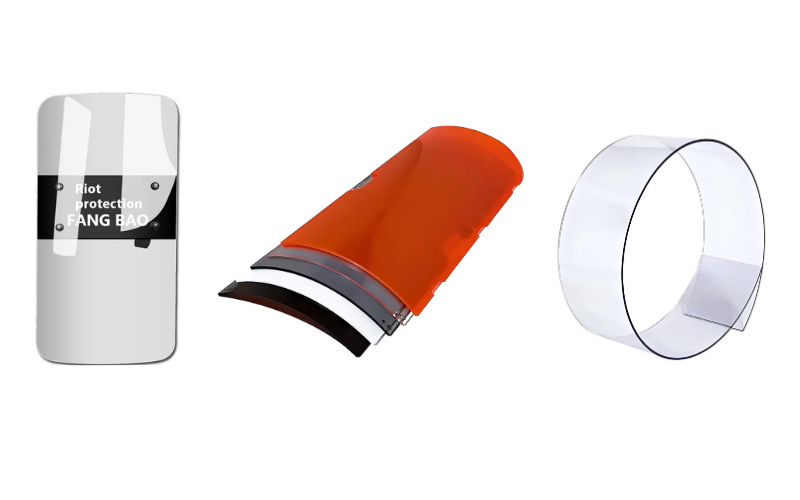
Policarbonato sheet OEM fabrication serves a wide range of industrial segments. Main application scenarios are listed below for your reference:
✅ Automation industrial equipment: Transparent safety machine guard, protective baffle, instrument observation window, cabinet viewing panel. These components frequently require CNC hole patterns and bending and forming, demanding tight dimensional and appearance requirements, perfect fit for polycarbonate sheet OEM fabrication.
✅ New-energy industry Polycarbonate protective panel for charging pile, protective cover for energy-storage equipment, isolation baffle. Many applications require flame retardancy and outdoor UV resistance. OEM service can source flame-retardant or weather-resistant polycarbonate sheet and complete full-set fabrication.
✅ Medical device equipment: Medical-equipment housing, observation window, protective partition plate. Many projects demand clean-finish, burr-free components and material traceability. Qualified polycarbonate sheet OEM fabrication controls dust and burr risk during the whole production cycle.
✅ Rail-transportation industry: Interior polycarbonate parts for trains & high-speed railways, safety baffles, luggage-rack accessory parts with strict flame-retardant and toughness requirements.
✅ Retail display & kiosk equipment: Transparent display stand, fixture accessory, machine front panel requiring logo printing and bending profile.
✅ Safety & security protection field: Machine safety barrier, isolation shield, leveraging polycarbonate’s high-impact performance with drilling and bending processing.
✅ Lighting industry polycarbonate diffuser sheet fabrication, lamp-shade accessory including cutting, grooving and assembly OEM.
What scenarios are NOT suitable for polycarbonate sheet OEM fabrication? If you need high-volume injection-molded plastic housing, injection molding will be preferred. Polycarbonate sheet OEM fabrication focuses on sheet-stock deep-machined components, covering prototype sampling, low-volume and mid-high-volume sheet-part orders.
5. Two major cooperation modes for policarbonato sheet OEM: customer–supplied material & turn–key full–material OEM, pros & cons
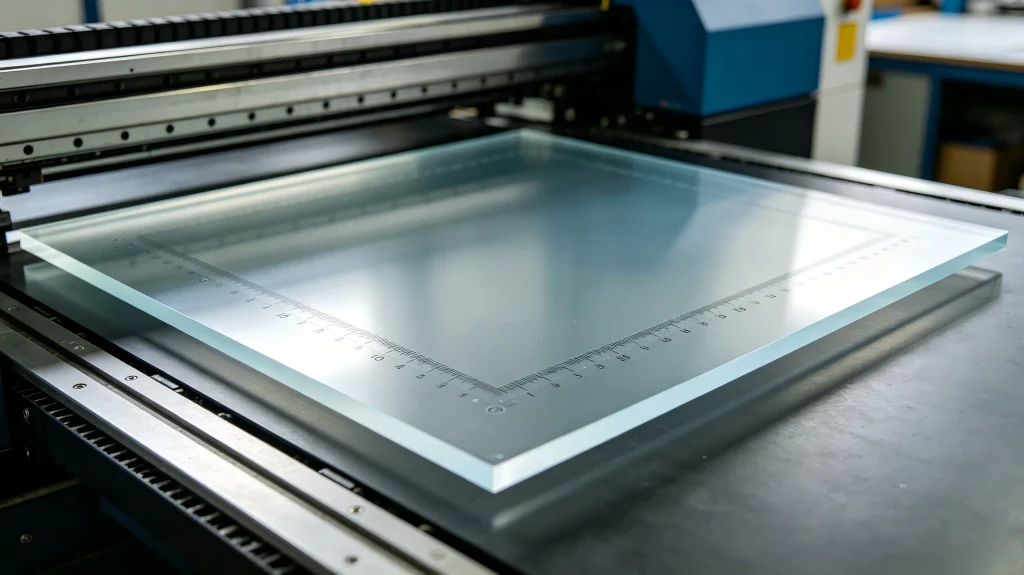
Before launching a polycarbonate sheet OEM fabrication project, you need to confirm the cooperation mode clearly. Two mainstream modes exist, and many project conflicts arise from ambiguous definition at initial phase.
Mode 1: Customer–supplied raw–material OEM fabrication
Client purchases polycarbonate sheets and delivers raw stock to the OEM manufacturer. The factory only charges processing fee and performs cutting, CNC, bending, printing and other fabrication work.
✅ Advantages: You retain full control over raw-sheet brand & specification. If you have strong bulk-purchase bargaining power for polycarbonate sheet, material cost may be optimized.
❌ Disadvantages:
- Raw-material quality risk sits on the client side. If incoming sheet contains high internal stress or uses recycled resin, cracking after fabrication will cause an ambiguous responsibility boundary.
- You take charge of sheet logistics and warehouse storage, occupying your internal storage space.
- Material loss caused by normal processing scrap belongs to the customer.
- Your team must master polycarbonate material knowledge; wrong material selection will trigger field-part failure afterwards.
Best fit: You have deep experience in polycarbonate-sheet material, stable large-volume raw-sheet procurement and a mature upstream material supply chain.
Mode 2: Turn–key full–material OEM fabrication (Yucheng Board Industry recommended mode)
Client only provides drawings, samples and technical requirements. polycarbonate sheet OEM fabrication factory selects and purchases qualified polycarbonate sheet, completes all fabrication, inspection and custom packaging, and delivers finished ready-to-use parts. The quotation combines raw-material cost plus processing cost.
✅ Advantages:
- Real one-stop experience. You only communicate with one supplier instead of coordinating multiple vendors.
- OEM manufacturer possesses deep knowledge of various polycarbonate grades and will recommend suitable substrate according to your application environment and avoid wrong-material mistakes.
- Incoming material IQC inspection is performed by the factory. The risk of bad raw sheets is borne by the OEM side. Normal processing scrap loss is calculated inside the quotation.
- Yucheng Board Industry can provide COA material certificate for export, medical and new-energy project audit requirements.
❌ Disadvantages: You do not participate in raw-sheet purchasing directly. You need to write the sheet specifications clearly into the technical agreement, confirming virgin-resin requirements, flame-retardant rating, UV-resistance, etc.
Critical reminder: When selecting turn-key polycarbonate sheet OEM fabrication, write down key sheet specifications in a written agreement: virgin polycarbonate resin requirement, flame-retardant grade, UV-stabilization, thickness tolerance, to prevent recycled-material substitution.
Yucheng Board Industry supports both customer-supplied-material OEM and full-turn-key OEM. Most overseas buyers and domestic equipment manufacturers prefer full-material OEM to reduce internal supply-chain burden.
6. Documents & information you need to prepare before starting policarbonato sheet OEM project
Many clients send only photos of physical samples without engineering drawings when inquiring about polycarbonate sheet OEM fabrication. Without precise drawings, accurate quotation and stable sampling cannot be achieved. To speed up project progress, prepare the documents as complete as possible. More complete input brings more precise quotation and lower defect risk.
- Engineering drawing (highest priority): CAD, DXF, DWG, STEP or PDF drawing. Mark all dimensions, tolerance requirements, hole size, chamfer features, and bending angle on the drawing.
Note: A screenshot picture or photo can only serve as a visual reference and cannot replace a formal manufacturing drawing.
- Physical sample: If the complete drawing is unavailable, you can send a physical sample to the factory for reverse measurement. Please note that reverse measurement will result in minor deviations; critical projects still require formal drawing.
- Raw-material specification requirements: polycarbonate sheet thickness, color; clear/matte finish; flame-retardant UL94-V0 requirement; anti-static function; outdoor UV-coating requirement; must specify virgin-resin or recycled-resin permission.
- Full list of required fabrication processes: list all needed procedures: cutting, CNC milling, hole drilling, thermal/cold bending, UV / silk-screen printing, polishing, bonding assembly. Provide vector graphic file for logo printing.
- Order quantity information: sampling quantity, pilot-batch quantity, estimated annual consumption. Order volume directly impacts unit price for polycarbonate sheet OEM fabrication.
- Application-environment description (very important): Indoor or outdoor service condition; working temperature range; chemical-solvent exposure possibility; impact-protection requirement; export certification requirement. OEM engineer will double-check material fitness for your real-world usage.
- Delivery-related requirements: dimensional-tolerance standard, visual-acceptance criteria; packaging specification; lead-time expectation; label requirement; whether COA material report is needed.
Many buyers overlook application-environment description. The same polycarbonate sheet works well indoors, but will turn yellow within half a year outdoors without UV-stabilized coating. A reliable polycarbonate sheet OEM fabrication provider will actively ask for service-condition information.
7. Standard complete workflow of policarbonato sheet OEM fabrication (inquiry–sampling–pilot–mass delivery)
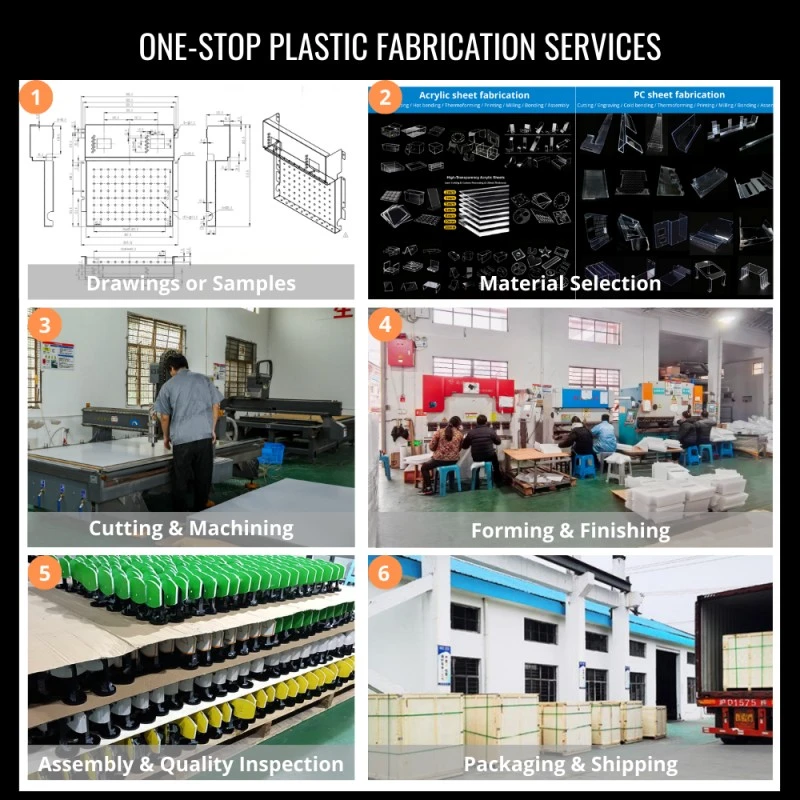
Standard full-cycle polycarbonate sheet OEM fabrication project contains seven workflow phases. Yucheng Board Industry follows this internal working procedure. You can evaluate whether your potential supplier runs standardized process.
Step 1: Requirement communication & document receiving
Client submits drawings, samples, and technical specifications to the sales engineer. Application scenario, order quantity and process requirements are collected.
Step 2: DFM manufacturability review
This is one core value of professional OEM service. The engineer evaluates fabrication feasibility against polycarbonate-sheet characteristics: bending spring-back risk, hole-edge cracking risk, thickness-process matching, material fitness for working conditions. If the drawing design contains hidden manufacturing risk, an improvement suggestion will be submitted before material cutting. Many small workshops skip DFM review and start cutting directly, leading to massive batch scrap afterwards.
Step 3: Formal quotation issuance
A detailed quotation is released after the confirmed solution, clarifying sheet grade, each-process cost, unit price, MOQ (minimum order quantity), lead time, packaging and payment terms. For turn-key OEM, raw-material specifications are clearly documented.
Step 4: Prototype sampling & sample confirmation
After quotation acceptance and sampling payment, the factory arranges polycarbonate sheet OEM sampling. Finished samples are shipped to the client. Customer verifies dimensions, appearance and assembly fitness. If revision is needed, process parameters are adjusted for second sampling until the sample is fully confirmed and locked as reference sample.
Sample locking is extremely important: the future mass-production acceptance standard will be based on the confirmed reference sample, to avoid appearance-standard disputes afterwards.
Step 5: Small-batch pilot production (recommended for large-volume projects)
For orders of thousands-piece scale, do not jump directly into full mass production. Run small pilot batch first to verify mass-processing stability. Only after pilot-batch validation is passed, full-scale mass production can launch. This step prevents huge financial loss from mass-batch defects.
Step 6: Mass-volume OEM manufacturing & in-process quality control
Raw-sheet incoming IQC inspection; in-line inspection during each fabrication procedure; finished-part full inspection including dimension measurement and visual sorting. Defective parts are segregated.
Step 7: Custom packaging, shipment & after-sales support
Products are packed per your requirement, custom label attached, arranged for domestic logistics or ocean export. The material certificate is delivered together with the goods. If product revision is needed later, the OEM team supports version updates.
General lead-time reference: sampling normally 3-7 working days; small-batch production 7-15 working days; mass-volume lead-time negotiated based on order scale. Rush-order solution can be evaluated upon request.
8. Top 8 common pitfalls in policarbonato sheet OEM fabrication and how to avoid them
Lots of clients encounter trouble in polycarbonate sheet OEM fabrication. Most issues do not result from intentional cheating, but originate from insufficient pre-project communication. Below summarizes eight frequent real-world pitfalls.
Pitfall 1: Recycled polycarbonate sheet disguised as virgin–resin sheet
Symptom: Extremely low quotation. Final parts suffer from poor toughness, easy yellowing, and unstable weather resistance.
✅ Avoidance: For turn-key OEM, write 100% virgin polycarbonate resin requirement into agreement; request COA certificate of analysis; reserve incoming material sample for reference. At Yucheng Board Industry, our default for polycarbonate sheet OEM fabrication uses virgin-resin polycarbonate sheet. Recycled sheet will only be adopted with explicit written permission from the client.
Pitfall 2: Missing tolerance specification on drawing, leading to dimension dispute
Symptom: Drawing marks dimension value without tolerance. Factory fabricates to ±0.2mm tolerance, while client requires tight ±0.1mm control. Conflicts occur at the goods-receiving phase.
✅ Avoidance: Mark tolerance on drawing; document tolerance standard inside quotation and technical agreement.
Pitfall 3: Hidden internal stress after fabrication, late-stage part cracking
Symptom: Parts look perfect right after production. Cracks and silver-stress lines appear later after screw-tightening assembly or contact with cleaning solvent. Root cause is CNC / bending induced internal stress.
✅ Avoidance: OEM factory optimizes machining parameters; annealing stress-relief treatment can be adopted for critical components. Assembly design shall reserve screw clearance, avoid over-compressing polycarbonate sheet. Yucheng Board Industry provides an optional annealing process for precision OEM polycarbonate parts.
Pitfall 4: Bending spring–back issue, actual angle deviates from design value
Symptom: Designed bending angle 90°, finished part bounces back to 93-95°.
✅ Avoidance: OEM team evaluates spring-back risk at DFM phase and applies process compensation. Thick-sheet application prefers thermal-bending process to reduce spring-back risk.
Pitfall 5: Poor adhesion for silk–screen / UV printing, ink scratches off easily
Symptom: Logo printing peels off after short-period usage. Root cause: insufficient surface degreasing pre-treatment on polycarbonate surface.
✅ Avoidance: Document surface pre-treatment requirement in OEM specification, perform ink-adhesion test.
Pitfall 6: Massive surface scratches on delivered parts due to improper protection
Polycarbonate surface is very vulnerable to scratches. Some factories process without protective film and use simple packing, resulting in scratched parts upon arrival.
✅ Avoidance: Require processing with protective film intact, keep protective film on finished parts, adopt cushion custom packaging.
Pitfall 7: Only focus on unit price while ignoring scrap–loss cost
Some vendors submit ultra-low quotations, yet generate high processing scrap rate. Finally, your real qualified-part cost becomes higher.
✅ Avoidance: Confirm a reasonable processing scrap ratio and defective-part return-replacement rule in advance.
Pitfall 8: Confidential–information leakage risk for drawings and samples
OEM clients worry their proprietary design drawings and sample leak to third parties.
✅ Avoidance: Sign an NDA non-disclosure agreement with the OEM supplier. Yucheng Board Industry accepts NDA signature and strictly protects client drawing and sample information without external disclosure.
9. How raw material choice determines OEM finished–part quality: virgin policarbonato, recycled policarbonato, functional modified polycarbonate sheet
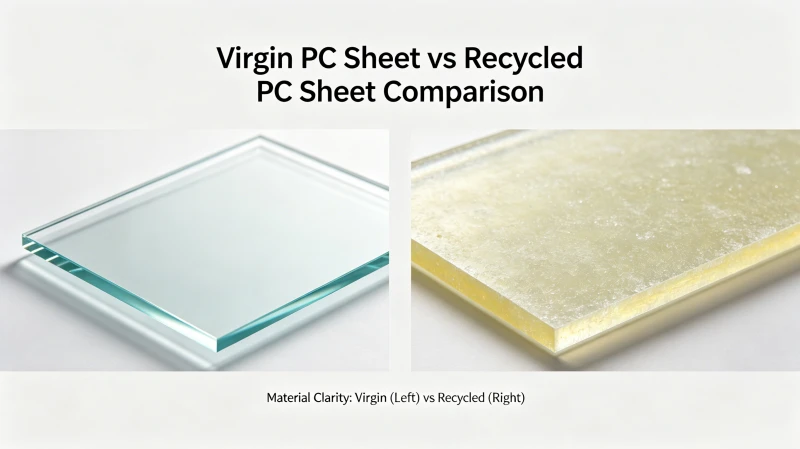
For polycarbonate sheet OEM fabrication, the raw polycarbonate substrate determines 70% of final-part performance. The fabrication process contributes only 30%. Even best-quality processing cannot rescue poor-grade raw sheet. Want to learn how to Tell Virgin Polycarbonate Sheet Apart from Recycled Polycarbonate Sheet? Click the link: https://yoochenplastic.com/knowledge-news/distinguish-virgin-polycarbonate-sheet-and-recycled-polycarbonate-sheet/
- Virgin-resin polycarbonate sheet. Extruded from brand-new polycarbonate pellets. Excellent toughness, high impact resistance, stable optical clarity, reliable weather-aging performance. Flame-retardant, UV-stabilized, anti-static modification can be realized. Most industrial equipment, new-energy and medical-device OEM projects should select virgin-resin polycarbonate sheet. Unit cost is higher than recycled sheet, yet delivers long-term stable field performance.
- Recycled polycarbonate sheet. Produced from re-ground plastic scrap. Cost advantage. Disadvantages: batch-to-batch performance fluctuation, degraded toughness, easy yellowing, impurity speckle, unstable flame-retardant and weather-resistance performance. Not recommended for outdoor applications, safety-critical protective components, or medical-device OEM parts. Only acceptable for non-critical internal components with the client’s written approval.
- Functionally modified polycarbonate sheet (high demand for OEM projects)
- UL94 V-0 flame-retardant chapa de policarbonato: For charging piles and electrical-safety-related equipment.
- UV-stabilized outdoor-grade chapa de policarbonato: For outdoor installation, resists ultraviolet radiation and slows down yellowing.
- Anti-static chapa de policarbonato: For electronic equipment applications to dissipate static charge.
- Hard-coated scratch-resistant chapa de policarbonato: For observation-window panels to improve surface wear resistance.
Common client mistake: Only tell the supplier “need polycarbonate sheet”, without specifying functional requirements. OEM factory uses general-purpose polycarbonate sheet by default. Client receives finished parts and later discovers it is non-flame-retardant or non-UV-stabilized.
During Indústria de Painéis de Yucheng polycarbonate sheet OEM fabrication turn-key order, our engineer will double-check working conditions with you and recommend the proper substrate grade to prevent material-selection mistakes.
10. Tolerance, surface finish, packaging & lead–time: key terms to write into OEM technical agreement
Many cooperation disputes originate from verbal commitments without written record. For polycarbonate sheet OEM fabrication, write the following items into the quotation sheet or technical agreement.
- Dimensional-tolerance standard: General cutting tolerance ±0.15mm; precision CNC machining ±0.05-0.1mm; bending angular tolerance. Mark which dimensions are critical controlled dimensions.
- Visual-acceptance criteria: Max allowed scratch length; bubble & speckle acceptance threshold; edge chipping rule; printing appearance standard. Polycarbonate plastic sheet cannot achieve absolute zero defects. Agree on an acceptable visual standard in advance to avoid receiving-inspection conflict.
- Raw-material clause: Virgin / recycled resin requirement; flame-retardant rating; UV-stabilization requirement; sheet thickness; color; whether COA certificate is required.
- Scrap handling & defective-part policy: Define defective-part judgment rule and return-replacement process.
- Lead-time definition: Lead-time starts counting from sample confirmation and advance-payment receipt, not from the date you send the drawing. Distinguish sampling lead-time and mass-production lead-time, specify rush-order additional conditions.
- Packaging requirement: Keep protective film intact; EPE foam separator; export-grade carton; label content; anti-scratch transit protection.
- NDA non-disclosure clause: Drawing and sample confidentiality commitment.
11. Yucheng Board Industry one–parar policarbonato sheet OEM fabrication service introduction
Yucheng Board Industry, located in Suzhou, has more than ten years of experience in the polycarbonate sheet industry. We provide complete one-stop polycarbonate sheet OEM fabrication service for global industrial customers. We are not a simple cutting workshop; we deliver full-link OEM solution covering material selection, DFM review, sampling, multi-process deep processing, quality inspection, custom packaging, and shipment. Our clients are spread across the new-energy equipment, automation machinery, medical device, rail transportation, and safety protection sectors. We support both domestic China orders and overseas export orders.
O nosso polycarbonate sheet OEM fabrication accepts both full-turnkey, material-included mode and customer-supplied-material mode.
Core strengths of Yucheng Board Industry OEM service
- Complete in-house processing equipment covering full-range procedures. Our workshop is equipped with NC cutting machines, laser cutters, multiple CNC routing centers, thermal-bending ovens, cold-bending presses, UV & silk-screen printing stations, and polishing machines. We independently finish cutting, CNC milling, hole-drilling, thermal and curvatura a frio, thermoforming, printing and bonding assembly without heavy external subcontracting. This minimizes quality loss and lead-time delays caused by multi-party outsourcing.
- Deep polycarbonate-material expertise to help you avoid material-selection pitfalls. We master the performance characteristics of general-purpose polycarbonate, UL94-V0 flame-retardant polycarbonate, outdoor UV-stabilized polycarbonate, anti-static polycarbonate and hard-coated polycarbonate sheet. In the early phase of polycarbonate sheet OEM fabrication project, our engineer will conduct DFM manufacturability assessment. If the drawing design or material selection contains potential risks, optimization suggestions will be provided proactively to reduce cracking, spring-back and aging-related field-failure risk.
- Support sampling, low-volume pilot and large-volume mass production seamlessly. Many factories only accept large-volume orders and refuse sampling; or they use different process settings for sampling vs. mass production. Yucheng Board Industry polycarbonate sheet OEM fabrication supports small-quantity prototype sampling, hundreds-piece pilot runs, and tens-of-thousands-piece mass-volume orders. The same equipment and process parameters are adopted for sampling and mass production to guarantee consistent quality.
- Strict internal quality-control workflow: raw-material incoming IQC inspection; in-process production patrol inspection; finished-part full visual sorting + key-dimension measurement. For turnkey OEM orders, a COA certificate of analysis can be provided for export, medical and new-energy customer audits. Annealing stress-relief service is available for high-requirement polycarbonate components to reduce stress-cracking risk.
- Confidentiality & customized delivery solution: An NDA non-disclosure agreement is available to protect your drawing and proprietary product design. Custom label and export-grade packaging can be arranged. Finished goods can be delivered directly to your downstream assembly factory or arranged for ocean export shipment.
- Complete after-sales technical support: After polycarbonate sheet OEM fabrication parts are delivered, our engineering team offers technical support if you encounter assembly or application-related difficulties, and provides improvement suggestions for field-service issues.
Additional note: Besides polycarbonate (PC) sheet OEM fabrication, Yucheng Board Industry also supports PETG and acrylic sheet complementary processing. If your project contains multiple plastic-material components, we can deliver one-stop multi-material fabrication to reduce your supplier-management burden.
12. How to work with Yucheng Board Industry for sampling, small–batch & mass–volume OEM orders
✅ Prototype sampling stage (few pieces to dozens of pieces): Send your engineering drawing, sample photo and technical requirements to our team. Our engineer completes a DFM assessment and releases a sampling quotation. After sampling payment is received, sampling production is scheduled. Finished prototypes are shipped to you for confirmation and reference-sample locking. Normal sampling lead time: 3-7 working days.
✅ Small-batch pilot order (dozens to hundreds of pieces): After sample confirmation, place formal order. We run small-batch pilot production first to validate mass-process stability before full-scale manufacturing. Perfect for new-product trial-validation phase.
✅ Large-volume mass-production order (thousand-piece and above): After pilot-batch validation passes, we launch large-scale polycarbonate sheet OEM fabrication. Volume-based tiered pricing and monthly production scheduling can be negotiated. For overseas clients, we are familiar with export packaging and document coordination.
Practical tip: Submit CAD / PDF engineering drawings rather than only photos; it greatly speeds up quotation progress. If drawings are unavailable, you can send physical sample to our facility.
13. Real–world case studies of policarbonato sheet OEM fabrication across different industries
Case 1: Automation–equipment manufacturer | policarbonato protective–window OEM fabrication
Client: Local Suzhou automation-equipment enterprise. Requirement: transparent polycarbonate machine safety guard, CNC hole pattern, U-shape thermal bending, UV-printed equipment scale mark. Requirement: UL94-V0 virgin flame-retardant polycarbonate sheet, full turnkey OEM fabrication. Yucheng Board Industry solution: DFM assessment for bending spring-back with thermal-bending process compensation. Source UL94-V0 virgin flame-retardant polycarbonate sheet. Complete cutting, CNC routing, thermal bending, UV printing and full-part inspection. Finished parts are delivered ready-for-assembly. Customer avoids investing in sheet-stock workshop and bending-printing equipment, and fully focuses on core equipment R&D.
Case 2: Overseas new–energy charging–pile brand | Outdoor policarbonato panel OEM fabrication
Client: Overseas charging-pile brand. Requirement: outdoor polycarbonate front panel for charging station, UV-weather-resistant performance, hole-drilling, silk-screen logo printing, export-oriented order. Yucheng Board Industry polycarbonate sheet OEM fabrication: Adopt outdoor UV-stabilized virgin polycarbonate sheet. Complete full-set fabrication, custom anti-crash export-packaging, provide COA material certificate. Goods shipped by sea. Outdoor long-term anti-yellowing performance is guaranteed.
Case 3: Medical–device supporting enterprise | policarbonato partition–plate component OEM
Client: Medical-equipment component supplier. Requirement: polycarbonate partition plate, precision CNC grooving, burr-free, high optical transparency, multi-batch small-volume order. Yucheng Board Industry OEM solution: Optimize CNC machining parameters to minimize internal stress. Strict visual sorting for finished parts. Deliver goods by multiple partial shipments according to client demand.
From the above real-world cases, you can see the core value of polycarbonate sheet OEM fabrication: delegate all sheet-stock-related manufacturing work to a specialized factory, so your team concentrates on your core product R&D and business growth.
14. Frequently Asked Questions for policarbonato sheet OEM fabrication
Q1: What is polycarbonate sheet OEM fabrication? What is the difference vs buying standard raw polycarbonate sheet?
A: Standard raw polycarbonate sheet is flat, unprocessed board stock. Polycarbonate sheet OEM fabrication takes flat raw polycarbonate sheet and performs cutting, bending, printing and other deep-processing steps to produce custom ready-to-assemble finished components.
Q2: What is MOQ (minimum order quantity) for polycarbonate sheet OEM fabrication?
A: Yucheng Board Industry has no rigid high-MOQ barrier. Small-quantity sampling is supported. Unit price reduces for higher-volume mass production.
Q3: Can you handle export–oriented policarbonato sheet OEM fabrication orders?
A: Yes. We serve large-quantity overseas clients for polycarbonate sheet OEM fabrication. Export-grade packaging and material certificate documents can be provided.
Q4: For customer–supplied–material OEM, who takes responsibility for processing scrap loss?
A: For customer-supplied-material mode: raw-sheet inherent quality problems belong to the client. Scrap induced by manufacturing-process defects belongs to Yucheng Board Industry. A reasonable processing scrap ratio will be agreed in advance. For full-turn-key OEM, raw-material risk is undertaken by our factory.
Q5: Can you keep my drawing confidential for policarbonato sheet OEM project?
A: Yes, an NDA non-disclosure agreement can be signed. Client drawings and physical samples will be strictly protected and never leaked to third parties.
Q6: Policarbonato sheet parts crack after OEM fabrication, how to solve?
A: Cracking is mostly caused by machining-induced internal stress, over-tight assembly screw compression or chemical-solvent contact. Our DFM review will remind you of these risks. The annealing stress-relief process is optional for critical components.
15. Final checklist: how to select a reliable policarbonato sheet OEM fabrication supplier
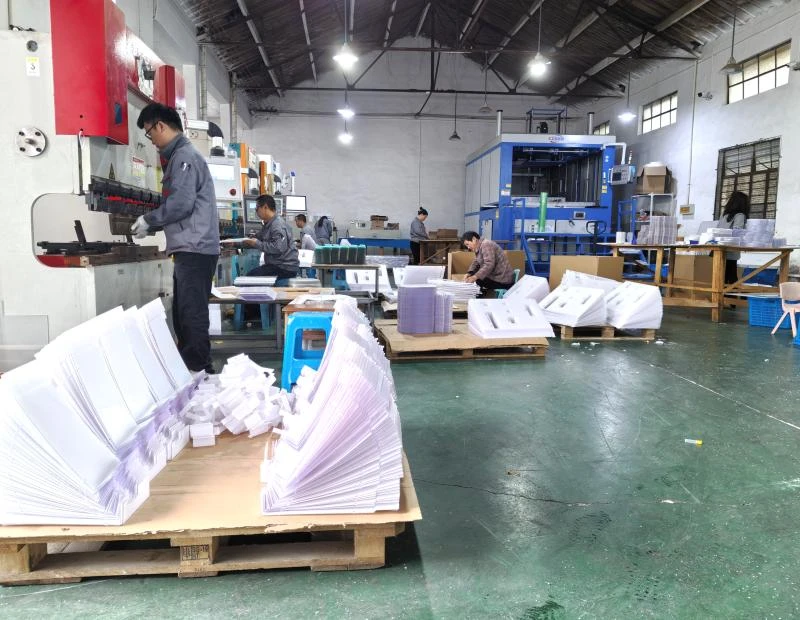
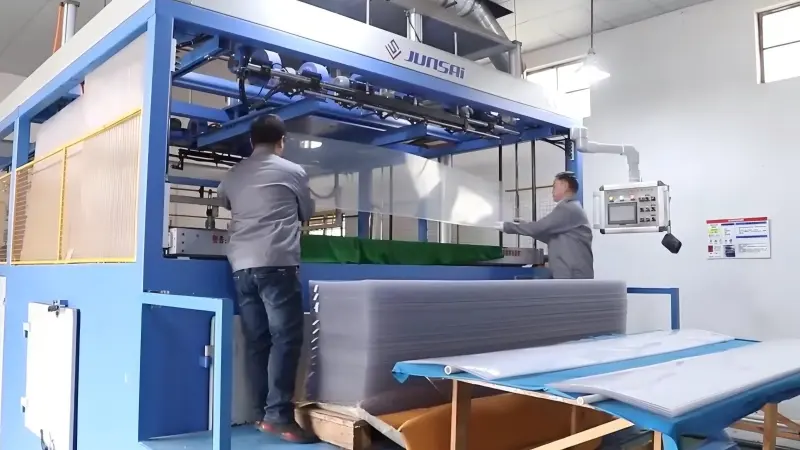
When you search for polycarbonate sheet OEM fabrication partner, do not only compare unit price. Evaluate suppliers from multiple dimensions below:
- Whether they own complete in-house processing equipment; avoid vendors who outsource almost all procedures externally.
- Whether they master polycarbonate material knowledge and perform DFM manufacturability review before cutting material, instead of directly cutting sheet after receiving drawing.
- Whether raw-material specifications can be written in a written agreement, and COA material certificate can be provided, distinguishing virgin-resin and recycled-resin sheet.
- Complete quality-control workflow: incoming-material inspection, in-process patrol inspection and finished-part outgoing inspection.
- Whether an NDA non-disclosure agreement is acceptable.
- Whether the sampling-phase process parameters are consistent with mass-production settings.
Ultra-low-cost polycarbonate sheet OEM fabrication may hide the risk of poor-grade raw materials and insufficient process control. Mass-batch scrap loss will bring higher total cost in return. Choosing a reliable OEM partner means selecting stable and controllable supply chain.
If you are searching for a trustworthy one-stop polycarbonate sheet OEM fabrication service provider, please contact Yucheng Board Industry. Send us your drawings and requirements. Our engineering team will quickly complete a manufacturability assessment and detailed quotation, helping you turn your design drawing into qualified finished polycarbonate components.