






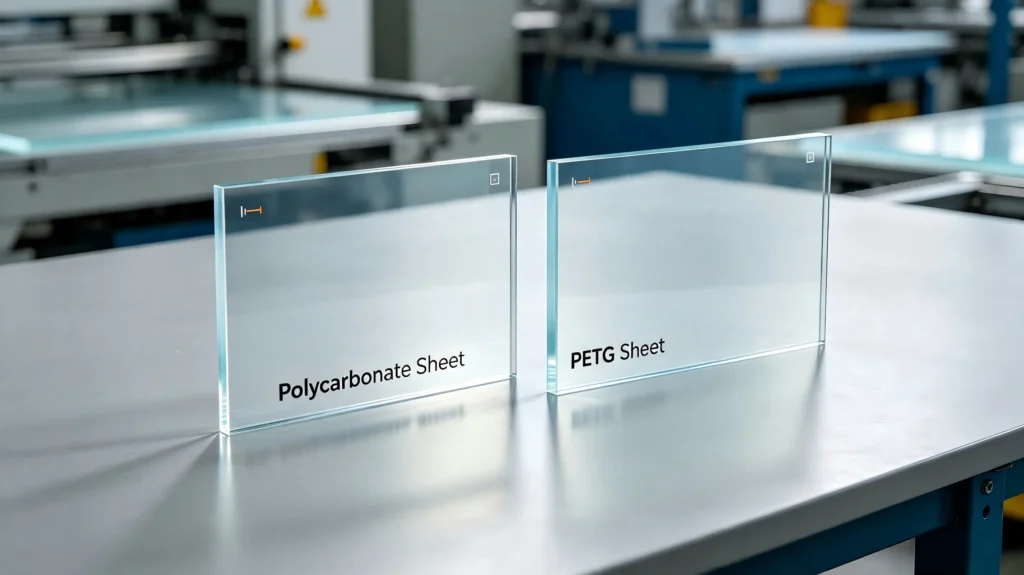
In modern manufacturing, polycarbonate sheet vs PETG sheet rank among the most widely used transparent thermoplastic sheets worldwide. You will find these two materials in machine safety guards, medical-device housings, new-energy protective covers, rail-transit interior components, light-box signs, retail display racks and instrument viewing windows.
Many procurement engineers, product designers and project managers run into a frustrating real-world problem. Polycarbonate sheet and PETG sheet look extremely similar visually. Both deliver high transparency, and it is hard to distinguish them by the naked eye. Quite a few people naturally assume they can replace each other freely. In real-world mass-production and export-order projects, wrong-material selection causes heavy losses: unexpected cracking after fabrication, thermal warpage, fine cracks after cleaning, rapid yellowing and haze under outdoor sunlight, low thermoforming yield, finished-part failure after assembly, resulting in huge material waste and delayed lead time.
Based in Suzhou, Yucheng Board Industry is an original-source manufacturer specialized in extrusion production and full-range precision secondary processing for polycarbonate sheet and PETG sheet. Over the years of serving global clients, we have witnessed countless real-world project failures caused by improper selection between polycarbonate sheet and PETG sheet. Some customers applied PETG sheet on protective covers close to heat-generating components. The parts warped within weeks after on-site installation. Some manufacturers adopted standard polycarbonate sheet for medical panels. Fine network-shaped stress cracks appeared after alcohol disinfection, forcing full-batch rework. Other buyers ignored raw-material quality and purchased recycled-content sheets, which yellowed rapidly for outdoor projects within several months.
Instead of filling this article with obscure lab-only datasheet figures, we write this guide from factory-floor and project-delivery perspective. We thoroughly break down polycarbonate sheet vs PETG sheet, covering raw-material origin, optical performance, impact toughness, high-low-temperature resistance, chemical tolerance, detailed performance in every secondary-processing procedure, flame retardancy & regulatory compliance, new-virgin vs recycled material traps, market-level cost analysis, real-world failure cases, industry-specific application scenarios, multi-dimension comparison table, supplier-selection tips and our full-scope service introduction. This article helps you pick the proper transparent plastic sheet in the early project phase and avoid manufacturing-stage risks. Whether you need raw plastic sheets or finished machined components processed via CNC cutting, grooving, vacuum thermoforming, hot bending, UV printing and screen printing, you can tell clearly whether polycarbonate sheet or PETG sheet fits your requirements after reading.
1. Raw–material basics: What exactly are polycarbonate sheet and PETG sheet?
Before diving into performance comparison, it is critical to understand that these two sheets derive from totally different plastic families. This is the root cause of most performance gaps.
Polycarbonate (PC) Sheet (commonly named PC impact-resistant sheet)
Polycarbonate sheet belongs to high-performance engineering thermoplastics with carbonate groups in molecular chains. It is amorphous non-crystalline thermoplastic material. Main commercial variants include solid clear polycarbonate sheet, multi-wall polycarbonate sheet, UL94 V-0 flame-retardant polycarbonate sheet, single-/double-sided UV-stabilized outdoor-grade polycarbonate sheet, hard-coating scratch-resistant PC sheet, matte diffuser polycarbonate sheet. Simply speaking, polycarbonate sheet is engineered for extreme toughness, high-impact resistance and elevated-temperature tolerance. Bullet-proof glazing interlayers, safety face shields and machine safety guards are typical downstream applications of modified polycarbonate sheet.
PETG Sheet (glycol-modified PET copolyester sheet)
PETG sheet is chemically modified from PET — the raw plastic for mineral-water bottles. By adding CHDM comonomer, it suppresses crystallization-caused whitening and haze in regular PET, achieving high optical clarity. It is also an amorphous thermoplastic. Popular commercial grades: clear PETG sheet, matte PETG sheet, diffuser PETG sheet, food-contact & medical-grade PETG sheet. In short, PETG sheet features easy fabrication, good alcohol & disinfectant resistance and BPA-free safety profile. It acts as high-performance general-purpose copolyester sheet.
Core takeaway: Although both polycarbonate sheet and PETG sheet are transparent thermoplastics, they belong to different polymer systems. Do not treat them as interchangeable substitutes.
✅ At YUCHENG, we produce polycarbonate sheet with 100% virgin polymer pellets instead of recycled mixed feedstock. Thickness ranges from 1 mm to 20 mm. Custom surface finishes including matte, diffuser, UV-stabilized and hard-coating are available. We support small sample trial orders and large-volume export shipments.
2. Light transmission, base tint and surface texture: How to roughly tell polycarbonate sheet and PETG sheet apart by visual inspection
Light-transmission figures are very close: polycarbonate sheet 88-90% transmittance; PETG sheet 89-90% transmittance. Human eyes hardly distinguish them purely from brightness. However, obvious differences exist in base tint, surface property and weathering performance. Many buyers cannot identify incoming material as polycarbonate sheet or PETG sheet upon delivery, and you may refer to practical observations below.
- Base tint difference
- Virgin new-feedstock polycarbonate sheet carries faint blue or light-amber base tint. This tint becomes more visible as sheet thickness increases. It has limitations for ultra-water-clear visual effect.PETG sheet delivers purer water-clear appearance, with much less inherent tint for equal thickness.
- Surface hardness & scratch susceptibility
- Virgin uncoated polycarbonate sheet suffers low surface hardness, which is its well-known weakness. Sharp objects easily leave permanent scratches. If scratch-resistance is mandatory for your project, extra hard-coating (hard-coat) treatment must be applied. Without hard-coating, scratches may appear during handling and assembly and ruin visual appearance.PETG sheet is also relatively soft and vulnerable to sharp-object scratching. Compared with uncoated polycarbonate sheet, PETG surface is less prone to cleaner-induced whitening. Still, PETG cannot be categorized as high-wear-resistant plastic.
- Yellowing & aging under natural environment
- Ordinary polycarbonate sheet without UV-protective layer will gradually turn yellow, haze and become brittle under long-term direct sunlight, as ultraviolet rays damage polymer molecular chains. For long-term outdoor deployment, you have to select outdoor-grade polycarbonate sheet with double-sided UV-stabilized protective layer. Standard unmodified PETG sheet shows even poorer UV resistance than regular polycarbonate sheet. Without special modification, PETG sheet is not suitable for permanent outdoor exposure. Gloss loss, yellowing and mechanical-property degradation may happen within several months to one-and-a-half years outdoors.
Note: Yellowing phenomenon cannot be used as single criterion to judge sheet material. Both materials require special modified formulation to boost weathering performance.
3. Impact mechanical toughness: The biggest performance gap between polycarbonate sheet and PETG sheet
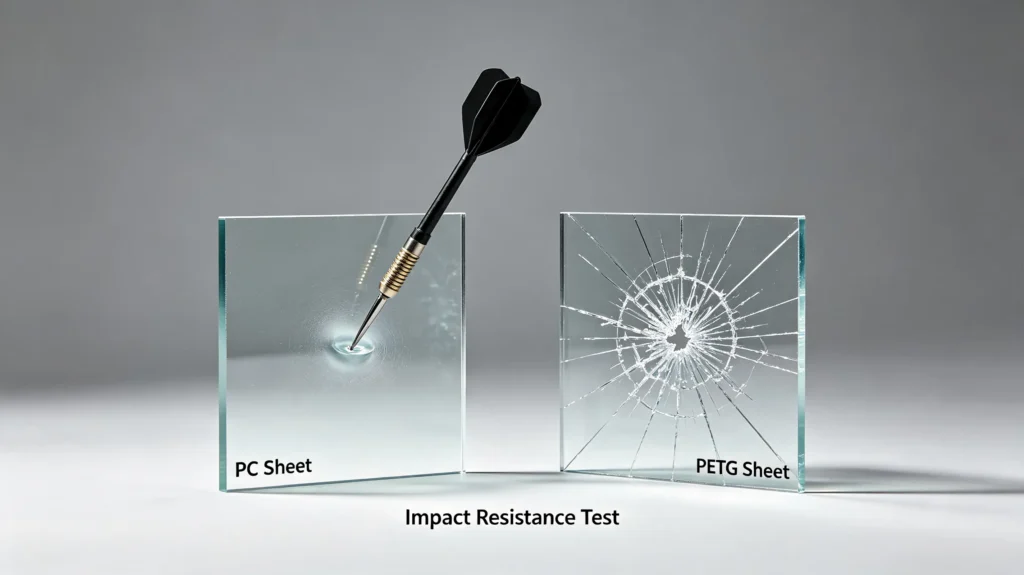
Impact–resistance represents polycarbonate sheet’s dominant advantage over PETG sheet. The gap is not doubled or tripled; it differs by order–of–magnitude level. Many safety-critical projects explicitly specify polycarbonate sheet, precisely for this property.
Polycarbonate sheet sits in the top tier among mass-produced commercial transparent plastic sheets. It earns the nickname “bullet-proof plastic”. Under heavy impact of equal-thickness specimens, polycarbonate sheet mostly deforms with indentation instead of shattering, splintering or fragmenting. Machine safety guards, high-speed-train luggage-rack panels and safety viewing windows adopt polycarbonate sheet for this safety feature. Even at -40℃ low temperature, polycarbonate sheet retains decent impact resistance and does not turn brittle easily.
PETG sheet delivers acceptable toughness, significantly tougher than acrylic (PMMA). Minor daily knocks rarely break PETG. Nevertheless, under violent heavy-weight impact, PETG sheet will rupture and crack. It cannot meet safety-guard performance requirements. In cold environments, PETG loses part of its flexibility; cracking risk rises under impact at low temperature.
📌 Practical selection rule-of-thumb:
If your product faces impact risk, flying-debris strike or requires safety-protection function, prioritize polycarbonate sheet. If deployed indoors with only mild-knock scenarios without high-intensity impact, PETG sheet provides sufficient toughness.
Real-world pitfall case: One equipment manufacturer replaced polycarbonate sheet with PETG sheet for safety guards to cut material cost. Samples behaved fine indoors. When component failure occurred inside equipment, flying debris shattered the PETG guard completely, creating severe safety hazard.
4. Temperature resistance: Thermal–deformation risk & low–temperature stability
Temperature-related failure accounts for a large share of real-world project scrap. Many buyers only test samples under room temperature, ignoring the actual operating temperature of equipment or enclosed-space solar-heating temperature, leading to mass-batch warped rejected parts.
Polycarbonate sheet continuous service temperature range: -40℃ ~ +120℃. Short-term peak temperature can go higher. Near heat-generating electrical components, inside hot enclosed cabinets and sun-trapped confined compartments, polycarbonate sheet resists softening and warpage. It maintains stable performance under repeated high-low-temperature thermal cycles even at sub-zero degrees.
For PETG sheet, the recommended safe continuous-service temperature stays within 60-70℃. When sheet temperature keeps exceeding 70℃, polymer chains soften, resulting in permanent softening and warping. Deformed PETG parts cannot recover flat geometry after cooling down.
Real-life example: Closed vehicle cabins or sealed equipment boxes easily go above 70℃ under summer sunlight. PETG sheet components will suffer irreversible warpage, while polycarbonate sheet keeps stable. For cold-climate scenarios: As ambient temperature keeps dropping, PETG sheet becomes stiffer and more brittle, and impact performance degrades. PETG is not recommended for load-bearing safety components outdoors in frigid regions.
⚠️ Frequent-pitfall reminder: Even indoors, local heat from motors and power modules may push nearby-sheet temperature quietly over 70℃ without an obvious hot-to-touch feeling. PETG sheet will slowly warp. Many engineers fail to trace the root cause because they overlook local heat-source temperature.
5. Chemical resistance to disinfectants, alcohol and solvent adhesives: Environmental stress–cracking risk
This section covers PETG sheet’s core strength versus standard polycarbonate sheet, and also a major source of mass-batch factory rework. We need to clarify the environmental stress-cracking (ESC) concept.
What is environmental stress-cracking: Invisible residual internal stress builds inside sheets during secondary processing. When contacting alcohol, certain cleaning agents or solvent-based adhesives, residual stress releases and generates dense fine micro-cracks spreading across the sheet surface, eventually causing complete fracture. Very often, cracks do not show immediately after processing; they appear days later after assembly or surface disinfection, leading to large-scale after-sales problems.
Chemical weakness of polycarbonate sheet:
Standard polycarbonate sheet has poor resistance against high-concentration alcohol, many commercial cleaners and certain fast-dry solvent adhesives. Wiping polycarbonate sheet repeatedly with alcohol or applying mismatched solvent-based glue easily triggers environmental stress-cracking. To mitigate polycarbonate ESC risk: ① Use slow-cure adhesive specially formulated for polycarbonate; ② Apply annealing post-processing to release internal residual stress after fabrication; ③ Avoid long-time direct contact with high-strength alcohol. Even with these precautions, standard polycarbonate remains sub-optimal for frequent alcohol-disinfection scenarios.
Chemical-resistance advantage of PETG sheet:
PETG sheet performs well against alcohol, routine disinfectants and many daily-use chemical cleaners. For medical-device panels requiring repeated alcohol wiping and sanitization, numerous manufacturers select PETG sheet exactly for this merit. Wider adhesive options are available for PETG bonding, with low solvent-cracking risk under normal operating conditions.
Note: Neither polycarbonate sheet nor PETG sheet resists strong acid, strong alkali or aggressive ketone solvents. Both materials shall avoid such chemical exposure.
Real-customer case: One medical-equipment manufacturer fabricated instrument housing panels out of standard polycarbonate sheet via CNC machining and shipped assembled products directly. End-users performed routine alcohol disinfection. Within one week after delivery, dense mesh-like micro-cracks spread across panels. Thousands of finished units had to be returned for full rework. After switching to PETG sheet, identical disinfection procedure caused zero cracking.
6. Detailed secondary–processing comparison: Cutting, CNC grooving, thermoforming, hot bending, bonding, drilling, UV & screen printing
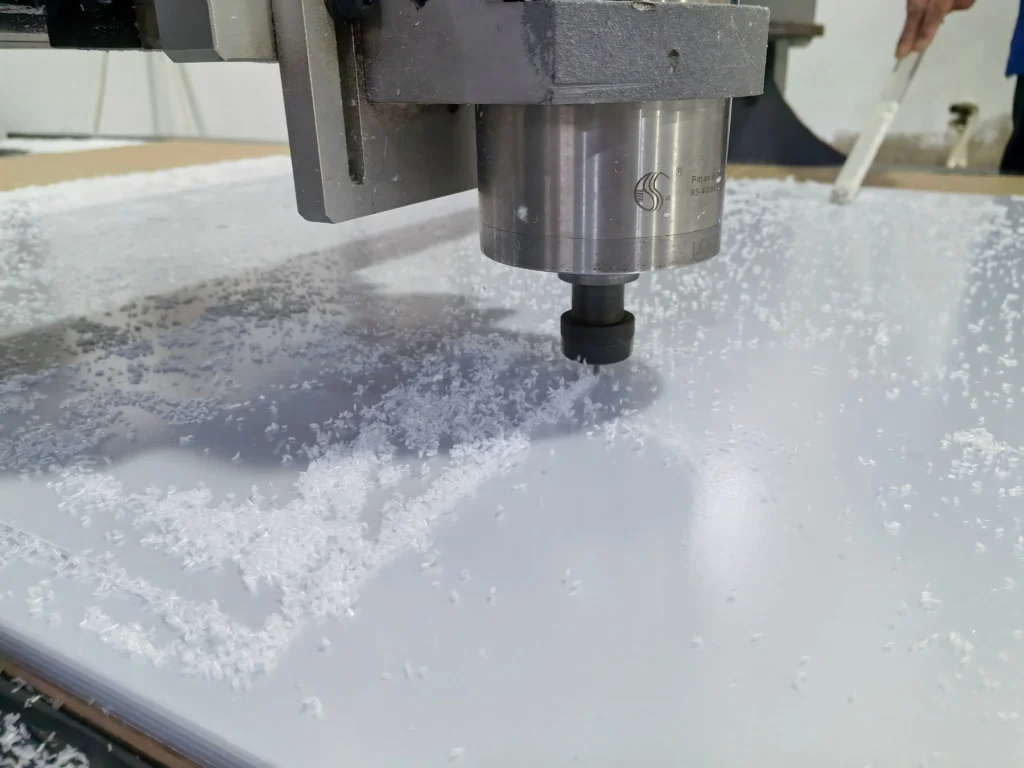
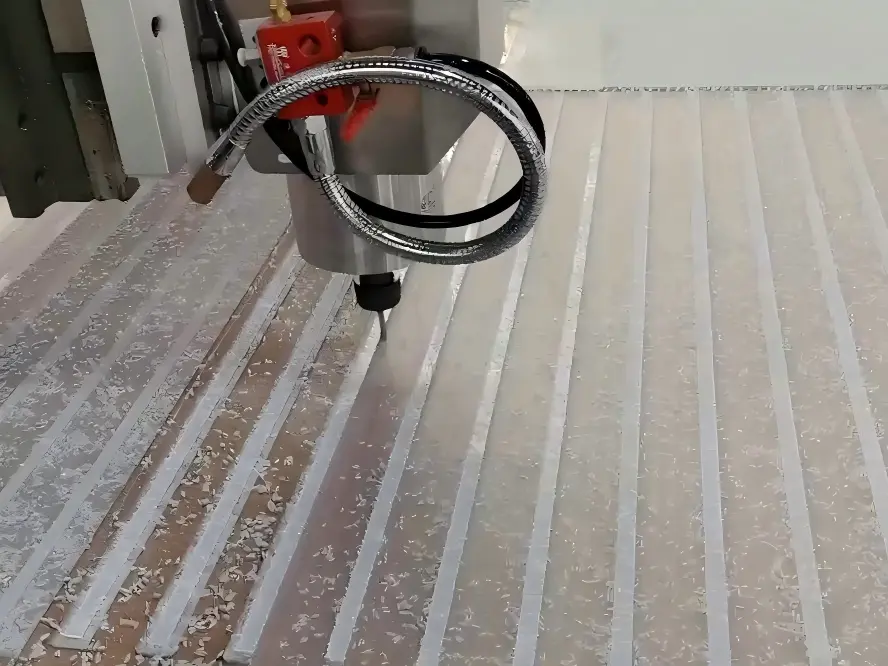
After receiving raw sheets, most buyers conduct further fabrication. The difference in processing window directly determines production yield, energy consumption, machining cost and final-part quality. Both polycarbonate sheet and PETG sheet support CNC work, drilling and thermal forming, yet critical details differ in every manufacturing procedure. We break them down following real-factory workflow.
1. Cutting: Laser cutting vs CNC routing
PETG sheet laser-cutting performance: Laser cutting delivers acceptable edge quality without severe black-yellow burning, yet high-power laser may leave minor burrs. Thick-gauge PETG prefers CNC processing. Polycarbonate sheet laser-cutting performance: Polycarbonate sheet is not recommended for priority laser cutting. High heat from the laser causes yellowing, black charring and melted edge that demands extra polishing. Industrial mass production mostly uses CNC cutting for PC sheet for clean edges.
2. CNC machining, grooving and drilling
PETG sheet CNC grooving: Easy-to-machine, low tool-wear rate. Drilling rarely induces edge chipping. Spindle speed must be controlled to avoid frictional heat melting and material sticking on cutting tools.
Polycarbonate sheet CNC grooving: polycarbonate sheet exhibits outstanding cold-bending capability. It can be cold-bent along grooved lines without fracture. This grooving-cold-bend process is widely adopted for rail-transit luggage-rack panels. Sharp cutting tools and controlled cutting temperature reduce newly introduced internal stress during grooving & drilling. High-spec polycarbonate components require annealing treatment after machining to prevent later-stage stress-cracking.
👉 YUCHENG runs full-set CNC production lines. We deliver high-precision CNC cutting, grooving, counter-sink drilling and chamfering for both polycarbonate sheet and PETG sheet. Tool parameters are tuned for different polymer materials to minimize machining-induced residual stress and lower cracking risk.
3. Vacuum thermoforming & hot bending
PETG sheet thermoforming advantage: Lower forming temperature reduces energy cost. PETG sheet does not demand strict pre-drying before thermal processing, saving process time and energy consumption. It achieves high yield rate for complex-curved, deep-draw Irregular‑shaped parts. Thin-gauge PETG can be hot-bent without sophisticated molds, with low processing threshold.
Polycarbonate sheet thermoforming: polycarbonate sheet is hygroscopic. Pre-drying is mandatory before thermoforming. Otherwise, trapped moisture vaporizes under heat and creates bubble defects on finished surfaces. Polycarbonate requires higher forming temperatures, consuming more energy. Mold design for deep-draw polycarbonate parts poses higher technical requirements. After thermal forming, appearance-critical and high-reliability polycarbonate workpieces need annealing treatment to release internal stress, avoiding later solvent-triggered cracking.
Common factory pitfall: Operators feed moisture-absorbed polycarbonate sheet directly into thermoformer, resulting in widespread bubble scrap across whole batches.
4. Adhesive bonding
PETG sheet bonding: Compatible with solvent cement and various structural adhesives. Wide adhesive-selection range and low stress-cracking probability.
Polycarbonate sheet bonding: Generic fast-dry solvent glue must be avoided. Only polycarbonate-matched special adhesive can be deployed. Wrong glue choice generates radial cracks surrounding bonding seams quickly.
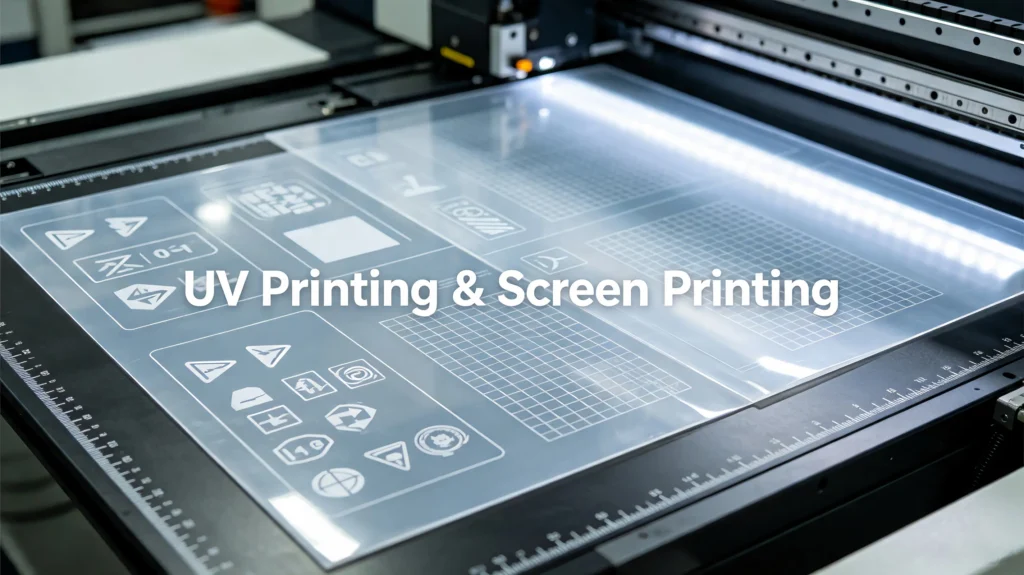
5. UV printing & screen printing
PETG sheet printing: Good ink adhesion without complicated pre-surface-treatment. Stable final print effect for both UV-printing and screen-printing.
Polycarbonate sheet printing: Untreated polycarbonate surface shows chemical inertness. Direct UV-printing risks poor ink adhesion and ink peeling. Flame-treatment or corona-treatment surface activation is required before printing. Outdoor-deployed polycarbonate parts need weather-resistant special ink.
📌 YUCHENG provides UV-printing and screen-printing service for polycarbonate sheet. We can print logos, warning texts and scale patterns, applying indoor-grade or outdoor weather-resistant ink for export-order requirements.
7. Flame retardancy, environmental compliance, food-contact & medical-grade requirements, BPA note
In new-energy, electrical equipment, medical-device and food-display industries, flame performance and regulatory compliance are non-negotiable selection factors. Many buyers directly purchase general-purpose sheets without checking grade specification, making finished products fail certification.
Polycarbonate sheet: Standard-grade polycarbonate sheet achieves UL94 V-2 flame rating. Formulation-modified flame-retardant grade reaches UL94 V-0, widely used for new-energy battery-protection partitions and electrical-equipment enclosures to meet fire-safety standards. Important BPA reminder: Regular unmodified polycarbonate contains BPA. According to regional regulations, it shall not be used for long-term direct drinking-water or food contact. Medical-application polycarbonate must adopt specially-modified medical-grade formulation; general transparent polycarbonate sheet cannot substitute for medical-spec sheet.
PETG sheet: Standard-grade PETG sheet can be BPA-free and easily obtain RoHS and FDA food-contact compliance certificates. It is widely selected for food-display panels and general-purpose medical-instrument housings. However, ordinary PETG only reaches HB flammability rating. If V-0 flame retardancy is required, special modification is necessary with noticeable material-cost increase.
Important reminder: Compliance certificates are tied to specific material grades. Neither polycarbonate sheet nor PETG sheet automatically satisfies medical or food-contact standards. We can provide batch-specific RoHS, REACH and UL material-certificate documents for customers’ export-product certification.
8. Distinguish virgin–pellet sheet vs recycled–content sheet: Procurement–phase hidden trap
Many buyers compare quotations only by thickness and material name (PC sheet or PETG sheet), ignoring whether raw feedstock is 100% virgin polymer or recycled mixed regrind. A huge price gap exists, together with dramatic performance differences in finished sheets.
- Virgin-pellet polycarbonate sheet: Stable optical clarity, low impurity content, high toughness, long anti-yellowing lifespan for UV-stabilized grades, consistent performance and full-set certification documents available. Recycled-content polycarbonate sheet: Mixed with post-consumer plastic regrind. It may look transparent visually but contains micro-impurities inside. Impact strength drops sharply; sheets crack easily upon strike even with the same thickness. Outdoor-exposed recycled polycarbonate yellows and hazes within months. Environmental-stress-cracking risk multiplies. Many ultra-low-price PC sheets on the market use recycled mixed feedstock.
- Virgin-pellet PETG sheet: Pure water-clear tint, low probability of pitting and fogging after thermoforming, stable chemical-disinfection resistance. Recycled-content PETG sheet: Grayish-hazy appearance. Thermoforming frequently brings pits and bubbles. Toughness degrades. Surface whitening occurs under disinfection cleaning. Recycled PETG must never be adopted for medical or food-contact projects.
At YUCHENG, polycarbonate sheets are extruded from brand-new virgin polymer pellets with zero recycled mixing. We have seen many customers chasing the lowest unit price and purchasing recycled-content sheets, only discovering performance non-conformity after mass fabrication. Scrap and rework loss far outweighs original material-cost saving.
9. Raw–material–cost analysis: Do not only check per–kg price; calculate total comprehensive fabrication cost
With equal thickness and 100% virgin feedstock: PETG sheet raw-material price is lower than polycarbonate sheet. Nevertheless, material selection should never solely rely on raw-sheet unit-price. You have to factor in secondary-processing yield, scrap-rate, after-sales-maintenance cost and service life of final product for full-picture total-cost evaluation.
Two real-world scenarios: Scenario-one: Indoor ambient-temperature application without heavy impact risk, requiring frequent alcohol disinfection and large-batch complex-shape vacuum-formed parts. PETG sheet delivers lower raw-material cost, lower thermoforming-energy consumption and high yield rate for optimal total cost. Scenario two: High-temperature working conditions with impact-risk safety guards. Even though polycarbonate sheet costs more for raw stock, PETG will warp and fracture under such conditions. Deploying PETG will trigger safety-hazard-related after-sales compensation, whose overall loss far exceeds the sheet-price difference.
In daily business, many customers only compare per-kilogram quotation and overlook application-condition matching. Minor short-term saving causes heavy loss afterwards.
10. Industry–specific application guide: Where to choose polycarbonate sheet, where to choose PETG sheet
✅ Prefer polycarbonate sheet for below applications
- Industrial machine safety guards & viewing protective shields against flying-work-piece impact;
- Rail-transit industry: high-speed-train & EMU luggage-rack panels, carriage interior transparent components, taking advantage of polycarbonate’s impact-resistance and wide-temperature-range stability; grooving cold-bending polycarbonate sheet process is widely deployed;
- New-energy sector: lithium-battery protective partitions, charging-pile protective panels, using UL94 V–0 flame–retardant polycarbonate sheet;
- Outdoor components requiring impact-resistance and heat-resistance (must adopt UV-stabilized outdoor-grade polycarbonate sheet);
- Safety-critical parts exposed to heavy-knock and impact risk;
- Viewing-window and protective-cover components with continuous local operating temperature above 70℃;
- Parts under repeated high-low-temperature thermal cycles that cannot turn brittle at low temperature.
✅ Prefer PETG sheet for below applications
- Medical-device housings and instrument panels subject to repeated alcohol-based disinfection;
- Food-contact display panels, retail display racks, advertising light-box panels and signage boards;
- Vacuum-thermoformed complex-curved Irregular‑shaped components, pursuing high thermoforming yield and lower processing-energy cost;
- Indoor ambient-temperature environment without violent-impact risk;
- Projects requiring BPA-free compliance for food-contact certification;
- High-volume fabrication aiming to cut thermoforming-processing cost.
11. Real–world project–failure review: Seven frequent–pitfall cases to avoid material–selection mistakes
Case-1: Equipment factory applied PETG sheet for guards next to indoor electric motors. Room-temperature sample test passed. Motor heat kept local sheet temperature at 72℃ continuously. Mass-assembled guards warped two months after operation.
Root-cause review: Neglected local heat-source temperature. Polycarbonate sheet should be adopted for this working condition.
Case-2: Medical-equipment manufacturer used standard polycarbonate sheet for panels, CNC-drilled and shipped directly. Alcohol disinfection by end-users caused network-shaped fine cracks, full-batch product return.
Root-cause review: Standard polycarbonate resists alcohol poorly. PETG sheet shall be prioritized for frequent-disinfection scenarios. If polycarbonate must be used, annealing treatment is required and alcohol wiping shall be avoided.
Case-3: Advertising client bought non-UV-stabilized polycarbonate sheet for outdoor light-box. The sheet yellowed and hazed after five months of outdoor deployment, light transmittance dropped sharply.
Root-cause review: Permanent outdoor usage demands double-sided UV-modified polycarbonate sheet. Generic polycarbonate sheet is not fit for long-term open-air service.
Case-4: Safety-equipment manufacturer substituted safety-guard polycarbonate sheet with PETG sheet to cut cost. Everything worked normally in daily operation. Flying fragments from equipment failure shattered the PETG guard completely, creating serious safety hazard.
Root-cause review: Safety-impact-protection scenario must use polycarbonate sheet; PETG cannot serve as replacement.
Case-5: Fabricator fed moisture-absorbed polycarbonate sheet directly into vacuum-thermoformer. Mass-batch bubble-defect scrap generated.
Root-cause review: Pre-drying is mandatory before polycarbonate thermoforming; PETG skips pre-drying requirement.
Case-6: Buyer purchased recycled-content PETG sheet for medical housings. Pitting and haze appeared across surfaces after thermoforming; anti-disinfection performance degraded.
Root-cause review: Medical-food-contact projects strictly require 100% virgin-pellet sheet. Recycled feedstock is forbidden.
Case-7: Customer bonded polycarbonate sheet with generic fast-dry solvent glue. Radial cracks appeared around bonding seams.
Root-cause review: polycarbonate sheet must adopt special matched adhesive. Generic solvent cement cannot be used.
12. Full comparison table: Polycarbonate Sheet vs PETG Sheet
| Comparison Item | Polycarbonate (PC) Sheet | PETG Sheet |
| Core Strength | Extreme impact-resistance, wide-range temperature tolerance, achievable UL94 V-0 flame retardancy | Good alcohol-disinfectant resistance, easy fabrication, BPA-free, high thermoforming yield, cost-effective |
| Impact Toughness | ⭐⭐⭐⭐⭐ Excellent, indents under heavy impact instead of shattering | ⭐⭐⭐ Moderate, tougher than acrylic, will rupture under violent strike |
| Continuous Service Temp | -40℃ ~ +120℃ | ≤60-70℃, softens and warps above threshold |
| Resistance to Alcohol & Common Disinfectants | Poor, high environmental-stress-cracking risk | Excellent, suitable for repeated sanitization wiping |
| Light Transmittance | 88-90%, with faint blue-amber inherent tint | 89-90%, purer water-clear visual appearance |
| Surface Hardness | Soft, easy-to-scratch, hard-coating recommended | Relatively soft, slightly better than uncoated polycarbonate, still vulnerable to sharp-object scratch |
| Vacuum Thermoforming & Heat-Bending | High forming-temperature, mandatory pre-drying; high-spec parts need annealing for stress relief | Low forming-temperature, no pre-drying required, high yield for complex-curved parts |
| Grooving & Cold-Bending | Superior performance, cold-bend feasible right after grooving without fracture | Good for grooving & heat-bending; not fit for large-angle cold-bending |
| Laser-Cutting Performance | Prone to yellowing & charring; prioritize CNC cutting | Minor burr risk; thick-gauge still prefers CNC processing |
| Adhesive Bonding | Requires polycarbonate-special adhesive; limited glue-option pool | Wide adhesive compatibility, low ESC risk |
| UV-Printing & Screen-Printing | Surface-activation pre-treatment required for good ink adhesion | Good ink adhesion, simple pre-treatment workflow |
| Flame-Retardant Grade | Modified grade reaches UL94 V-0 | Standard grade HB; special modification needed for high flame-retardancy |
| BPA Risk | Standard grade contains BPA; special grade required for food-medical scenario | Standard grade BPA-free; easy to pass FDA & RoHS food-contact certification |
| Outdoor Weathering | Needs UV-stabilized modification otherwise fast yellowing | Poor inherent UV-resistance; not recommended for long-term outdoor exposure |
| Raw-Material Cost | Higher | Mid-range, better cost-performance |
13. Practical step–by–step material–selection workflow
If you feel confused about material selection for your project, check your application conditions following the steps listed below:
- Operating-temperature check: Will continuous working temperature stay over 70℃? If yes, prioritize polycarbonate sheet.
- Impact-risk & safety-guard requirement: If flying debris strikes or safety-protection function exists, choose polycarbonate sheet.
- Frequent disinfection with alcohol or solvent cleaning: Repeated sanitization scenario prefers PETG sheet.
- Vacuum-thermoforming for complex-curved Irregular‑shaped geometry: High-volume thermoforming project evaluates PETG sheet first.
- BPA-free food-medical-contact requirement: Give priority to PETG sheet.
- Mandatory UL94 V-0 fire-safety requirement: Select modified polycarbonate sheet.
- Deployment environment: Indoor or outdoor? Outdoor long-term service uses UV-stabilized polycarbonate sheet. PETG is not suggested for permanent open-air use.
- Budget & comprehensive yield-rate consideration: Never judge only by raw-sheet unit-price; calculate scrap-risk-related total cost.
If you cannot decide suitable material for your working condition, send us operating-condition description, temperature data, impact risk, chemical-exposure information and drawings. YUCHEGN technical team provides free material-selection assessment to help you avoid wrong-spec material risk.
14. How to choose reliable sheet supplier with secondary–processing capacity
Material-spec selection is only the first step. Even with perfect data sheet parameters, poor-quality raw stock or insufficient fabrication capability from your supplier will ruin your project. Beyond quotation comparison, pay attention to these key factors during supplier evaluation:
- Insist on 100% virgin-pellet feedstock, reject recycled mixed-regrind sheets.
- Supplier shall provide batch-specific RoHS, REACH, UL material-certificate documents to satisfy export-product certification requirements.
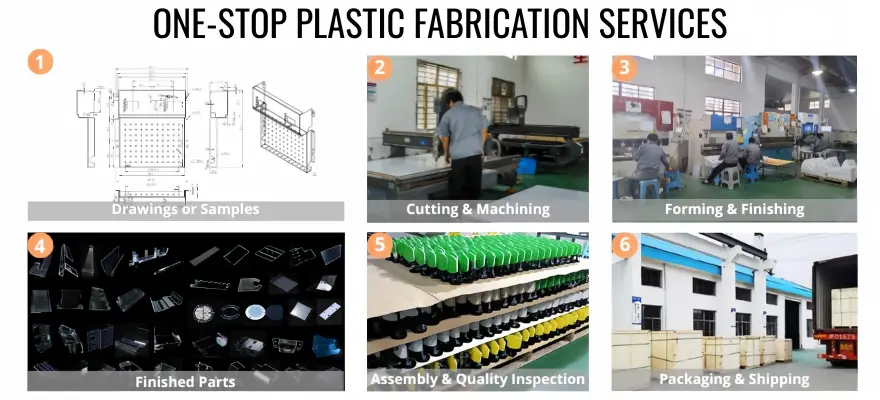
- In-house full-range secondary-processing capacity: CNC cutting, grooving, vacuum thermoforming, hot bending, UV-printing, screen-printing, drilling and coating service. Heavy reliance on third-party outsourcing raises quality-control difficulty.
- Supplier understands material-processing pitfalls and proactively informs you of manufacturing risks instead of only accepting orders. Many vendors accept drawings without material-feasibility evaluation, leading to mass-batch problems after fabrication.
- Support small-batch sample trial run. Validate performance with prototypes before large-volume order placement to reduce customer trial-and-error cost.
Suzhou Yucheng Board Industry is Suzhou-based integrated manufacturer combining sheet extrusion production and precision secondary processing. We focus on polycarbonate sheet and PETG sheet, supplying clients across the globe. Our service portfolio includes:
✅ Raw-material sheet supply: clear/matte/diffuser/UV-stabilized outdoor-grade polycarbonate sheet, hard-coating scratch-resistant polycarbonate sheet; clear/matte/medical-grade PETG sheet, thickness 0.5- 20 mm;
✅ Full-scope secondary-processing service: CNC precision cutting, grooving, hot bending, vacuum thermoforming, counter-sink drilling, chamfering, UV-printing, screen-printing, film lamination, UV-protective coating, hard-coating treatment;
✅ Supporting service: material compliance certificates, sample-prototype support, small-trial-order up to large-volume export-order delivery.
We deliver finished-machined components for new-energy, medical-device, rail-transit, machinery-manufacturing and advertising-display industries. Customers can simply provide drawings; we handle full-cycle production & fabrication and ship finished parts directly, saving your multi-vendor coordination workload.
Whether you need raw-stock plastic sheets or finished machined components, feel free to contact us for samples, specification datasheets and quotations. If you are hesitating between polycarbonate sheet and PETG sheet for your project, send us working-condition description and drawings for free technical-selection consultation.