




Table of Contents
- Introduction: Why polycarbonate sheet printing brings many practical–project pitfalls
- What is polycarbonate sheet screen printing, complete workflow
- How digital UV printing works on polycarbonate sheets
- Full comparison: screen printing VS UV printing for PC sheets
- Advantages, disadvantages & suitable products of PC screen printing
- Advantages, disadvantages & suitable products of PC UV printing
- Real–world industry applications for printed polycarbonate sheets
- Common defects in PC printing: ink peeling, cracking, pinholes, fading
- Decision guide: when to choose screen printing or UV printing
- Why pre–treatment matters before printing polycarbonate material
- Our one–stop custom polycarbonate sheet printing service(Zenuove)
- Frequently Asked Questions
Why polycarbonate sheet printing brings many practical project pitfalls
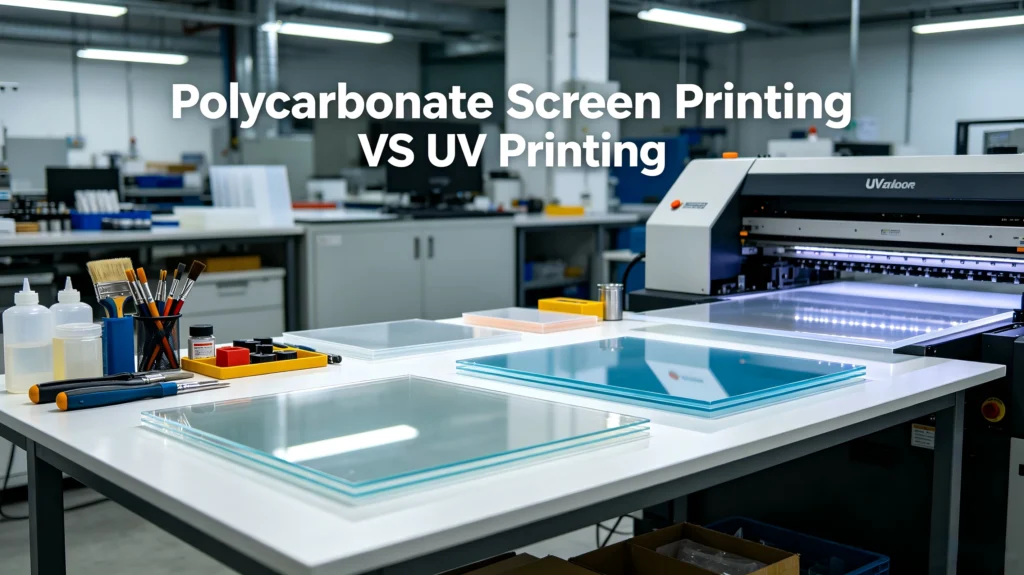
Polycarbonate sheet (PC sheet) features high impact resistance, great light transmission, wide temperature tolerance and shatter-safe performance. It is widely adopted for equipment panels, rail transit interior components, medical device housings, new-energy protective covers, outdoor signage and instrument viewing windows. Many buyers and engineers assume printing on polycarbonate sheets is straightforward. In real-world production, projects frequently run into trouble: ink peels off after light scratching; printed layers crack when bent; prints fade rapidly under outdoor sunlight; pinholes and bubbles appear on transparent PC sheets. Poor printing quality leads to mass rejection, delayed delivery and extra unexpected costs.
Most failures are not caused by raw polycarbonate material itself. The root cause is the wrong selection between polycarbonate screen printing and polycarbonate UV printing. Improper ink selection, insufficient surface preparation, and incorrect production parameters also result in poor final performance on this low-surface-energy engineering plastic substrate.
A common misunderstanding is that UV printing, as a newer digital technology, always outperforms traditional screen printing. In real industrial manufacturing, neither method is universally better. Each process has its irreplaceable strengths and inherent weaknesses. The right choice depends on your order volume, pattern complexity, end-use environment, budget and lead-time requirements.
This article targets B2B buyers, product engineers and overseas customers. We fully break down screen printing and UV printing on polycarbonate sheets, covering working principles, ink features, cost, lead time, wear-and-weather resistance, real-industry use cases, typical defects and practical selection logic. We will also introduce a one-stop polycarbonate sheet processing & printing solution. Our in-house service covers PC sheet cutting, CNC routing, bending, surface pre-treatment, polycarbonate screen printing, polycarbonate UV printing, final inspection and packaging. We help clients eliminate quality risks and communication delays caused by multiple-supplier coordination.
What is polycarbonate sheet screen printing, complete workflow
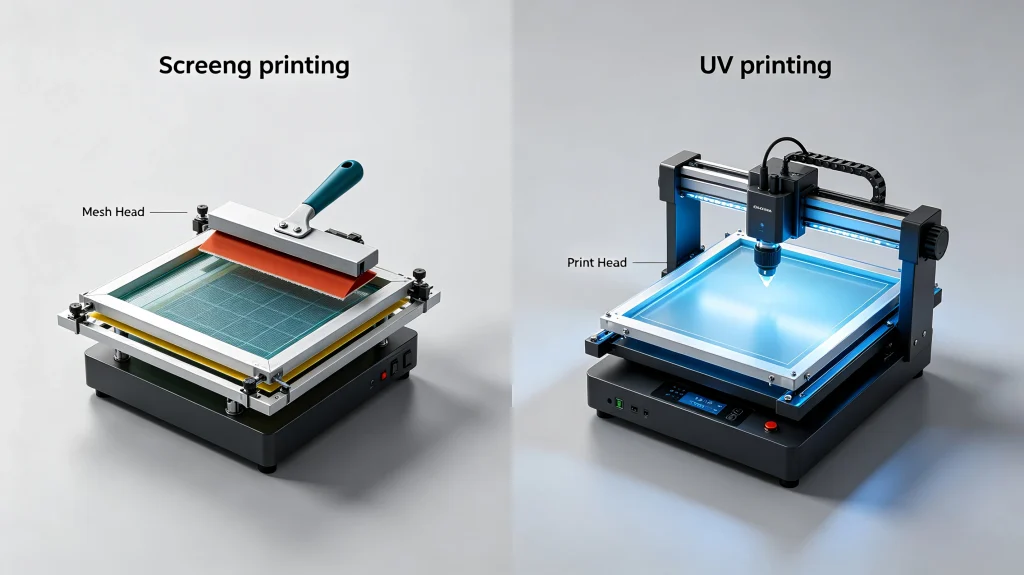
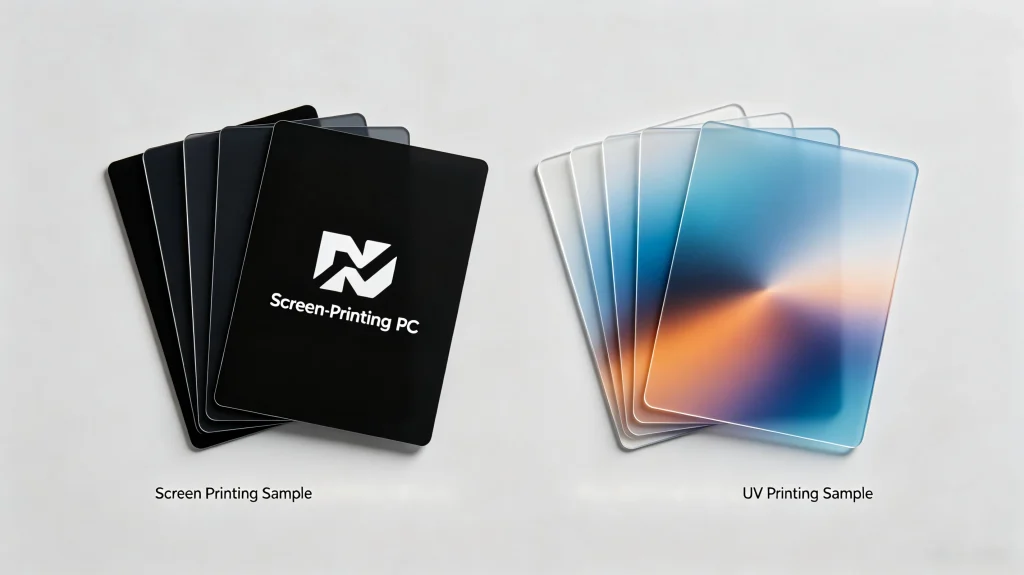
Polycarbonate screen printing (silk-screen printing) is a contact stencil printing technology. To put it simply: we produce mesh screens with hollow graphic openings. Ink is placed on top of the screen. A squeegee pushes ink through hollow mesh openings onto polycarbonate sheet, forming text and logos. One separate screen is required for one single color. Multi-color graphics need repeated alignment and overprinting. After printing, PC sheets go into oven chambers for heating, so solvent-based ink can fully cure.
Step-by-step workflow for polycarbonate screen printing:
- File preparation: Receive vector files (AI / CDR). Separate each color and output film negatives.
- Screen making: Manufacture printing screens according to film negatives. One screen corresponds to one color. Mesh count is selected based on line detail requirements.
- PC sheet pre-treatment: Clean oil and dust from the polycarbonate surface. Corona treatment or primer coating will be applied for better ink adhesion, which directly prevents ink peeling in later application.
- Alignment setup: Mount the screen on the screen-printer, fix PC sheet position, and calibrate graphic registration.
- Printing operation: Squeegee moves and transfers ink through mesh onto polycarbonate substrate. Single-color jobs finish in one pass. Multi-color designs require screen replacement and repeated printing cycles.
- Oven curing: Most screen-printing inks for polycarbonate are solvent-based. Freshly printed sheets cannot be stacked immediately. They are baked for dozens of minutes to hours so the solvent evaporates completely.
- Cooling phase: Take sheets out of the oven and cool down thoroughly.
- Full visual inspection: Check for burr edges, missing print, registration offset, bubbles.
- Film lamination, packaging and delivery.
Key point: Screen printing requires screen investment. More colors mean higher screen cost and more manual alignment work. It works best for solid-color logos and simple text, but poorly handles smooth gradients or photo-realistic images. Screen printing creates relatively thick ink layers, which deliver outstanding wear resistance for outdoor applications.
How digital UV printing works on polycarbonate sheets
Polycarbonate UV printing is non-contact digital inkjet printing. No screen or film negative is needed. Graphic files are sent directly to the printer. Print heads spray UV ink droplets onto the polycarbonate sheet surface. Right after the ink lands on the polycarbonate substrate, UV lamps emit ultraviolet light. UV ink cures within seconds. Sheets are dry instantly without long-time oven baking.
Step-by-step workflow for polycarbonate UV printing:
- File preparation: Import image or vector artwork. Adjust color profile, white-ink layer and varnish layer in software. Gradients and multi-color photos can be printed in a single run, no color separation is needed.
- PC sheet pre-treatment: Remove dust and grease. Corona or primer coating is applied for certain polycarbonate grades to improve UV-ink adhesion.
- Sheet positioning: Place flat polycarbonate sheets on the UV flat-bed printer platform.
- UV inkjet printing: Print heads travel back and forth, spraying color ink, white ink and spot varnish in one printing pass. Emboss relief effect can be achieved by multi-layer printing.
- Instant UV curing: UV lamp cures ink within seconds during printing. Sheets can be stacked right after printing.
- Post-processing: Additional varnish or emboss layers if required.
- Visual inspection, protective film lamination and packaging.
Core difference: UV printing cost will not rise with color quantity. It is very friendly for sampling, small-batch and customized orders. However UV ink layer is thinner than screen-print ink. Operators must carefully tune UV lamp power. Improper settings may cause poor adhesion or thermal warping on heat-sensitive polycarbonate sheets.
Full comparison: screen printing VS UV printing for polycarbonate sheets
| Comparison Item | Polycarbonate Screen Printing | Polycarbonate UV Printing |
| Screen / Film Requirement | ✅Required, one screen for one color; artwork revision requires new screen | ❌No screen & film needed. Digital file modification only; no setup cost |
| Graphic performance | Solid-color logos & texts preferred; poor gradient effect; minimum line ~0.2mm | Supports photos, smooth gradients, complex color graphics; fine line down to 0.1mm, up to 1200 DPI resolution |
| Ink layer thickness | Thick ink layer, strong hiding power, solid texture | Thin ink layer, delicate appearance; white ink & varnish can build embossed relief |
| Curing method | Solvent-based ink, oven heating, long curing cycle | UV light instant curing, dry upon print completion, no oven waiting |
| MOQ & Sampling | High sampling cost due to screen charge; cost-effective above 500 pcs | 1-piece sampling available, no screen fee; ideal for small-batch custom jobs |
| Color registration accuracy | Manual multi-color overprinting, tolerance ±0.2mm | Digital one-pass output, registration tolerance ±0.1mm or better |
| Weather & abrasion resistance | Dedicated outdoor screen-print ink delivers excellent outdoor wear performance | High-grade polycarbonate-formulated UV ink works outdoors. Wear resistance slightly lower than thick-layer screen printing; extra varnish improves service life |
| Lead-time | Sampling 3-5 days (screen production time); high efficiency for mass volume | Sampling within 1-2 days; fast artwork revision; mass-production speed slightly lower than screen printing |
| Environmental feature | Solvent ink generates VOCs; solvent-free UV screen ink optional | Low-VOC solvent-free UV ink, easy to meet RoHS & REACH compliance |
| Cost structure | High upfront screen cost; unit cost drops sharply in mass production | No screen investment. Higher ink cost; unit price stays stable regardless of batch size |
| Reverse printing (print on back side of transparent polycarbonate) | Mature process, excellent hiding performance | Supported; white-ink parameter tuning required |
| Special effects | Thick solid finish, metallic & pearlescent ink perform well | Emboss relief, spot varnish, seamless gradient graphics |
Advantages, disadvantages & suitable products of polycarbonate screen printing
✅Core advantages of polycarbonate screen printing
- Strong hiding power and excellent wear resistance. For semi-transparent & transparent polycarbonate sheets, thick screen-print ink delivers solid black/white coverage. When outdoor-grade polycarbonate-special ink is selected, printed parts withstand long-term sunlight exposure and friction. Rail-transit interior panels and outdoor equipment labels widely adopt screen printing for its durable performance.
- Superior unit-cost performance for large-volume orders. Once screens are finished, per-piece printing cost becomes very competitive for thousands or tens of thousands of units. It is the best-value solution for standardized mass production.
- Wide selection of functional inks. Metallic ink, pearlescent ink, high-opacity solid ink and medical-compliant inks are widely available for polycarbonate screen printing.
- Proven reverse-printing solution. Printing graphics on the back side of transparent polycarbonate viewing window: the polycarbonate sheet itself protects the ink layer from scratches, greatly extending service life. Reverse screen printing is well-proven in the industrial field.
❌Disadvantages of polycarbonate screen printing
- Economically unfit for small-batch sampling. Each separate color costs one screen set. Even small sampling orders need to bear the full screen-making expense. Any logo or text revision requires new screens, extra cost and longer lead time.
- Cannot achieve smooth gradients and photo-realistic effects. Gradient effects can only be simulated by multi-layer over-printing, causing obvious color banding. Photographs and complex colorful artwork are not suitable.
- More colors mean more working steps. Three-color graphics require three cycles of alignment-print-baking. Every over-print step brings registration error risk; defect rate rises.
- Long oven curing cycle. Solvent ink cannot be stacked right after printing. Insufficient baking will cause ink-adhesion failure.
- Low flexibility for artwork revision. Every modification needs new film negatives and new screens.
Best-fit products for polycarbonate screen printing
Large standardized orders; simple logos & solid-color text; projects requiring long-term outdoor wear resistance; reverse printing for transparent polycarbonate viewing windows; metallic/pearlescent visual effect; rail-transit interior signage, heavy-duty equipment warning panels, outdoor polycarbonate signs.
Advantages, disadvantages & suitable products of polycarbonate UV printing
✅Core advantages of polycarbonate UV printing
- No screen cost, fast sampling, friendly for small-batch orders. No film or screen required. Print directly from digital files. Sampling lead time: 1-2 days. Even single-piece prototype is acceptable. Each piece can carry different graphics. Perfect for custom-made items, multi-SKU orders, overseas sample orders and the new-product validation phase.
- Powerful color reproduction. Smooth gradient transitions, photo-realistic images and complex color textures are achievable. White ink and spot varnish produce emboss tactile effect, which is hard to realize economically via screen printing.
- Instant dry, fast production turnover. UV ink cures within seconds. Printed sheets can be stacked immediately, with no oven cooling waiting time. Easy to switch between different artwork designs.
- Low-cost artwork adjustment. Revise text or patterns only by editing digital files, no extra setup charge.
- Environment-friendly. Qualified UV ink features low-VOC, easy to satisfy RoHS and REACH requirements, highly valued for medical devices and export-oriented projects.
❌Disadvantages of polycarbonate UV printing
- Higher per-unit cost in high-volume production. Expensive UV ink makes UV printing less competitive compared with screen printing for tens of thousands of orders.
- Thinner ink layer, slightly weaker raw wear resistance. Even hard UV ink forms a thin film. Without protective varnish, long-term outdoor and heavy-friction scenarios will accelerate wear. An extra varnish layer is required to compensate for durability.
- High parameter-tuning requirement. Polycarbonate is heat-sensitive. Excessive heat from the UV lamp may lead to sheet warping. Insufficient UV energy causes incomplete curing & ink peeling. Over-curing makes ink brittle and crack during bending. Different polycarbonate raw-material grades need separate UV-parameter calibration. Not all general UV printers can deliver stable quality on polycarbonate sheets.
- High cost for full-solid large-area printing. Extensive full-black or full-white coverage consumes massive UV ink, raising total cost, where screen printing performs better.
Best-fit products for polycarbonate UV printing
Prototyping & small-batch custom jobs; gradient, photo-rich complex graphics; frequent artwork revision; tight sampling lead time; equipment decorative panels, display props; emboss & spot-varnish special visual requirements.
Real-world industry applications for printed polycarbonate sheets
1. Industrial machinery control panels
Transparent or matte polycarbonate sheets are widely used as machine operation panels.
- Mass-produced standardized machines: choose polycarbonate screen printing, reverse-print icons on the back surface for stable wear resistance and cost control.
- Multi-model small-batch machines with variable graphics: adopt polycarbonate UV printing to avoid repeated screen-making and shorten lead time.
2. Rail transit interior parts (high–speed train & coach interior)
Polycarbonate interior panels for rail transit must meet strict flame retardant, weather-resistance and low-odor specifications. Most orders are large-volume and standardized. Polycarbonate screen printing with rail-transit qualified ink is a mainstream choice. Symbols are printed on the back side so the polycarbonate substrate protects the ink layer against sunlight aging. UV printing is used for small-batch prototype validation.
3. Medical equipment instrument panels
Control panels and viewing windows for medical instruments need low-emission, non-toxic compliance.
- Mass-produced standard medical equipment: screen printing with medical-grade polycarbonate-matched ink.
- Prototypes & small-batch customized medical instruments: UV printing with low-VOC ink for fast sampling. Important note: ink must provide a material compliance report for medical-related projects. Cheap general-purpose ink is forbidden.
4. New–energy industry protective covers & warning signs
Polycarbonate protective guards and warning labels for photovoltaic and energy-storage equipment are frequently installed outdoors. Standard large-batch warning signs choose polycarbonate screen printing for outdoor durability. Small-project customized labels adopt UV printing.
5. Outdoor advertising & signage
For long-term open-air service under sun and rain: polycarbonate screen printing plus outdoor-special ink is preferred. Short-term event signage can use UV printing with protective over-varnish.
6. Display props & retail decorative sheets
Graphic-rich, gradient-heavy, multi-style small-batch display products benefit from polycarbonate UV printing.
7. Household appliance & instrument viewing windows
Reverse printing is common for transparent polycarbonate windows. Mass production uses screen printing; new-product prototyping uses UV printing.
In real-world practice, many customers combine two technologies: validate appearance with fast polycarbonate UV printing sampling; after design finalization, switch to polycarbonate screen printing for mass production to lower unit cost, balancing speed and total cost.
Common defects in polycarbonate printing: ink peeling, cracking, pinholes, fading
Polycarbonate is a low-surface-energy plastic, ink does not naturally stick firmly to its surface. Both screen printing and UV printing will suffer quality failures without proper process control. Most defects come from insufficient pre-treatment, wrong ink selection or incorrect curing parameters, rather than printing technology itself.
- Ink peeling & easy scratch-off
- Most frequent failure. Root causes: oil & dust contamination on PC sheet surface; missing corona / primer pre-treatment; ink not formulated for polycarbonate; insufficient oven baking for screen-print ink; insufficient UV-lamp energy for UV printing. Corona treatment effect decays over time. Printing should be finished within 72 hours after corona processing, otherwise, surface energy drops and ink peels off.
- Ink cracks after sheet bending
- Polycarbonate sheets are often bent after processing. Over-hard, brittle ink cannot follow polycarbonate substrate deformation, resulting in cracks. For screen printing: ink lacks a flexible additive. For UV printing: excessive UV energy over-cures the ink layer and makes it brittle. Best practice: finish bending operation before printing, avoid printing-then-bending workflow. If you must bend after printing, select high-flexibility ink and run a pre-production bending test.
- Bubbles & pinholes on printed surface
- Dust and oil residues on PC sheets; air bubbles mixed inside ink; high workshop humidity; contaminants adsorbed on polycarbonate after peeling protective film. A clean workshop environment is essential.
- Fast color fading in outdoor exposure
- Using indoor-only ink for outdoor projects. Screen printing without outdoor-grade ink; UV printing without protective varnish layer. UV radiation destroys pigment molecules and causes fading.
- Polycarbonate sheet warping after printing
- Oven temperature exceeds polycarbonate heat tolerance in screen printing; excessive heat radiation from UV lamp in UV printer. Polycarbonate long-term working temperature should not exceed 120℃. Temperature must be strictly controlled during the whole printing process.
Important reminder: Do NOT use PMMA (acrylic) ink for polycarbonate printing. Chemical properties differ greatly between the two plastics. Mismatched ink will cause large-scale peeling failure. Always select screen-print ink or UV ink specially formulated for polycarbonate substrate.
Decision guide: when to choose screen printing or UV printing
✅ Choose polycarbonate screen printing if most conditions below apply:
- Large-volume order ≥500 pcs, fixed artwork with rare revisions;
- End-product works outdoors, requires long-term anti-aging and wear resistance;
- Designs are solid-color logos, text & symbols, no gradient or photo image;
- Reverse printing on transparent polycarbonate sheets for high hiding power;
- Requires metallic or pearlescent special ink effects.
✅ Choose polycarbonate UV printing if most conditions below apply:
- Prototype, sampling or small-batch order from 1 piece to several hundred pieces;
- Artwork includes gradient, photograph, or complex multi-color texture;
- Frequent text & graphic modification, want to avoid repeated screen-making cost;
- Tight lead time for fast sample delivery;
- Require embossed relief or spot varnish special visual effect.
⚠️ Both processes are feasible for medium-volume simple patterns for indoor usage. Compare quotation and lead time before final decision.
Why pre-treatment matters before printing polycarbonate material
Many clients remove protective film from new polycarbonate sheets and send sheets directly for printing, only to face mass-production peeling and rework. Raw polycarbonate sheets have low surface dyne value, which creates poor intrinsic ink adhesion. Pre-treatment is the foundation of successful polycarbonate printing.
Common pre-treatment methods:
- Cleaning & degreasing: Remove release agent, oil stains, and dust, basic mandatory step.
- Corona treatment: High-voltage impulse modifies the polycarbonate micro-surface structure, raising surface energy for better ink anchoring. Corona effect decays with storage time, so print sheets shortly after the corona process.
- Primer/adhesion promoter coating: Apply a thin primer layer to build a bonding bridge between the polycarbonate substrate and the ink. Widely adopted for high-end outdoor and medical-grade projects.
At Suzhou Yucheng Board Industry, for both polycarbonate screen printing and polycarbonate UV printing, all PC sheets go through cleaning and dust removal. Corona treatment or primer coating will be arranged according to end-use requirements to minimize ink-peeling risk at the source.
Our one-stop custom polycarbonate sheet printing service
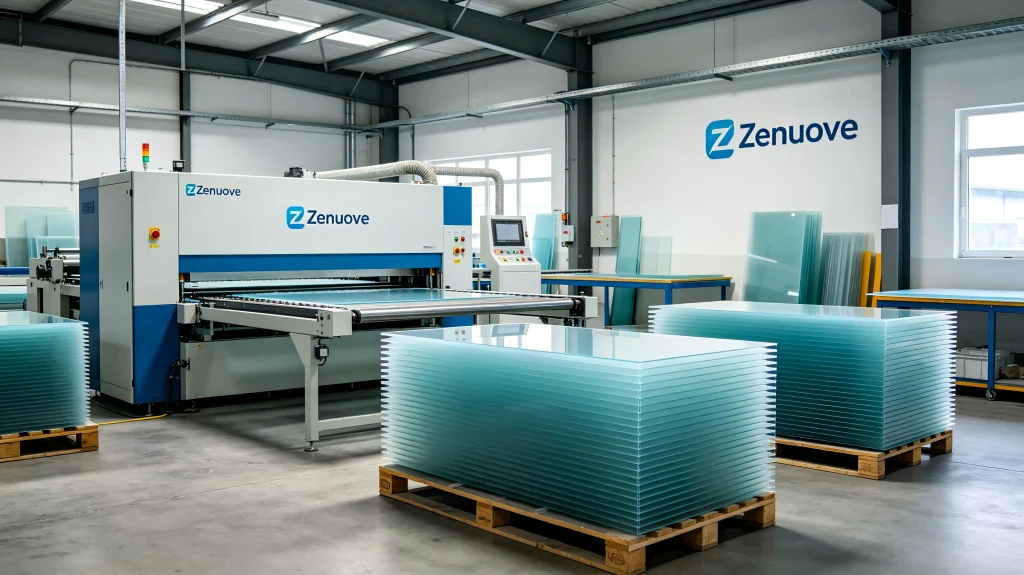
Suzhou Yucheng Board Industry has rich experience in polycarbonate sheet fabrication & printing. We provide a full range of in-house services: raw PC sheet cutting, CNC routing & drilling, bending, thermoforming, surface pre-treatment, polycarbonate screen printing, polycarbonate UV printing, final inspection and protective-film packaging. We serve global B2B clients covering industrial equipment, rail transit, medical devices and new-energy equipment sectors.
Many customers suffer from troubles with multi-supplier coordination: contacting the sheet factory, CNC workshop and printing house separately. Miscommunication, quality disputes, and uncontrollable lead times often happen. We complete most processing steps inside our own facility, reducing intermediate logistics and coordination work. Overseas buyers can place a one-stop order, send only drawings & print-ready files, and we deliver finished parts.
Our available services:
- Polycarbonate screen printing: Mass-production panels & signage; support front-side printing and reverse back-side printing. Polycarbonate-formulated screen-print ink can be supplied with RoHS & REACH reports. Outdoor weather-resistant ink and rail-transit grade ink are optional.
- Polycarbonate UV printing: Fast sampling & small-batch custom jobs. Supports white ink, varnish and embossed relief effect. Sample turnaround within 1-2 working days.
- Supporting fabrication: PC sheet cutting, CNC machining, bending, grooving, hole punching, matte finish, UV-stabilized polycarbonate raw-material supply.
- Quality control: Sheet cleaning before printing; corona/primer pre-treatment on demand; ink adhesion test and full visual inspection after printing.
- Support export-oriented orders, neutral packaging available. Smooth English-language document communication for overseas customers.
Whether you are doing new-product R&D sampling or large-volume mass production, send us your drawings, print files, end-use environment and order quantity. Our technical team will evaluate and recommend the most suitable printing process for your working conditions, provide an accurate solution and quotation, and help you avoid later-stage product failure caused by wrong-process selection.
Frequently Asked Questions
Q1: For transparent polycarbonate sheet, front-side printing or reverse back-side printing? A: Reverse back-side printing is highly recommended. Polycarbonate material itself protects the ink layer from scratches and UV damage, greatly extending service life. Both screen printing and UV printing support reverse printing.
Q2: Can UV-printed polycarbonate sheets be used outdoors? A: Yes, but general indoor UV ink cannot be used. You need polycarbonate-special weather-resistant UV ink. Adding a protective varnish layer will further prolong outdoor service life. For heavy-duty long-term outdoor scenarios, screen printing is still the priority option.
Q3: Can we bend polycarbonate sheet after printing? A: Not recommended. Bending after printing easily creates ink cracking. Optimized workflow: finish bending first, then perform printing. If post-print bending is unavoidable, use high-flexibility ink and complete bending validation test before mass production.
Q4: Who owns screen-print screens? Will Zenuove store screens for re-orders? A: After clients pay the screen-making charge, screens belong to clients. We can store screens for a certain period for repeat orders.
Q5: Can polycarbonate printing meet medical-device requirements? A: Yes. You must select medical-compliant ink and obtain ink compliance documentation. We can assist with ink-grade selection to match medical regulatory requirements.