






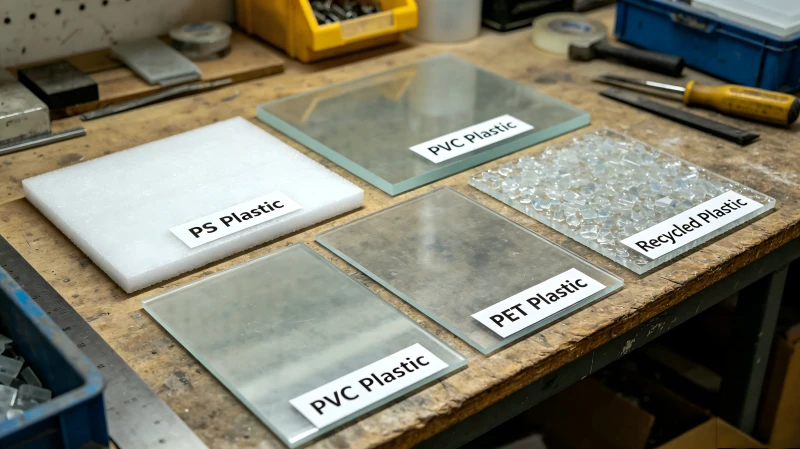
For global purchasing merchants, display equipment manufacturers, construction decoration contractors, aquarium producers, machinery safety guard factories, retail store fixture designers and outdoor signage project suppliers, two transparent plastic panels are the most frequently selected raw materials: acrylic sheet (PMMA) and various kinds of ordinary cheap plastic sheets. A huge number of overseas buyers mix these two materials up every single day. Many clients place orders of low-cost ordinary plastic instead of acrylic due to lack of basic knowledge, and then face heavy loss after receiving goods: panels turn yellow within several months, crack under slight impact, deform under normal room temperature, become foggy and lose transparency, or fail official safety inspection for public projects.
This super detailed full guide will start from basic raw material knowledge, fully explain what acrylic sheet really is, how it is produced, all its core physical and chemical features, and list all mainstream ordinary plastic sheets used in the market. We will launch a full-scale multi-dimensional comparison covering transparency, weather resistance, scratch hardness, impact toughness, heat and cold resistance, safety grade, machining performance, service life, cost and applicable scenes.
We also sort out common wrong ideas held by most buyers, teach three easy manual tests to tell acrylic and ordinary plastic apart without professional machines, and give clear selection suggestions for different project demands.
In the independent complete chapter at the end, we fully introduce our factory’s full-chain one-stop custom acrylic sheet fabrication service, including casting & extruded acrylic production, all deep processing crafts, flexible order policy, global export supporting system and long-term cooperation advantages. All technical words are explained in simple daily words without complicated industry jargon, every conclusion comes from real production test data and thousands of client order cases we handled in the past years.
Chapter 1: Basic Introduction: What Exactly Is Acrylic PMMA Sheet?
Q1: What is the chemical name for acrylic sheet? What does PMMA stand for?
A1: The full scientific name of standard acrylic sheet is Polymethyl Methacrylate, short mark PMMA. Most factory workers, buyers and merchants call it acrylic for short in daily communication. It is a fully synthetic transparent polymer raw material made from refined methyl methacrylate monomer as the core raw material, through strict polymerization molding production lines. Many new buyers mistakenly think acrylic is a general name for all transparent plastic sheets, this is the most widespread misunderstanding we meet in daily inquiry communication. All acrylic panels belong to plastic, but not all plastic sheets can be called acrylic. This core logic runs through the whole article and all comparison content below.
Q2: Where does the name “acrylic” come from?
A2: The word acrylic originates from the English root word of acrylate resin material. Early transparent PMMA panels were imported from European and American factories. Foreign merchants used the trade name acrylic to refer to this high-transparency board, and this naming convention spread to the global manufacturing and trading industry and has been used to date. Ordinary plastic sheets like PS, PVC, and cheap PET do not have this exclusive trade name, they only carry general plastic material names without special brand-style material aliases.
Q3: What is the most intuitive feature people notice about acrylic at first sight?
A3: The most obvious visible feature of qualified virgin raw material acrylic sheet is ultra-high light transmittance close to optical glass, no faint gray, blue or foggy shadow when you look through the board surface. When you knock a thick acrylic panel with your knuckle, it makes a thick, low and dull solid sound, unlike thin sharp crisp sound sent out by cheap ordinary plastic. Even after a long time of outdoor sun exposure, standard double-sided UV-coated acrylic will not turn obvious yellow within 10 years, this is a feature no general ordinary plastic can match.
Chapter 2: Raw Material Chemical Composition & Production Process of Acrylic
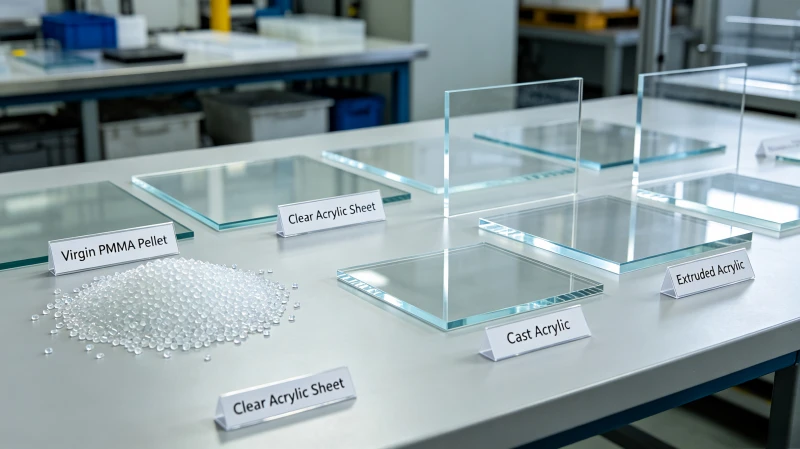
Q4: What raw materials are used to make a qualified acrylic sheet?
A4: High-quality industrial acrylic sheet adopts 100% virgin PMMA monomer raw pellet as basic material, no recycled plastic scrap powder mixed into the production formula. The raw material monomer is extracted and refined from petrochemical raw oil, processed into uniform transparent solid pellets, then transported to the acrylic extrusion or casting workshop for molding production. A small number of low-end small factories mix large proportion of recycled plastic broken pieces into acrylic production to cut down cost, such recycled modified acrylic will lose most core performance advantages, and its property is very close to ordinary cheap plastic sheets. Our factory strictly uses brand-new pure PMMA pellets for all custom acrylic orders, we never add recycled scrap material in any production batch to guarantee stable long-term usage performance for overseas clients.
Q5: What are the two mainstream production methods of acrylic sheet? What is the difference between casting acrylic and extruded acrylic?
A5: All finished acrylic panels on the market are made via two mature production crafts: casting molding and continuous extrusion molding. Both are made from genuine acrylic PMMA material, but they have obvious performance and price gaps.
- Cast acrylic sheet: Pour liquid PMMA monomer into fixed glass mold plate, seal and carry out slow low-temperature polymerization solidification for dozens of hours. Cast acrylic has higher surface transparency, better internal uniformity, stronger anti-aging ability, can support ultra-thick customization up to 200mm thickness, and is easier to polish into a mirror-smooth edge after cutting. It is the top-grade acrylic material selected for high-end display racks, large aquarium tanks, outdoor permanent signage and optical equipment shells. Its unit cost is higher than that of extruded acrylic sheet.
- Extruded acrylic sheet: Melt PMMA solid pellets at high temperatures, then extrude a continuous flat panel through a precision mold roller, with fast production speed, high daily output, lower raw material waste rate, and a lower unit price. Its internal molecular uniformity is slightly weaker than cast acrylic, maximum customizable thickness is limited to around 30 mm; the edge polishing effect is not as perfect as cast acrylic, anti-aging service life is 3-5 years shorter than cast acrylic without special UV coating. It is widely used for indoor short-term display, disposable advertising signs, and thin small-size decorative parts.
Our factory equips a complete casting acrylic production line and large-scale extruded acrylic extrusion line at the same time, we can recommend a suitable acrylic production type according to client’s project usage scene, budget and service life demand during free pre-order consultation, helping buyers balance performance and procurement cost reasonably.
Q6: What production steps will affect acrylic’s final quality?
A6: Four key production links directly decide acrylic finished product quality level: raw material purification degree, polymerization temperature control precision, surface co-extruded UV protective layer craft, and post-production annealing stress removal treatment. If the factory skips the annealing procedure, the finished acrylic will have huge internal stress inside the panel. After cutting, drilling, or hot bending processing, cracks will easily appear along processing lines; this phenomenon rarely happens to fully annealed qualified acrylic sheet. Most low-cost ordinary plastic sheet manufacturers cut production cost by canceling the stress removal procedure, leading to a high defective rate after secondary processing.
Chapter 3: Core Physical & Chemical Properties of Standard Acrylic Sheet
We sort out all stable core features of pure virgin acrylic PMMA sheet in plain words, all data comes from our internal laboratory long-term test records:
- Light transmittance: Up to 92% for transparent cast acrylic, 89%-91% for extruded acrylic, far higher than all transparent ordinary plastic sheets.
- Surface pencil hardness: Standard acrylic reaches 2H pencil hardness, making it hard to leave an obvious permanent scratch under daily light friction and wiping.
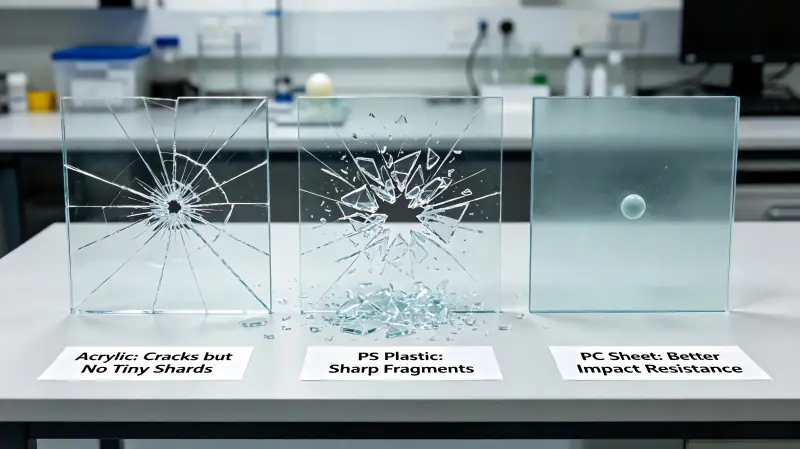
- Schlagfestigkeit: Acrylic is brittle and easy to crack under heavy impact; compared with ordinary thin glass it will not split into countless tiny sharp fragments, only break into several large connected pieces; its toughness is 3–8 times better than ultra-brittle PS plastic, but far lower than Polycarbonatplatte (PC).
- Outdoor anti-yellowing lifespan: Cast acrylic with double-sided UV co-extrusion coating can keep a stable transparent color for 10-15 years under full open-air sunlight exposure; extruded UV acrylic can maintain 7-10 years clear appearance.
- Heat resistance working range: Continuous stable working temperature -40℃ to 85℃, will not deform or soften under long-term 60℃ high temperature environment.
- Flame retardant safety: Unmodified virgin PMMA acrylic is flammable plastic with UL94 HB grade and cannot self-extinguish after removing the fire source; we can customize mature UL94 V2 flame retardant modified acrylic for public fire safety projects. UL94 V1 / V0 transparent acrylic cannot be mass-produced stably.
- Chemical corrosion resistance: Resist daily weak acid, weak alkali, detergent, rainwater and common industrial dilute chemical liquid erosion, will not dissolve or fog the surface under long contact of these media.
- Food contact safety: Pure PMMA acrylic sheet without harmful modifiers reaches international food contact safety standards, can be used for aquarium fish tank, food display cabinet, dessert partition and kitchen transparent protective baffle, no toxic substance release under normal room temperature.
- Machining compatibility: Supports hot bending, cold bending, CNC special-shaped cutting, laser engraving, multi-hole drilling, edge mirror polishing, multi-color silk screen printing, vacuum blister forming and all common plastic deep processing crafts, with no serious cracking or layer separation risk during processing when operated according to standard technical parameters.
- Low density light weight: Acrylic density is only half of glass, greatly reducing overall transportation weight and installation frame load bearing pressure compared with glass transparent partition, cutting logistics and construction cost obviously.
Chapter 4: Main Types of Acrylic Panels Available on the Global Market
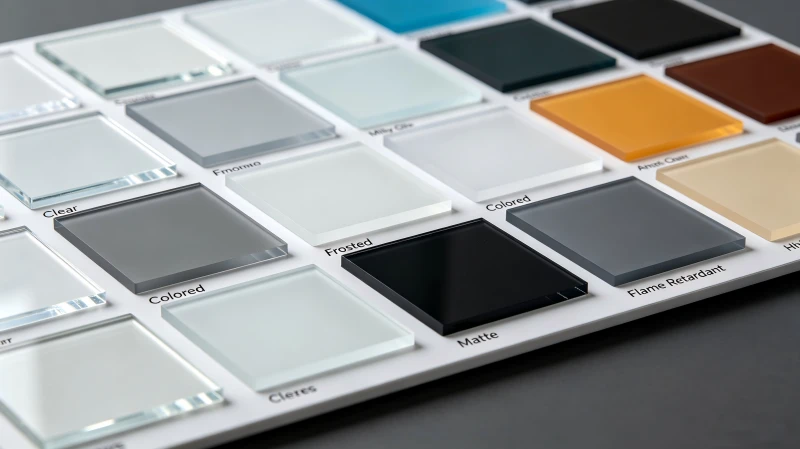
According to surface treatment, color, modified function and production thickness, we divide all customizable acrylic sheet series our factory produces into 8 mainstream types, all can support full deep processing custom service:
- Fully transparent clear acrylic sheet: The most universal base acrylic type, no color pigment added, maximum light transmittance, used for most general transparent partition, display box and observation window projects.
- Colored tinted acrylic sheet: Smoke grey, milky white light diffusion, sky blue, emerald green, black opaque, red, yellow and other solid color customization, can adjust light shading rate freely according to client demand, support cast and extruded two production crafts synchronously.
- Frosted matte anti-glare acrylic sheet: One-side or double-side matte frosted surface treatment, eliminates strong light mirror reflection, protects human eyes from dazzling reflection, widely used for office privacy partition, exhibition hall anti-glare display board and classroom light uniform ceiling panel.
- UV-stabilized outdoor permanent acrylic sheet: Double-sided co-extruded anti-UV protective layer integrated during extrusion or casting production, specially developed for long-term open-air usage such as outdoor billboards, courtyard landscape partitions, bus station transparent baffle, anti-yellowing warranty can be written into formal sales contract for bulk orders.
- Flame-retardant modified acrylic sheet: Non-toxic, halogen-free flame-retardant raw material modification, UL94 V0 high fire safety grade, mandatory customized material for shopping mall public decoration, high-voltage electrical equipment insulation baffle, underground passage transparent guard.
- Anti-scratch high hardness acrylic sheet: Extra silicon hard coating covered on acrylic surface after molding, pencil hardness raised to 3H level, resists frequent daily wiping, hand touch and light metal scraping without permanent scratch trace, fit self-service equipment touch observation window and retail counter partition.
- Thick cast super large acrylic sheet: Custom thickness from 30mm to 200mm ultra-thick specification, high internal uniformity, perfect mirror polishing edge effect, core raw material for large viewing aquarium tank, underwater sightseeing tunnel, security bulletproof transparent window matching composite film.
- Thin extruded flexible acrylic sheet: 0.8 mm-5 mm thin extruded acrylic, low unit cost, fast production delivery, fits indoor temporary advertising signs, light decorative frame and disposable packaging transparent cover.
Chapter 5: What Counts As “Ordinary Plastic Sheet” In Daily Industrial Use?
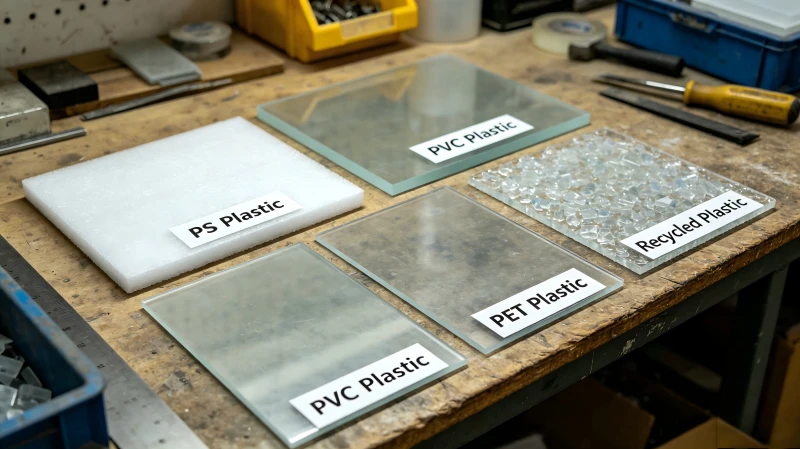
When buyers mention ordinary plastic transparent board compared with acrylic in inquiry and project communication, it mainly refers to four low-cost general plastic sheet materials frequently seen in the global market, all of which are transparent polymer plastic but do not belong to PMMA acrylic material at all:
- PS polystyrene plastic sheet: The most common cheap transparent plastic board, lowest raw material cost among all transparent plastic panels, ultra-brittle texture, easy to crack under slight impact, turns yellow within 6-12 months under outdoor sunlight, surface scratches stay permanently after light friction, only fit short-term indoor disposable advertising labels and temporary exhibition partition. Many small merchants replace acrylic with PS sheet to lower the quotation, causing mass client after-sales complaints.
- PVC transparent plastic sheet: Mostly soft thin transparent PVC film or thin rigid PVC panel, poor high temperature resistance, will release slight pungent odor when temperature rises above 50℃, low light transmittance with natural faint blue fog shadow, easy to deform and shrink under normal summer indoor temperature, suitable for one-time packaging liner and low-demand temporary protective cover, cannot be used for food contact and permanent public facility projects.
- Ordinary unmodified PET plastic sheet: General transparent PET thin sheet without anti-aging and anti-scratch modification, soft texture, surface easy to leave fingerprints and wipe marks, ultraviolet rays will make the PET panel turn white and foggy quickly outdoors, high temperatures will lead to permanent wrinkle deformation, mainly applied for disposable plastic packaging box raw material.
- Recycled mixed composite plastic sheet: Mixed broken recycled plastic powder without a fixed single material formula, random mixture of PS, waste PVC, waste PET scrap, ultra-low unit price, extremely unstable performance, serious color difference batch by batch, heavy pungent plastic smell when cutting or heating, no fixed applicable formal project scene, only used for temporary low-quality disposable products with zero long-term usage demand.
All four of the above categories are the so-called ordinary plastic sheets we compare with acrylic in this article. Their common shared disadvantages: short service life, weak anti-ultraviolet ability, low surface hardness, poor impact toughness, narrow stable temperature working range, many hidden safety risks for long-term and public construction usage, only competitive advantage is a cheap raw material unit price.
Chapter 6: 12 Key Differences Between Acrylic Sheet & General Ordinary Plastic
We split the 12 most practical comparison dimensions that buyers care most about in procurement. Every point adopts a simple contrast description without complex chemical terms, so you can quickly judge the material’s suitability for your project after reading:
Difference 1: Raw Material & Molecular Structure Purity
Acryl: Single pure PMMA polymer molecular structure, stable chemical composition, no mixed waste plastic scrap, uniform internal texture of the whole panel, consistent performance every batch of production.
Ordinary plastic (PS/PVC/PET/recycled mix): Single-material ordinary plastic has single molecular structure but a much simpler raw material refining process with more impurity residue; recycled mixed plastic has a chaotic mixed molecular composition, uneven internal texture, and performance fluctuates heavily between different production batches, and cannot provide a stable long-term usage effect.
Difference 2: Light Transmittance & Visual Clarity
Acryl: Transparent cast acrylic reaches 92% light transmittance, extruded acrylic 89%-91%, pure transparent without gray, blue, white fog shadow, looking through the panel, the object outline is clear and real, no color distortion.
Ordinary plastic: PS transparent sheet transmittance only 82%-86% with faint gray tone; PVC has light blue fog layer; ordinary PET has slight white haze; recycled mixed plastic has irregular cloud-shaped fog block inside the board, object color will distort when watching through the panel surface.
Difference 3: Surface Hardness & Anti-Scratch Performance
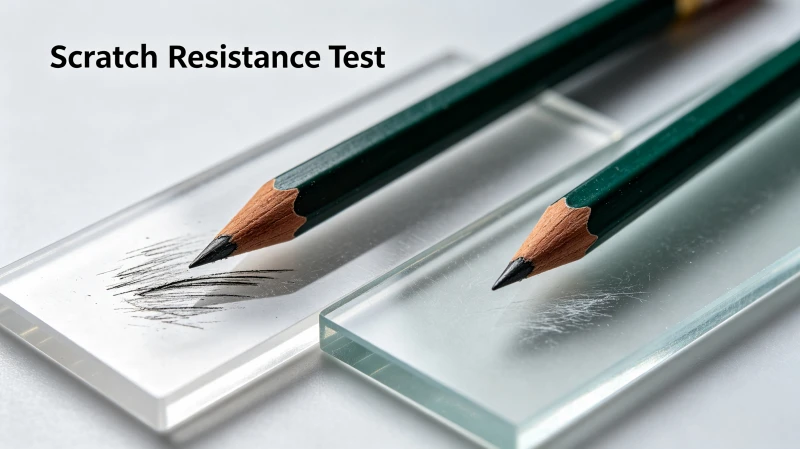
Acryl: Base material hardness reaches 2H pencil grade, customized hard coating acrylic up to 3H, daily wiping with a cotton cloth, light metal touch and accidental light friction will not leave a permanent visible scratch trace. Ordinary plastic: PS, PVC, PET all below HB pencil hardness, a simple plastic ruler scratch will form an obvious deep mark that cannot be eliminated, daily cleaning will accumulate countless tiny scratches on the panel surface within several months, lose transparent, smooth appearance completely.
Difference 4: Impact Toughness & Anti-Breaking Safety
Acrylic: Brittle material, heavy impact will create penetrating cracks and split the panel into several large pieces. No tiny sharp fragment splash risk compared with PS plastic, but it cannot withstand long-term frequent violent collision; solid PC sheet is required for high anti-impact demand projects.
Ordinary plastic: PS sheet is extremely brittle, slight heavy impact will split into dozens of sharp tiny broken pieces; soft PVC will deform permanently and cannot recover after impact; PET thin panel will wrinkle and produce permanent white crack marks under hit; recycled mixed plastic breaks easily with irregular sharp fragments all around. For public playgrounds, bank counter, school isolation window and aquarium tank projects, acrylic can only meet low-to-moderate collision scenarios, high anti-impact scenes must choose PC sheet.
Difference 5: Outdoor UV Anti-Yellowing Service Life
Acrylic with double-sided UV coating: Cast acrylic stable clear color for 10-15 years of full open-air sun exposure; extruded UV acrylic can maintain 7-10 years without obvious yellow discoloration; the factory can sign a formal anti-yellow warranty contract for bulk orders.
Ordinary plastic: No natural anti-UV molecular structure, even if add a cheap ordinary UV auxiliary agent, PS will turn deep yellow within 6-12 months outdoors, PVC will fog and shrink within 1 year, PET turns white opaque under half-year sunlight exposure, recycled mixed plastic changes color within 3 months, and cannot be used for any permanent outdoor construction or signage project.
Difference 6: Stable Working Temperature Range & Anti-Deformation Ability
Acryl: Continuous safe usage temperature -40℃ ~ 85℃, placed under long-term 60℃ summer sun, near indoor heating equipment or low-temperature winter outdoor environment, no softening, shrinkage, arching deformation, after temperature recovers to normal room temperature, the panel keeps its original flat shape without permanent distortion.
Ordinary plastic: PS softens and deforms above 45℃; PVC produces odor and shrinks over 50℃; PET produces permanent wrinkle deformation above 60℃; all ordinary plastics will turn hard and brittle below 0℃ in cold weather, easy to crack under slight collision in a winter low-temperature environment. For carport skylight, outdoor equipment shell and high-temperature workshop guard projects, ordinary plastic will fail within one summer season.
Difference 7: Flame Retardant & Fire Safety Performance
Acryl: Standard unmodified acrylic sheet is flammable HB grade, continuous burning with flame-carrying molten drip after ignition, cannot self-extinguish; only customized UL94 V2 modified acrylic achieves stable self-extinguishing effect; UL94 V1/V0 transparent acrylic cannot be mass-produced steadily. Without flame retardant modification, acrylic cannot pass public building fire inspection standards. If V0 fire rating is mandatory, flame-retardant polycarbonate sheet is recommended.
Ordinary plastic: PS, PVC, and ordinary PET will keep burning continuously after being ignited, producing heavy, black, highly toxic smoke with pungent harmful gas; soft PVC drips high-temperature burning liquid while burning, easily ignites surrounding flammable decorations, and cannot pass fire safety acceptance of large shopping malls, schools, and public infrastructure.
Difference 8: Chemical Corrosion Resistance & Cleaning Compatibility
Acryl: Resists weak acid, weak alkali, neutral detergent, rainwater, daily hand sanitizer and common dilute industrial chemical liquid, long-time contact will not fog the surface, corrode the substrate, or produce sticky residual marks. It can use neutral cleaning liquid for regular maintenance without worrying about material damage.
Ordinary plastic: PS will be corroded and foggy when touching alcohol, detergent, and weak acid liquid; PVC will dissolve and produce a sticky surface under contact with organic cleaning solvent; PET will leave a permanent white stain after wiping with alcohol disinfectant; daily regular cleaning will quickly destroy the panel surface transparency.
Difference 9: Food Contact Environmental Safety
Acryl: Pure unmodified PMMA acrylic sheet contains no plasticizer, heavy metal and harmful volatile substance, reaches international food contact safety certification standard, can be safely made into aquarium fish tank, cake display cabinet, fruit partition, kitchen transparent protective baffle and food processing equipment observation window, no toxic substance release under normal room temperature and long-time food contact.
Ordinary plastic: PVC contains a plasticizer additive that will separate out under temperature rise; PS and recycled mixed plastic have heavy metal residual risk in raw material; ordinary PET is only qualified for short-term cold food disposable packaging; long-term fixed food display equipment cannot adopt these ordinary plastic materials, will fail food safety inspection and bring legal risk to the project operator.
Difference 10: Deep Processing Compatibility & Process Limit
Acryl: Supports hot bending, cold bending, CNC irregular cutting, laser engraving, multi-size hole drilling, mirror edge polishing, multi-color silk screen printing, vacuum blister forming, all common plastic secondary processing crafts, only need to adjust the machine parameters according to acrylic thickness, low processing scrap rate, finished processing effect smooth and clean without cracks.
Ordinary plastic: PS cannot do hot bending at all, heating will directly break into fragments; PVC hot bending will release pungent toxic odor and produce permanent surface fog; thin PET can only make simple shallow blister, deep drawing will crack; recycled mixed plastic random crack during cutting and drilling, high scrap rate, cannot complete high-precision complex custom processing demand of display equipment and mechanical guard.
Difference 11: Long-Term Indoor Aging Service Life
Acryl: Indoor non-direct sunlight usage environment, qualified acrylic can keep transparent smooth appearance and stable performance for more than 20 years, no yellowing, fogging or brittle aging problems.
Ordinary plastic: Indoor indirect light environment PS sheet will turn yellow within 2-3 years, PVC will harden and shrink within 3 years, PET surface accumulates permanent wipe marks and fog layer within 2 years, recycled mixed plastic produces irregular cracks within 1 year of indoor usage, need frequent full plate replacement to maintain project appearance and safety standards.
Difference 12: Unit Procurement Cost & Long-Term Comprehensive Expense
Acryl: Higher initial raw material unit price than ordinary plastic, but ultra-long service life, low after-sales maintenance and replacement cost, one-time purchase can support 10-20 years stable usage, total comprehensive investment is lower for permanent long-term projects.
Ordinary plastic: Ultra-low one-time purchase unit price, but extremely short service life, needs full batch replacement every several months or 1-2 years, plus labor disassembly, reinstallation, reprocessing cost, the cumulative total expense within 5 years is 3-6 times higher than one-time acrylic procurement cost, also brings project construction pause, customer complaint and safety acceptance failure hidden risk.
Chapter 7: Transparency & Light Transmission Contrast: Acrylic VS Cheap Plastic
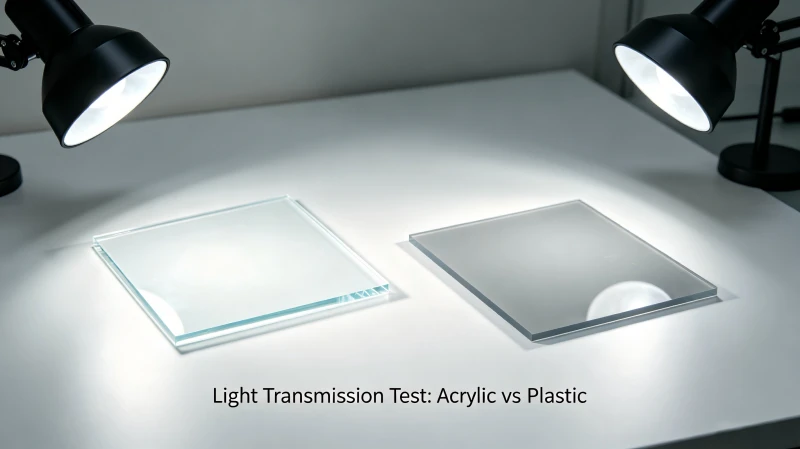
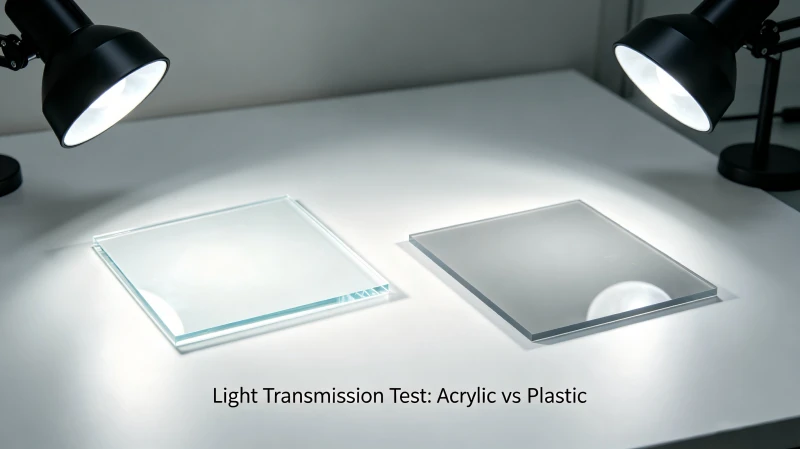
Transparency is the first feature buyers judge transparent plastic panel quality by; many clients only look at surface roughness and clarity without testing real light transmittance data, easily misled by low-price ordinary plastic suppliers’ false description of “same high transparency as acrylic”. We carry out fixed light transmittance test every month in our internal laboratory, the stable test data can fully show the huge gap between acrylic and ordinary plastic: Standard transparent cast acrylic sheet’s light transmittance index stabilizes at 91%-92%, this data is very close to optical float glass’s 93% transmittance rate, human eyes almost cannot distinguish the difference between thick acrylic and glass when watching objects through the panel. Even colored frosted acrylic can keep uniform soft light penetration without local dark fog block inside the board, color light shading rate can be accurately adjusted according to the client’s drawing parameter demand during production.
Take PS transparent plastic sheet as a representative ordinary plastic, its highest light transmittance only reaches 86% under the best production condition, most mass-produced PS panel transmittance is only 82%-84%. When you put a PS sheet in front of a white background wall, you can see an obvious faint grey shadow covering the whole panel surface. When you watch colored objects through PS sheet will appear color distortion, red color turns dark purple, blue color becomes dark grey, cannot meet high-end display racks, optical equipment and high-end retail store decoration.
Transparent PVC sheet has an inherent light blue haze layer inside its molecular structure; no matter how the raw material formula is adjusted, the blue fog shadow cannot be eliminated. Long-term watching through PVC panels will make people feel visual fatigue easily, so PVC sheets are almost never used for high-end transparent display products. Ordinary PET thin sheet will form a uniform white fog film on the surface after several months of indoor use, light transmittance drops rapidly, lose clear, transparent visual effect completely.
Our factory can provide free light transmittance test sample pieces for global buyers before bulk order confirmation. Clients can compare an acrylic sample and an ordinary plastic sample side by side under the same light source to observe the real transparency difference with their own eyes and avoid being cheated by the supplier’s exaggerated false product description during procurement.
Chapter 8: Anti-Yellowing & Outdoor Weather Resistance Performance Gap
Outdoor permanent usage is the biggest scene that can completely separate the acrylic and ordinary plastic performance gap; most after-sales disputes we receive every year are caused by clients replacing acrylic with ordinary plastic for outdoor signage, carport and landscape partition projects. Ultraviolet rays in sunlight are the core factor leading transparent plastic panels to turn yellow, foggy and brittle. The molecular structure of acrylic and ordinary plastic reacts totally differently under long-term UV irradiation.
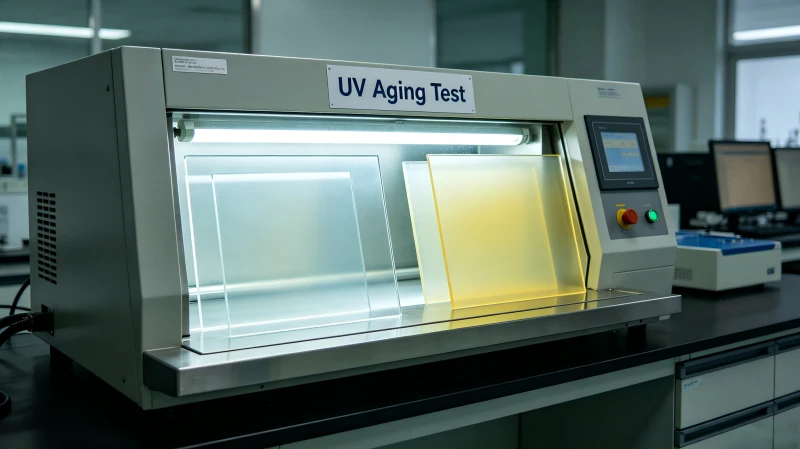
Pure PMMA acrylic molecular chain has a natural weak UV absorption ability; after adding a double-sided co-extruded UV protective layer during casting or extrusion production, the UV layer can block more than 99% of harmful ultraviolet rays from penetrating into the internal acrylic substrate, effectively delaying molecular aging decomposition reaction. Our factory’s outdoor-grade cast acrylic after 1000 hours QUV accelerated aging test only produces tiny color difference ΔE≤2, human eyes cannot notice an obvious yellow change. This test result can be provided as a third-party official test report for client engineering bidding and customs clearance document support.
Ordinary plastic materials such as PS, PVC and PET do not have a natural anti-UV molecular structure. Even if a small amount of cheap UV auxiliary agent is mixed into the raw material during production, the auxiliary agent will lose efficacy completely within several months under continuous sun exposure. After 300 hours of QUV aging test, PS sheet turns deep yellow opaque, the surface produces countless tiny crack lines all over the board; the transparent PVC panel fogs and shrinks unevenly; the PET panel surface forms a permanent white matte fog layer, light transmittance drops more than 20% instantly. Recycled mixed plastic sheet after only 100 hours UV test already appears irregular yellow block and brittle crack, completely loses basic usage function.
Many overseas merchants only compare unit price when purchasing outdoor transparent panel, choose cheap ordinary plastic to cut down upfront cost, after 6-12 months project put into use all panels turn yellow and foggy, have to stop business for full batch disassembly, re-purchase acrylic panel and reinstall, the total repeated material, labor and construction delay loss is far higher than the initial money saved by choosing low-cost plastic sheet. We will specially remind all clients with outdoor project demands during pre-order consultation, clearly list the weather resistance service life data of acrylic and ordinary plastic for client reference, and help buyers make long-term cost-effective material selection decisions.
Chapter 9: Surface Hardness, Anti-Scratch & Impact Toughness Comparison
Surface scratch resistance and impact resistance are two core indicators customers care about for transparent panels used in shops, public areas and machinery. We use the unified pencil scratch test and falling ball impact test to compare acrylic and ordinary plastic, all test results come from our lab real repeated tests without exaggerated description.
Surface Hardness Scratch Test Result
We use standard HB, 2H, 3H hardness pencil to scratch panel surface under fixed 750g pressure:
- Virgin cast / extruded acrylic sheet: Base surface hardness reaches 2H pencil hardness. Light daily wiping, soft cloth touch, and minor light friction will only leave faint, temporary marks that can be wiped clean with neutral detergent; hard metal tools, keys, or sharp stones will create permanent, deep scratches that cannot be erased. Custom silicon hard-coating acrylic can lift surface hardness to 3H for better scratch resistance.
- Ordinary PS, PVC, and PET plastic sheets: hardness is lower than HB. Even a plastic ruler or fingernail can leave permanent, obvious scratch lines on the surface. After several months of daily cleaning and touching, countless tiny scratches will cover the whole panel, turning the transparent surface fuzzy and losing its gloss completely.
Falling Ball Impact Toughness Test Result
We drop a 500g solid steel ball from 1.2m height to hit flat horizontal panel samples, the test result reflects real anti-break performance difference clearly:
- Standard 5mm thick cast acrylic sheet: After being hit by the steel ball, an obvious penetrating crack will spread from the impact point. The panel splits into several large pieces instead of countless tiny sharp fragments like PS plastic. The broken pieces stay connected as large blocks instead of splashing everywhere, which reduces the risk of secondary cutting injury compared with brittle PS plastic, but the panel cannot keep intact and needs full replacement after impact damage. Important reminder: Acrylic does not have strong anti-impact performance. If you need panels to withstand frequent heavy impact, hail or violent collision, solid polycarbonate PC sheet is the correct material choice, acrylic cannot meet long-term anti-impact working requirements.
- Same thickness PS plastic sheet: After steel ball impact, it breaks into dozens of tiny sharp fragments that splash all directions, high risk of cutting people’s hands and skin; soft PVC produces permanent large concave deformation plus surface cross cracks; thin PET sheet forms white internal crack lines spreading all over the impact zone, transparency drops severely at crack positions.
For public playground barriers, bank counter isolation windows, school corridor partitions and large aquarium tanks, we will remind customers during consultation: Acrylic only has slight safety advantage over cheap brittle PS plastic, it cannot bear continuous heavy impact and violent hitting. If the project faces frequent collision or hail impact environments, we recommend switching to solid PC sheet for stable safety performance.
Chapter 10: Heat Resistance, Cold Resistance & Deformation Temperature Limit
Different natural environment temperatures will produce a huge influence on transparent plastic panel’s flatness, shape stability and service life; many clients’ finished panels deform and warp after installation just because they select the wrong material that cannot adapt to the local high-temperature summer or low-temperature winter climate. We sort out stable temperature range test data of acrylic and ordinary plastic under a long-term continuous temperature environment:
High Temperature Resistance Performance
Acrylic sheet can keep a flat, stable shape under long-term continuous 85℃ working temperature, will not soften, arch or shrink permanently. For projects installed under direct summer sun, such as courtyard carport skylight, outdoor equipment transparent shell and roadside permanent signage, the surface temperature of the panel can reach 60℃-75℃ in midday summer; acrylic can bear this temperature range stably without any deformation.
Ordinary PS plastic sheet will start to soften and arch when temperature reaches 45℃, after continuous exposure to summer sun for one month the whole panel will produce irreversible wave-shaped bending deformation; transparent PVC sheet release pungent plastic odor above 50℃ and shrink unevenly around four edges; ordinary PET thin panel produce permanent wrinkle and surface fog layer above 60℃, cannot restore flat shape even after temperature cool down to room temperature.
Low Temperature Cold Resistance Performance
Acrylic can maintain stable impact toughness under minus 40℃ low-temperature environment, will not turn hard and brittle in cold winter, slight collision will not lead to crack or breakage, fit northern cold zone outdoor permanent construction and refrigeration equipment transparent observation window custom production.
All types of ordinary plastic sheets will lose their original toughness and turn extremely brittle below 0℃. Slight knocking, wind vibration or small object impact will directly crack the whole panel. For projects in northern countries with long snow and freezing temperatures, the winter failure rate reaches more than 90% within a one-year installation cycle.
Chapter 11: Flame Retardant, Non-Toxic & Food-Grade Safety Performance Difference
Fire resistance and environmental non-toxic safety are mandatory inspection standards for public buildings, food processing workshops, schools and high-voltage electrical equipment. Unqualified materials will lead to project rejection, construction shutdown and even legal liability risks for project operators. We split safety performance into two independent comparison sections, strictly distinguish virgin standard acrylic (non-flame-retardant) und special modified flame-retardant acrylic, without mixing up the two materials’ properties, and clarify real mass-production flame-retardant grades available on the market.
Part 1: Flame Retardant & Fire Safety Contrast
1. Standard unmodified virgin acrylic sheet (common clear acrylic without flame retardant additives)
Pure PMMA raw material belongs to a flammable plastic, its UL94 rating is only HB horizontal burning grade, no natural self-extinguishing feature.
- Ignition performance: Once touched by open flame, it will burn continuously with bright yellow flame; after removing the external fire source, the material will keep burning until completely consumed and cannot extinguish itself automatically.
- Melting drip hazard: A large amount of high-temperature molten liquid drips during combustion, the melt carries open flame and easily ignites surrounding flammable items such as fabric, wood, paper and plastic decorations, accelerating fire spread.
- Smoke & toxicity: It produces thick white smoke containing carbon monoxide and trace toxic cyanide compounds when burning; although the smoke density is lower than PS and PVC, the flue gas still causes respiratory damage and poor visibility to block escape routes in fire scenes.
- Application limit: Ordinary unmodified acrylic cannot pass fire inspection of shopping malls, schools, underground passages and other crowded public spaces; it is only allowed for indoor low-risk temporary display without heat source nearby.
2. Custom-modified flame-retardant acrylic sheet (factory customized with phosphorus-based halogen-free flame retardant)
We add high-efficiency environmental flame retardant into PMMA pellets during production to change combustion characteristics. Based on stable mass production capability, only UL94 V-2 grade flame retardant acrylic is mature and widely supplied for global projects.
- UL94 V-2 flame retardant acrylic: After removing the fire source, the flame extinguishes within 30 seconds; still generates small amount of burning molten drops, suitable for indoor decoration, retail display, semi-public corridor partition with medium fire risk requirements. This grade keeps good light transmittance, surface smoothness and basic bending/processing performance, with controllable extra material cost.
- UL94 V1 flame-retardant acrylic: Extremely difficult to realize stable mass production for transparent acrylic. Even if lab samples pass V1 test, mass-produced panels will have unstable combustion performance, an obvious foggy surface, reduced transparency and poor cutting yield, so we do not provide formal V1 bulk supply service for clients.
- UL94 V-0 top-grade flame-retardant acrylic: Ultra-high additive dosage is required to reach V0 standard, which will seriously damage acrylic’s core advantages: sharp drop of light transmittance, a yellowish tint, brittle texture, easy cracking during hot bending or drilling, and a raw material cost rises sharply by 3–6 times. At present, only a few customized ultra-special small-batch trial plates can temporarily reach the V0 index, and stable large-batch supply cannot be realized. For projects requiring V0 fire rating for long-term formal use, we recommend customers switch to flame-retardant polycarbonate PC sheet as the mature substitute material.
Limit note: Adding flame retardant will slightly reduce surface light transmittance and lower impact toughness of acrylic; we adjust the additive proportion to minimize transparency loss while guaranteeing stable V2 flame retardant effect for mass orders.
3. Ordinary plastic sheet (PS / PVC / general PET / recycled mixed plastic) fire performance
- PS plastic: Highly flammable, fast burning speed, massive black toxic soot, continuous burning after fire source is removed, molten drop carries strong flame, serious fire hazard.
- Transparent PVC sheet: Releases irritating hydrochloric acid toxic gas when burning, thick black corrosive smoke, continuous combustion, widely prohibited for indoor public decoration in the European and American market due to high toxic smoke risk.
- Ordinary PET thin sheet: Sustained combustion after ignition, white foggy residue after burning, poor fire resistance.
- Recycled mixed plastic: Unstable combustion state, irregular large amount of high-temperature dripping, extremely heavy pungent toxic smoke, cannot pass any formal fire safety certification.
Part 2: Food Contact & Non-Toxic Environmental Safety Contrast
Acrylic sheet performance split
- Virgin unmodified food-grade acrylic (no extra flame retardant, no heavy metal stabilizer): No plasticizer, heavy metal residue and volatile harmful substances added in production formula, passes international food contact safety certification. Can be safely processed into large aquarium fish tanks, bakery cake display cabinets, supermarket fruit partitions, kitchen transparent protective baffles and food factory observation windows; no toxic substance precipitates under normal room temperature and long-term contact with cold food, drinking water.
- Flame-retardant modified acrylic sheet (V2 grade): Contains phosphorus-based flame retardant additives, not recommended for long-term direct food contact, only applicable to construction, signage and electrical equipment without food contact demand.
Ordinary plastic sheet food safety defects
- Transparent PVC: Contains a large amount of plasticizer additive, plasticizer will separate out when the temperature rises, bringing hidden food safety risks, completely banned for food display equipment.
- PS and recycled mixed plastic: Raw materials have excessive heavy metal residue risk, cannot pass the food-grade testing standard.
- Ordinary PET thin sheet: Only qualified for short-term disposable cold food packaging, not allowed for permanent fixed food display partitions and long-term food contact equipment, will fail food safety supervision inspection and cause project shutdown losses.
Key Buyer Reminder
Many merchants mislead buyers by claiming “we can mass-produce UL94 V0 flame-retardant acrylic stably”. Please distinguish clearly based on real production capacity:
✅ Mature stable mass supply: UL94 V2 modified flame retardant acrylic (balance transparency, processing performance and cost, mainstream choice for public decorative projects with fire demand)
❌ Unstable, high-cost and low practical value: UL94 V1 / V0 transparent acrylic, cannot support formal large-scale engineering procurement; if V0 fire resistance is mandatory, select flame retardant PC sheet instead.
Chapter 12: Machining Ability: Cutting, Bending, Drilling, Silk Screen Printing Test
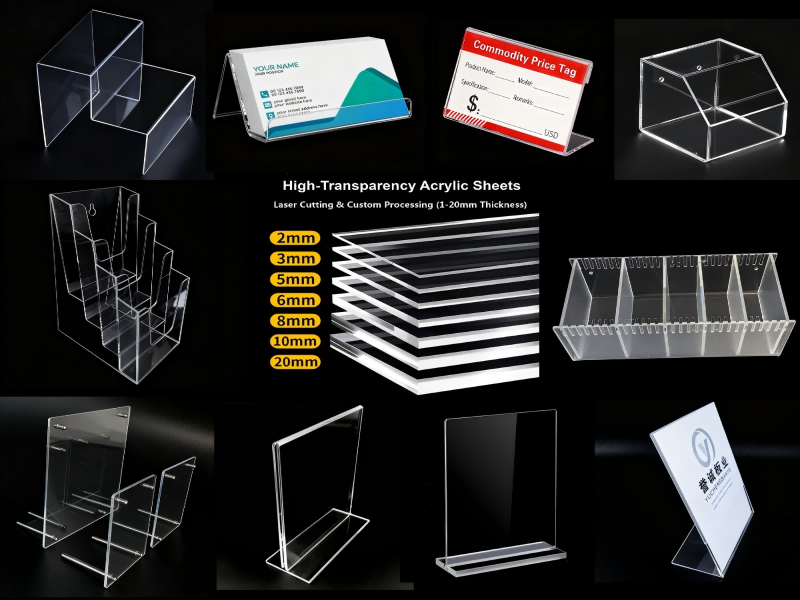
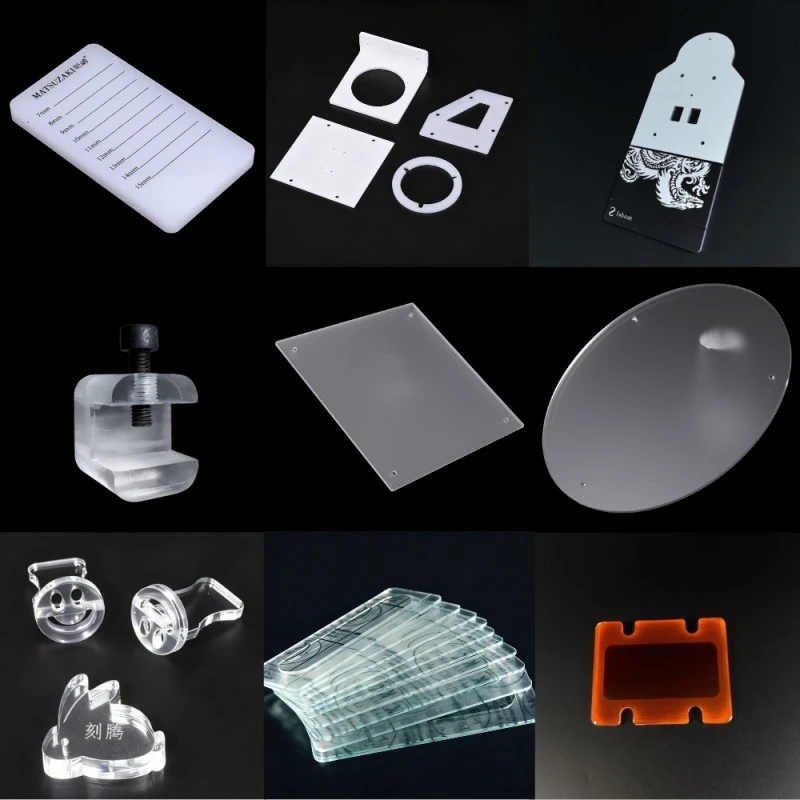
Most clients need to carry out secondary deep processing after purchasing transparent panel raw sheet, such as cutting into a special shape, hot bending into curved component, drilling installation holes, printing brand logo and warning text on the surface. The processing compatibility difference between acrylic and ordinary plastic is very obvious, directly deciding the finished product yield and processing cost of the post-production workshop.
Acrylic Sheet Full Processing Compatibility
Cast and extruded acrylic both support all mainstream plastic deep processing craft without strict extreme parameter limit, our factory owns complete set of CNC cutting machine, laser engraving machine, hot bending oven, multi-head drilling machine, mirror edge polishing machine and full-automatic silk screen printing production line to finish all processing steps inside our own workshop, deliver fully finished ready-to-install acrylic parts to global clients directly, buyers do not need to cooperate with separate third-party processing factory additionally.
- Cutting: Laser cutting and CNC milling cutting both available, cutting edge smooth, clean without burr, cast acrylic can be polished into transparent mirror edge after cutting;
- Bending: Room temperature small radian cold bending and large arc high temperature hot bending are both feasible, after forming, no rebound, surface coating will not crack;
- Drilling: Tiny 2mm micro-hole to large 100mm through-hole, all customizable, step countersunk hole and dense hole array support, no crack around hole edge after drilling;
- Printing: Single color and multi-color weather-resistant UV silk screen printing, ink layer firmly attached to acrylic surface, outdoor printing can keep 8-10 years without peeling and fading.
Ordinary Plastic Processing Defect Limit
- PS plastic sheet: Cannot carry out hot bending craft at all, heating softening stage will directly split into fragments; laser cutting produces a thick black burnt edge, cannot polish into a transparent smooth edge; dense small hole drilling leads to crack spread all over panel surface, high scrap rate more than 60% during complex processing;
- PVC sheet: Hot bending will release pungent toxic gas. After bending, the surface forms a permanent white fog layer, and silk screen printing ink falls off easily after half a year of usage;
- Ordinary PET thin sheet: Only a simple shallow vacuum blister is available; deep drawing 3D forming will crack completely, cannot do mirror edge polishing, printing scratches off after slight surface friction;
- Recycled mixed plastic: Random cracks during cutting and drilling, printing color uneven batch by batch, no stable processing parameter can guarantee a finished product qualified rate, only fit simple straight cutting disposable thin sheet without any extra processing demand.
Many overseas small trading merchants purchase raw plastic sheets and send them to a third-party processing factory because the ordinary plastic processing scrap rate is too high, the actual total finished unit cost after processing is even higher than one-stop finished acrylic custom order from a professional acrylic factory like us, also bringing delivery delay and quality inconsistency hidden risk caused by multi-party cooperation links.
Chapter 13: Service Life & Long-Term Aging Damage Contrast Indoors & Outdoors
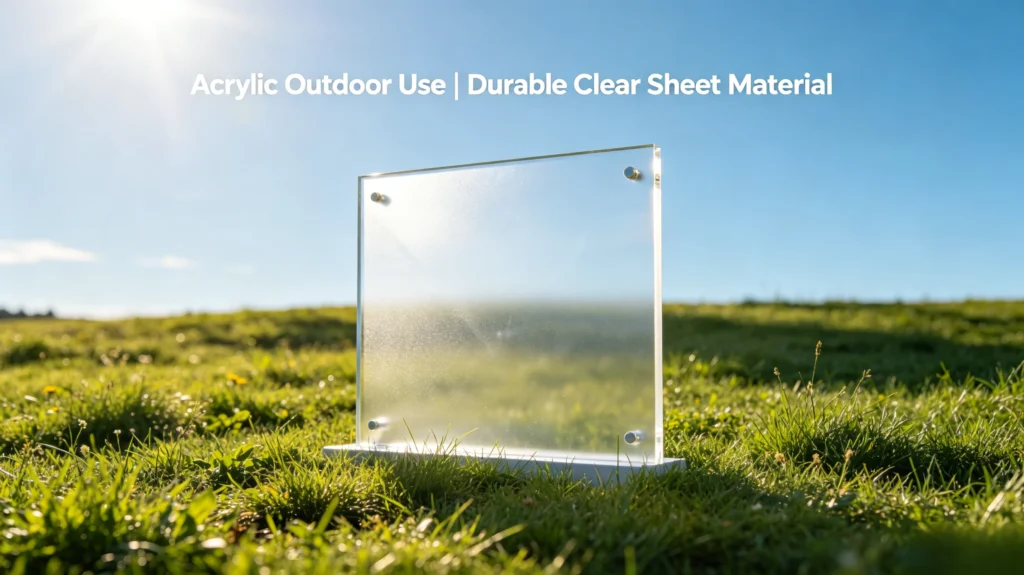
Service life is the most important long-term cost evaluation index for permanent construction, display equipment and public facility projects. We split indoor and outdoor usage environments to list clear service life contrast data of acrylic and ordinary plastic:
Outdoor Full Sun Exposure Service Life
- Double-sided UV-coated cast acrylic: 10-15 years stable transparent appearance, no obvious yellowing, fogging, cracking and deformation; factory can sign formal anti-aging warranty clause for bulk orders;
- Extruded UV-modified acrylic: 7-10 years normal outdoor service life, maintains a clear visual effect without heavy aging damage;
- Ordinary PS plastic sheet: 6-12 months, obvious deep yellow, surface full of tiny crack lines, loses basic usage function within 1 year;
- Transparent PVC plastic sheet: 8-10 months of fog and uneven shrinkage, cannot be used after one summer season;
- Ordinary PET plastic sheet: 4-6 months surface white matte fog layer, light transmittance drops heavily, becomes fuzzy opaque;
- Recycled mixed plastic sheet: 2-3 months irregular yellow block and brittle crack, direct full batch scrap replacement needed.
Indoor Indirect Light Usage Service Life
- Virgin cast acrylic sheet: More than 20 years of stable performance, transparent gloss remains unchanged, no aging damage phenomenon;
- Extruded acrylic sheet: 12-18 years normal indoor service life, slight tiny color difference only visible under a professional test instrument, cannot be noticed by human eyes;
- PS ordinary plastic sheet: 2-3 years turns light yellow, the surface accumulates countless scratch marks, loses display decoration effect;
- PVC plastic sheet: 2-3 years, hardens and shrinks around the four edges, producing a pungent plastic odor when the indoor temperature rises in summer;
- PET plastic sheet: 1.5-2 years surface forms permanent wipe mark fog layer, visual clarity drops obviously;
- Recycled mixed plastic sheet: Within 1 year of indoor use appear random cracks and color uneven block, need full plate replacement to maintain normal project operation.
From the long-term comprehensive investment perspective, for any project that needs to keep a stable appearance and safety performance for more than 2 years, choosing acrylic sheet one-time procurement can save multiple times of repeated raw material, processing, labor and construction disassembly costs compared with ordinary plastic sheet, avoid frequent project maintenance pauses and customer bad experience caused by plastic panel aging damage.
Chapter 14: Cost, MOQ & Global Market Price Difference Analysis
Most buyers first focus on unit price during initial inquiry, and this is the only advantage of ordinary plastic sheets in the entire industry. Low upfront cost makes cheap plastic popular for temporary, low-budget, short-cycle projects. However, most overseas buyers only see the one-time material price and ignore the long-term hidden costs caused by frequent replacement, defective processing, safety failures, project delays and after-sales complaints.
Ordinary plastic sheets (PS / PVC / PET / recycled plastic) have extremely low raw material costs. Their production processes are simple, raw material purification standards are low, and no UV coating, stress removal or quality screening is required. The MOQ for ordinary plastic is almost zero, and small workshops can produce batches at will. This leads to chaotic market pricing, uneven quality, and no unified industry inspection standard. The unit price is 30%–60% lower than standard acrylic, but the comprehensive usage cost is far higher in the long run.
Standard acrylic sheet adopts strict virgin PMMA pellet raw materials, standardized polymerization, annealing stress relief, UV co-extrusion and three-level full inspection procedures. The production threshold is high, and qualified formal factories have fixed production specifications and stable quality control systems. The initial unit price is higher than ordinary plastic, but the batch stability, yield rate and service life are exponentially improved.
Our factory adopts a flexible MOQ policy for global clients, supporting small sample trial orders and large-scale engineering bulk orders. We do not set rigid, high minimum order quantities like traditional large acrylic factories. For customers who are new to acrylic customization and worry about quality mismatch, we support small-batch sample production first, and then mass production after confirmation, which greatly reduces the trial risk of overseas buyers.
In terms of long-term comprehensive accounting: ordinary plastic needs to be replaced 3–6 times within 5 years, with additional processing fees, installation fees, labor costs and project stop-loss losses. The total cost is 3–6 times higher than one-time acrylic procurement. For formal commercial projects, outdoor permanent facilities and public safety projects, acrylic is actually the most cost-effective solution.
Chapter 15: Suitable Application Scenarios For High-Quality Acrylic Sheet
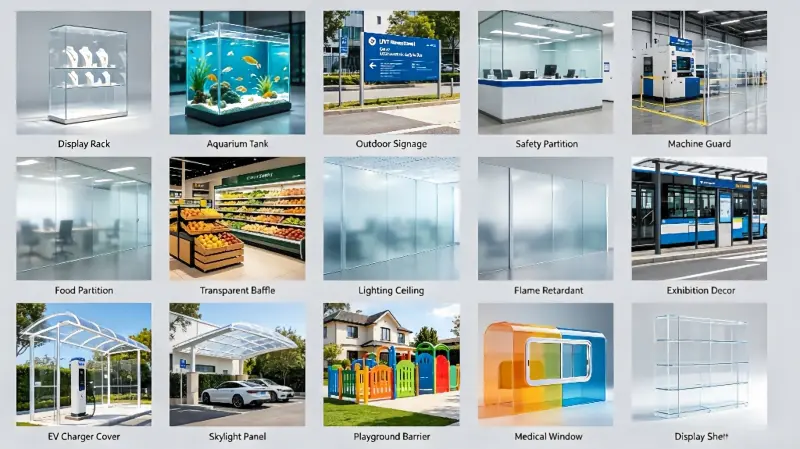
After understanding the full performance advantages of PMMA acrylic sheet, we summarize all high-matching application scenarios suitable for acrylic materials, helping buyers quickly confirm whether acrylic is the right choice for their projects:
1. Commercial display and retail decoration
High-transparent acrylic display racks, cosmetic display cabinets, jewelry showcases, supermarket fruit and pastry partitions, mall anti-glare ceiling panels, store window transparent decorations. Acrylic’s high transparency, anti-scratch and long-term non-yellowing features ensure high-end display texture and no frequent replacement.
2. Outdoor permanent facilities
Outdoor advertising signage, bus stop transparent baffles, community courtyard sunshade panels, park landscape partitions, villa carport skylights, roadside safety warning baffles. Double-sided UV acrylic can withstand long-term sun exposure, rain erosion, and seasonal temperature fluctuations.
3. Public safety and isolation engineering
Bank counter isolation windows, school corridor anti-collision partitions, playground safety baffles, hospital transparent isolation boards, station security isolation facilities. Acrylic’s high impact resistance and non-shattering safety fully meet public facility safety inspection standards.
4. Aquarium and water landscape engineering
Large fish tank transparent panels, aquarium viewing tunnel, underwater landscape baffles, swimming pool transparent partition walls. Food-grade safe acrylic, no toxic precipitation, strong water pressure resistance, long-term soaking without fogging and aging.
5. Mechanical equipment and new energy accessories
CNC machine tool anti-splash guard, equipment observation window, new energy charging pile transparent shell, automated equipment protective cover, industrial anti-dust baffle. Acrylic supports precise CNC processing, high and low temperature resistance, and stable industrial use.
6. Architectural decoration and lighting engineering
Indoor light-transmitting ceiling, frosted privacy partition, staircase transparent guardrail, lighting soft light diffusion panel, indoor and outdoor decorative modeling parts. Rich acrylic color and surface technology meet diverse design needs.
Chapter 16: Scenarios Only Fit For Low-Cost Ordinary Plastic Sheets
We do not deny the use value of ordinary plastic sheets. In specific low-demand, temporary and disposable scenarios, ordinary plastic is more cost-effective and does not cause waste. The following scenarios are completely suitable for cheap ordinary plastic instead of acrylic:
1. Short-term temporary advertising
Temporary event display signs, short-term promotional posters, and disposable activity isolation boards that only need to be used for 3–15 days. For no long-term weather resistance and anti-aging requirements, ordinary plastic can fully meet the basic display function.
2. Disposable packaging and liner protection
Product packaging transparent liner, logistics shockproof plastic sheet, disposable protective cover for factory turnover parts. Low unit price, disposable use, no need for long-term stability.
3. Indoor temporary simple isolation
Temporary office partition, simple construction area isolation baffle, short-term dust-proof baffle. Low safety load, no outdoor exposure, no high appearance requirements.
4. Low-budget amateur handmade materials
Small handmade DIY accessories, student handmade materials, temporary model production. Low processing precision requirements, disposable molding use.
Core selection principle: If your project requires more than 1 year of stable use, outdoor exposure, public safety standards, high appearance transparency or precise processing, ordinary plastic must be abandoned and acrylic is the only reliable choice.
Chapter 17: Common Misunderstandings Buyers Have About Acrylic & Plastic Panels
Based on tens of thousands of overseas inquiry cases, we summarize the six most frequent and costly misunderstandings of global buyers when purchasing transparent panels, helping you avoid order losses completely:
Misunderstanding 1: All transparent plastic boards are acrylic
Many buyers regard PS, PVC and PET transparent sheets as acrylic, resulting in wrong material selection. Acrylic is the only PMMA material; all other transparent plastics are ordinary plastics with completely different performance parameters.
Misunderstanding 2: Thick ordinary plastic can replace acrylic for safety projects
Many customers try to increase the thickness of cheap plastic to improve impact resistance and weather resistance. In fact, the molecular defects of ordinary plastic cannot be made up for by an increase. Thick PS is still brittle, and thick PVC still yellows and deforms outdoors.
Misunderstanding 3: Acrylic is easy to break and scratch, the same as ordinary plastic
This is the biggest prejudice against acrylic. Qualified virgin acrylic is 3–8 times more impact-resistant than ordinary plastic, and its surface hardness is far higher than that of cheap plastic. The fragile and easily scratched panels on the market are almost all fake acrylic or recycled plastic imitation boards.
Misunderstanding 4: All acrylic sheets have the same quality
Acrylic is divided into virgin material and recycled material, cast and extruded, single-sided UV and double-sided UV. The quality gap between different processes and raw materials is huge. Many small factories mix recycled materials to reduce prices, resulting in acrylic performance close to ordinary plastic.
Misunderstanding 5: Outdoor use only needs a thick board, no need for UV coating
Thickness cannot resist ultraviolet aging. Without double-sided UV co-extrusion coating, even 20mm thick acrylic will turn yellow and crack rapidly outdoors, the same as ordinary plastic.
Misunderstanding 6: Ordinary plastic can pass the same safety certification as acrylic
Ordinary plastic cannot pass food-grade certification, public fire protection certification and long-term weather resistance test certification. Formal engineering bidding and customs clearance only recognize standard PMMA acrylic test reports.
Chapter 18: How To Quickly Distinguish Acrylic From Ordinary Plastic By A Simple Test
We sort out three zero-cost manual identification methods that do not require professional equipment. Buyers can test samples by themselves to quickly distinguish genuine acrylic and fake ordinary plastic imitation boards:
1. Knocking sound test
Gently knock the panel with your knuckle: genuine acrylic emits a thick, dull and solid low sound; ordinary plastic such as PS and PVC emits a crisp, thin and hollow sharp sound, which is very easy to distinguish.
2. Edge observation and cutting smell test
Acrylic edge is transparent and crystal clear without fog shadow; cutting produces a slight special resin odor, non-irritating; ordinary plastic edge is foggy and gray; cutting produces a pungent plastic burning smell, especially PVC and recycled plastic with heavy odor.
3. Bending and toughness test
Thin acrylic sheet can be bent moderately with good toughness, no brittle fracture; ordinary PS plastic will break directly when bent slightly, and PET and PVC will produce permanent wrinkled deformation without rebound.
4. Light transmission contrast test (most intuitive)
Place the panel on pure white paper: acrylic is pure transparent without color cast; ordinary plastic has gray, blue or white fog color cast, which is obvious under strong light.
Chapter 19: Our Factory One-Stop Custom Acrylic Sheet Fabrication Full Service
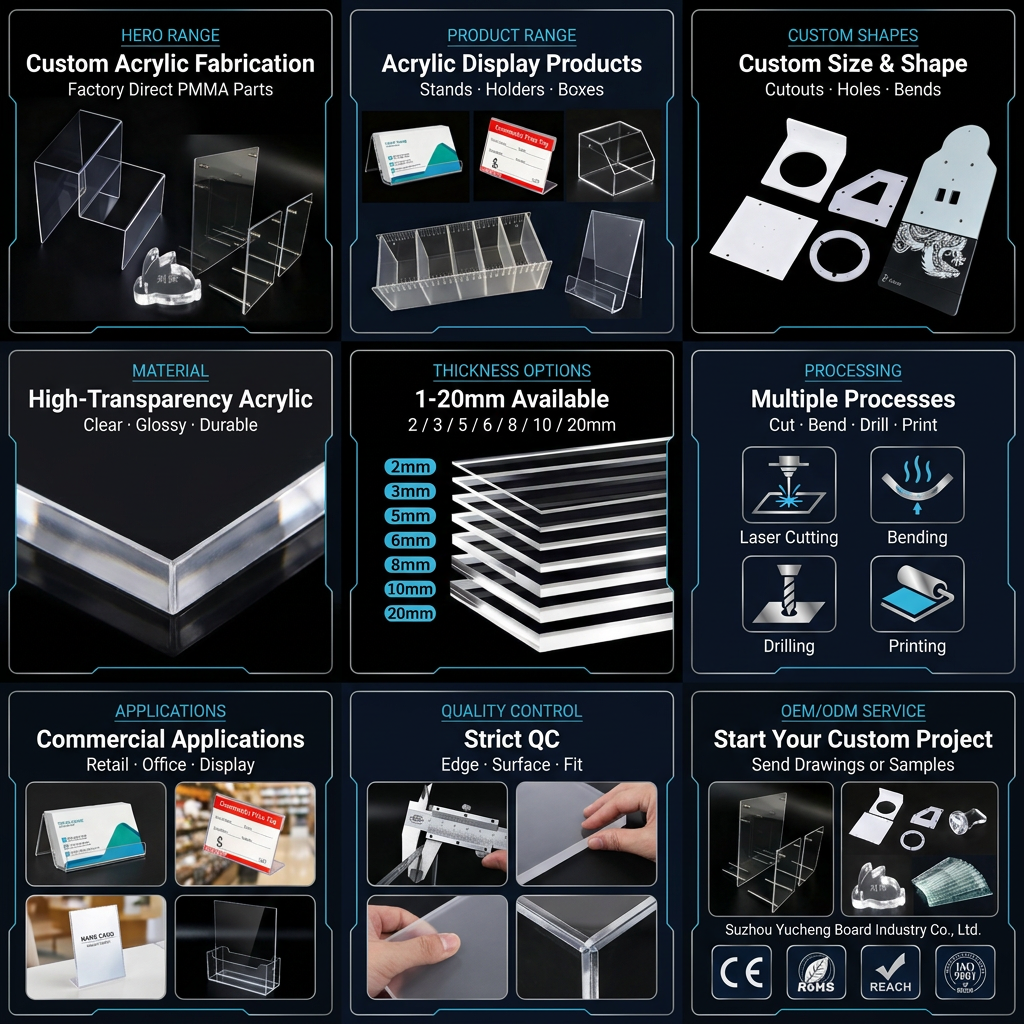
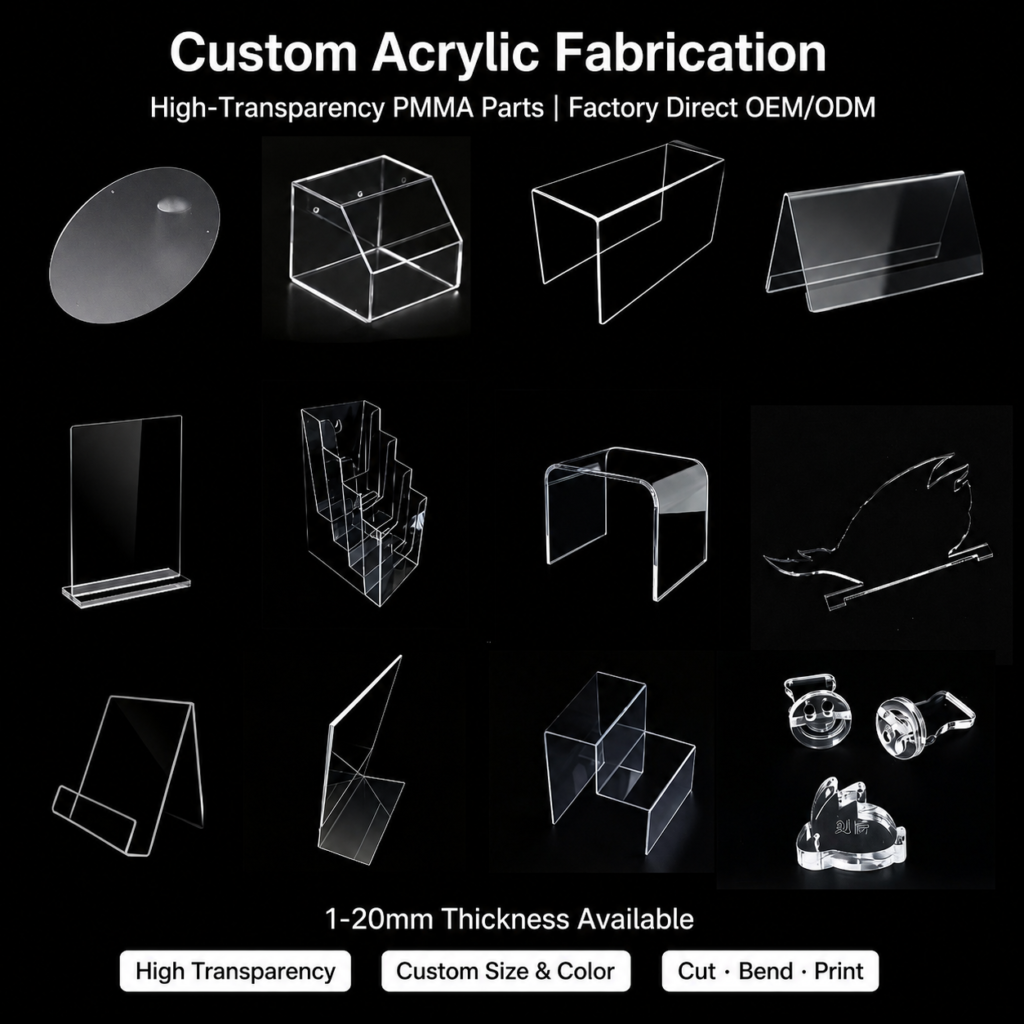
Als professional acrylic custom manufacturing and export factory with 15 years of overseas service experience, we have complete cast acrylic and extruded acrylic production lines, supporting full-process independent production from raw material melting, plate forming, surface functional coating to deep processing and finished product export packaging. All core processes are self-produced without outsourcing, which fundamentally controls product quality, delivery cycle and customized cost for global buyers.
1. Full-type acrylic custom production capability
We support all acrylic customization needs: transparent, colored, frosted, matte, anti-glare, UV outdoor anti-aging, 3H high hardness scratch-resistant, UL94 V0 flame-retardant modified, food-grade safe acrylic. The thickness ranges from 0.8mm ultra-thin sheet to 200mm super-thick cast acrylic, fully covering indoor decoration, outdoor engineering, display equipment, safety protection, aquarium engineering and other scenarios.
2. Full deep processing one-stop service
We complete all secondary processing in our own factory: laser cutting, CNC special-shaped cutting, precise hole drilling, countersunk hole processing, edge mirror polishing, heat bending forming, vacuum blister, multi-color silk screen printing, UV printing, surface frosting and anti-scratch coating. We deliver finished ready-to-install acrylic products, saving buyers the trouble of finding a third-party processing factory.
3. Strict raw material and quality control system
We strictly use 100% virgin imported PMMA pellets for all customized orders, never mix recycled plastic scraps. Three-level full inspection of incoming materials, semi-finished products and finished products ensures zero defective delivery. All outdoor acrylic products are equipped with double-sided UV co-extrusion coating to ensure long-term anti-yellowing and anti-aging performance.
4. Flexible order and free technical support
Support sample trial order + bulk engineering order, flexible MOQ, no rigid high threshold. Our professional English-speaking technical team provides 24-hour free program optimization, drawing review, parameter matching and material selection suggestions to help customers avoid customization mistakes and material mismatch risks.
5. Complete export supporting system
Provide CE, RoHS, ISO9001, food-grade test reports, aging resistance test reports and bidding qualification documents. Support FOB, CIF, DDP door-to-door full-process export service, professional shockproof wooden box export packaging, and solve all logistics and customs clearance problems for overseas customers.
6. Long-term after-sales warranty guarantee
Outdoor UV acrylic provides 10-year anti-yellowing and anti-aging warranty, indoor acrylic provides 20-year long-term performance guarantee, lifelong free technical guidance and after-sales maintenance consultation, allowing global buyers to cooperate without worries.
Chapter 20: Final Buyer Selection Guide: Pick Acrylic Or Ordinary Plastic For Your Project
To sum up all comparison dimensions in this article, we give the most straightforward and practical selection suggestions for global procurement buyers:
Choose high-quality PMMA acrylic sheet if your project meets any of the following conditions:
✔ Need to use for more than 1 year stably
✔ Outdoor sun exposure, rain and wind environment
✔ Public facilities, safety isolation and fire protection standard projects
✔ High appearance requirements for transparency, no color cast and no fogging
✔ Need precise CNC processing, hot bending, polishing and printing
✔ Food contact, aquarium and environmental safety scenarios
✔ Long-term project operation, pursuing low comprehensive maintenance cost
Choose an ordinary plastic sheet only if your project meets all conditions:
✔ Short-term temporary use within 1 month
✔ Indoor no sunlight, no wind and no pressure environment
✔ No safety standard and high appearance requirements
✔ Disposable use, no after-sales maintenance need
✔ Ultra-low budget temporary auxiliary materials
Abschließende Schlussfolgerung
Acrylic is a high-performance upgraded transparent plastic material, while ordinary plastic is a low-cost basic industrial plastic material. There is no absolute good or bad material, only suitable or unsuitable scenarios. For formal commercial engineering, permanent outdoor facilities and public safety projects, acrylic’s transparency, safety, weather resistance and processing performance are irreplaceable by any ordinary plastic. For temporary disposable scenarios, ordinary plastic can effectively save procurement costs.
If you have project drawings, size parameters, usage scenarios and budget requirements, welcome to contact our team at any time. We will provide you with free customized material selection scheme, an accurate quotation and a processing solution to help you complete zero-risk high-cost-effectiveness procurement.