






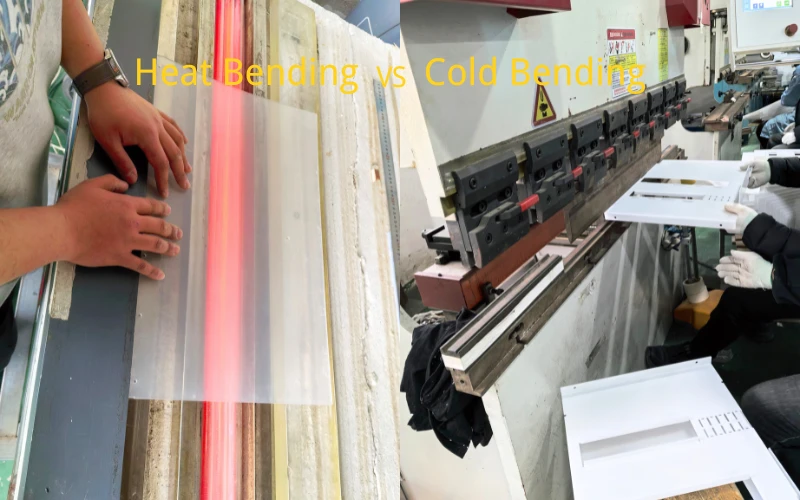
When fabricating custom plastic parts—acrylic, polycarbonate (PC), PETG, ABS, or other thermoplastics—bending is a core process to create angles, curves, enclosures, guards, and displays. Two primary methods dominate: cold bending and heat bending. Choosing the right one directly impacts cost, lead time, part quality, and durability.
In this article, we will compare cold bending vs heat bending plastic, helping you choose the best method for your project.
We also share how Yoochen Plastic’s precision bending services deliver tailored solutions for your project.
What Is Cold Bending?
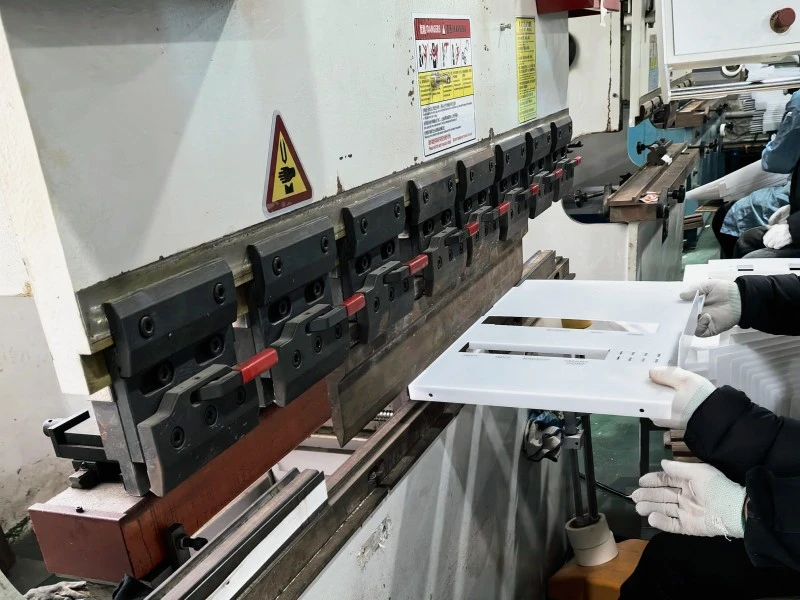
Cold bending is a room-temperature forming process that uses mechanical force (press brake, manual jig, or bending machine) to bend plastic sheets into shape—no heat required. It relies on the plastic’s inherent ductility to deform plastically and hold the bend.
How It Works
- Clamp the plastic sheet (typically thin, ≤4mm) in a bending machine.
- Apply controlled mechanical pressure to create the desired angle (90°, 120°, etc.).
- The bend is set immediately; no cooling time is needed.
Key Advantages
- Ultra-fast: No heating/cooling—parts ready in minutes.
- Low cost: No heating equipment, energy, or labor for thermal control.
- Preserves material properties: No heat-induced discoloration, warping, or strength loss.
- Clean edges: Sharp, precise bends with no surface defects.
Limitations
- Thickness restricted: Best for sheets ≤4mm (thicker materials risk cracking/stress fractures).
- Angle limits: Difficult to achieve tight radii or complex curves; prone to spring-back.
- Material limited: Works best for ductile plastics (PC, PETG, thin ABS); not ideal for brittle acrylic.
What Is Heat Bending Plastic?
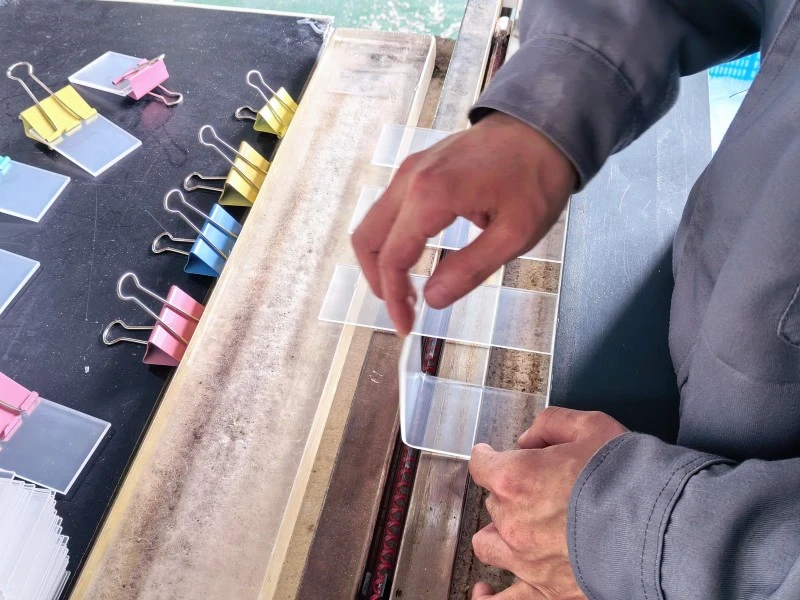
Heat bending (also called line bending or thermo-bending) uses controlled heat to soften a narrow strip of plastic, making it malleable for bending. After bending, the plastic cools and hardens, permanently retaining the shape.
How It Works
- Heat the target bend line (hot wire, heating strip, or heat gun) to 100–180°C (material-dependent).
- Once softened, bend the sheet to the desired angle/radius using a jig or press.
- Hold in place until fully cooled to lock the shape.
Key Advantages
- Unlimited shape potential: Sharp angles, tight radii, large curves, and complex multi-bend parts.
- Thick material compatible: Works for acrylic, PC, ABS up to 20mm+ thickness.
- Minimal stress: Heat relieves internal tension, reducing cracking and spring-back.
- Wide material fit: Ideal for acrylic (PMMA), PC, PETG, ABS, polystyrene, and engineering plastics.
Limitations
- Longer cycle time: Heating + cooling adds 10–30 minutes per part.
- Higher cost: Requires specialized heating equipment and skilled operation.
- Minor surface risk: Poor temperature control may cause slight discoloration or hazing.
Cold Bending vs Heat Bending: Key Differences
| Factor | Cold Bending | Heat Bending |
| Temperature | Room temperature | 100–180°C (material-specific) |
| Thickness Range | ≤4mm (optimal) | 1–20mm+ (all thicknesses) |
| Bend Type | Simple angles (90° preferred) | Sharp angles, tight radii, curves, complex bends |
| Cycle Time | 1–5 minutes per part | 10–30 minutes per part |
| Cost Per Part | Lowest (no heat cost) | Higher (equipment + energy) |
| Material Fit | PC, PETG, thin ABS; poor for acrylic | Acrylic, PC, PETG, ABS, all thermoplastics |
| Stress & Cracking | Higher risk (thick/brittle materials) | Low risk (heat relieves stress) |
| Surface Quality | Perfect (no heat marks) | Excellent (minor risk with poor control) |
| Best For | Thin sheets, fast production, simple angles | Thick sheets, complex shapes, acrylic parts |
| Applications | ✅Thin PC machine guards & safety shields ✅Instrument panels & electronic enclosures (≤4mm) ✅Fast-turn prototypes & small-batch simple parts ✅PETG display shelves & protective covers ✅Protective shields | ✅Acrylic retail displays, sign holders, curved stands,and boxes ✅Thick PC industrial guards & custom housings ✅Complex multi-angle enclosures & medical device components ✅Large-radius curved plastic parts & architectural glazing ✅Acrylic/PC fabrication for retail, medical, and industrial use |
| Plastic Material | Cold Bending | Heat Bending | Notes |
| Acrylic (PMMA) | ❌ Not recommended (brittle, cracks easily) | ✅Excellent (most common use) | Ideal for displays, guards, enclosures |
| Polycarbonate (PC) | ✅ Excellent (ductile, thin sheets) | ✅Excellent (thick sheets, complex bends) | Impact-resistant; used for machine guards |
| PETG | ✅ Very good | ✅ Excellent | Clear, durable; medical/display parts |
| ABS | ✅ Good (thin) | ✅ Excellent (thick) | Structural parts, enclosures |
| HDPE/PP | ❌ Poor (too flexible) | ✅ Good | Industrial tanks, covers |
When to Choose Cold Bending
Choose cold bending if:
- You need simple curved shapes
- Fast processing is required
- Material is flexible (like polycarbonate)
When to Choose Heat Bending
Choose heat bending if:
- You need precise angles
- Complex shapes are required
- High-quality appearance is important
Yoochen Plastic: Your Trusted Plastic Bending Partner
We specialize in precision cold bending and heat bending services for a full range of thermoplastics—acrylic, PC, PETG, ABS, and more. Our advanced equipment and skilled technicians ensure tight tolerances (±0.1mm), clean finishes, and consistent quality for every project.
Our Bending Capabilities
- Cold Bending: Fast, cost-effective.
- Heat Bending: Precision line bending for acrylic/PC up to 20mm.
- Custom Solutions: Material selection guidance, design optimization, and full fabrication (cutting, bending, bonding, assembly).
- Fast Turnaround: Cold-bent parts in 1–3 days; heat-bent parts in 3–7 days.
Whether you need thin, fast cold-bent guards or thick, complex heat-bent acrylic displays, we deliver tailored solutions that match your budget, timeline, and quality requirements. Contact us today to discuss your plastic bending project and get a free quote.
Conclusion
Cold bending and heat bending are both essential plastic fabrication processes—each with unique strengths. Cold bending excels at fast, low-cost, thin-sheet simple bends for ductile materials like PC and PETG. Heat bending is the go-to for thick materials, complex shapes, and acrylic parts, offering unmatched design flexibility and durability.
By matching your material, thickness, bend complexity, and timeline to the right process, you can optimize cost, quality, and lead time. For professional, reliable plastic bending services, partner with Yoochen Plastic—your one-stop source for custom plastic fabrication.
Contact us today for a free quote!