





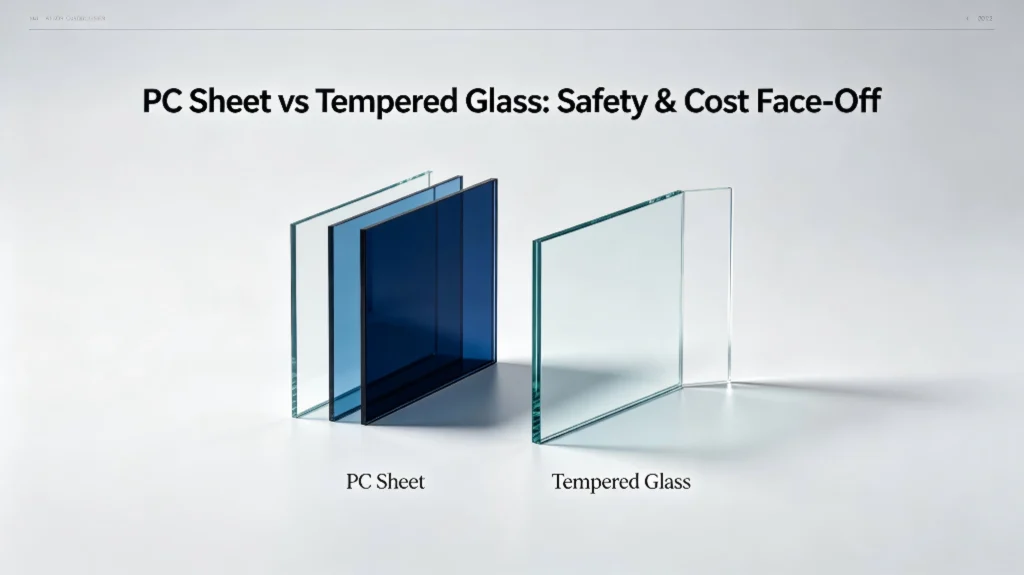
When you start planning a sunroom, carport, greenhouse, patio cover, safety guardrail, skylight, or any project that needs a clear, strong, weather-resistant panel, you will almost always end up with two main choices: tempered glass or polycarbonate (PC) sheet. Both are transparent, both are widely used in construction, and both are considered “safe” materials in their own right. But if you dig a little deeper, you will quickly find they are very different in terms of safety performance, installation difficulty, maintenance work, and overall cost over the years.
Many homeowners, contractors, and business owners get stuck here. “Glass is glass, it’s proven safe, right?” “But everyone says PC sheet is unbreakable and cheaper to install.” It’s easy to get confused by conflicting information online, or by salespeople who only push one product because it’s more profitable for them.
This guide will walk you through everything you need to know about PC sheets vs tempered glass. We will compare them on safety (impact resistance, shatter risk, weather safety, fire safety), durability (UV resistance, aging, discoloration), installation (weight, labor, structural requirements), and the real total cost (initial price, installation, maintenance, repairs, and long-term replacement). We will also break down which projects each material is best for, and when one is clearly the better choice over the other.
By the end of this article, you will know exactly when to choose PC sheet, when to choose tempered glass, and how to avoid common mistakes that cost you time and money. We will also share how our factory supplies high-quality, 100% virgin PC sheets for all kinds of projects, with custom sizes, UV protection, and long-term warranties.
1. Quick Overview: What Is Tempered Glass vs Polycarbonate Sheet?
1.1 What Is Tempered Glass?
Tempered glass is regular glass that has been heated to a very high temperature and then cooled quickly. This process makes it stronger than ordinary glass, and when it breaks, it shatters into small, blunt pieces instead of sharp, dangerous shards. That’s why it’s called “safety glass” — it’s designed to reduce injury risk when it fails.
Tempered glass is common in car windows, shower doors, balcony railings, building facades, and skylights. It’s clear, scratch-resistant, and has a classic look that many people associate with quality construction.
1.2 What Is Polycarbonate (PC) Sheet?
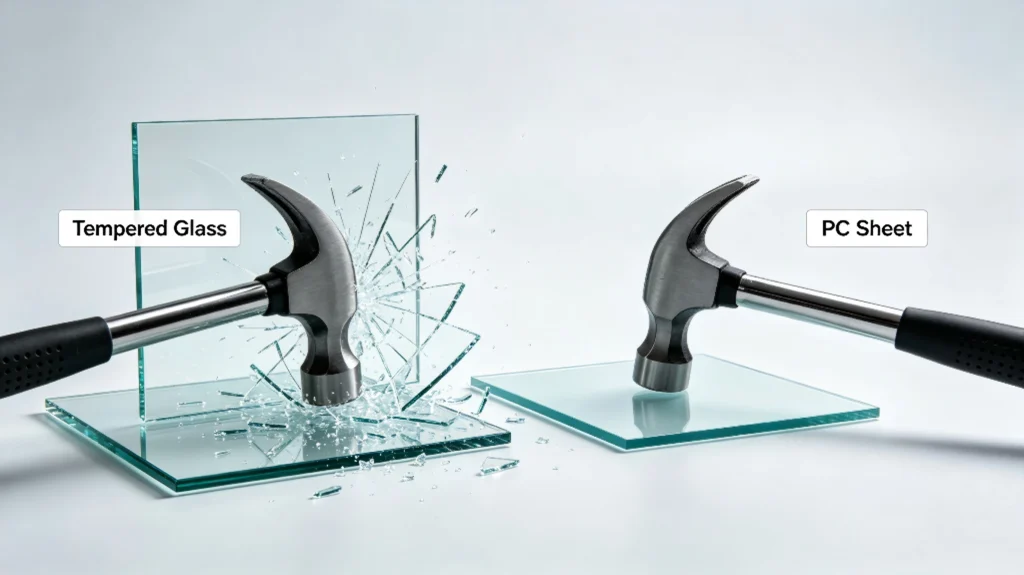
Polycarbonate sheet (also called PC sheet, lexan sheet, or solid polycarbonate panel) is a type of plastic that is extremely strong, lightweight, and impact-resistant. It’s often described as “unbreakable” — you can hit it with a hammer and it won’t shatter.
PC sheets come in different styles: clear, frosted, colored, fire-retardant, and even multiwall (hollow) sheets for better insulation. They are widely used for carports, sunrooms, greenhouses, safety guards, machine shields, and noise barriers.
2. Safety Comparison: The Most Important Difference
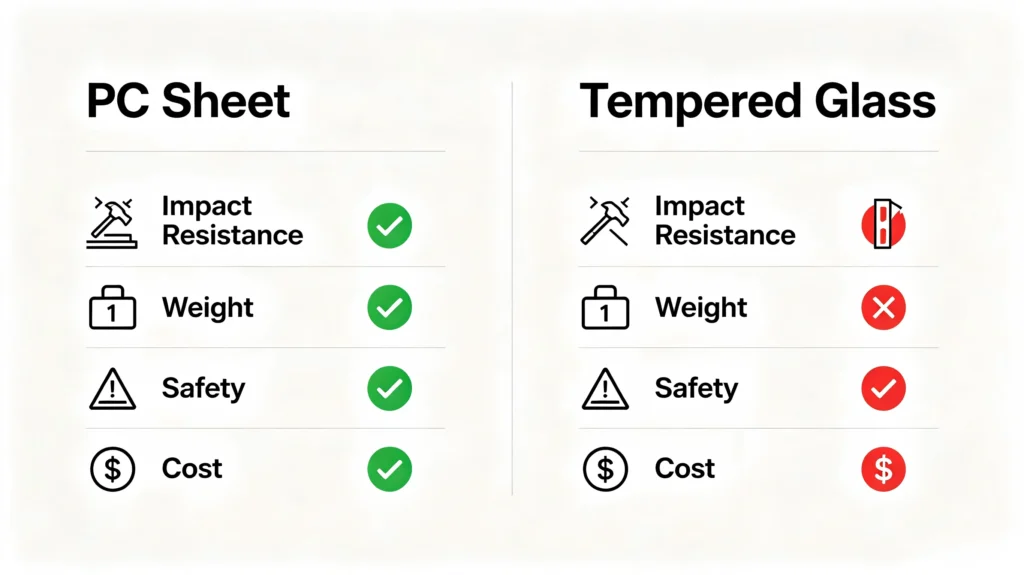
When it comes to safety, these two materials are worlds apart. Safety isn’t just about “not breaking” — it’s about what happens if something goes wrong.
2.1 Impact Resistance & Shatter Risk
Tempered Glass
Tempered glass is stronger than regular glass, but it’s still glass. If you hit it hard enough (like with a falling tree branch, a hailstone, or a strong impact), it will break. When it breaks, it shatters into small pieces. While those pieces are less sharp than ordinary glass, they can still cause cuts and injuries, especially in public areas or homes with children.
In some cases, tempered glass can even “spontaneously break” due to internal stress, minor defects, or temperature changes. That’s a rare but real risk.
PC Sheet
PC sheet is almost impossible to break under normal conditions. It’s 250–300 times stronger than glass. If you drop a hammer on it, it won’t shatter. If a tree branch falls on your carport roof, the PC sheet might dent a little, but it won’t break into pieces. There’s no flying debris, no sharp edges, and no risk of injury from broken material.
This makes PC sheet the safer choice for high-impact areas, hail-prone regions, public spaces, and places where children play.
2.2 Weather Safety: Wind, Rain, Hail, and Temperature
Tempered Glass
Tempered glass is weather-resistant and won’t be damaged by rain or sunlight. But in strong winds, the weight of glass can put extra stress on frames, increasing the risk of the glass breaking or the structure failing. Hail is also a big risk — large hailstones can crack or shatter tempered glass.
In extreme cold or heat, glass expands and contracts, which can cause stress cracks over time.
PC Sheet
PC sheet is lightweight and flexible, so it can flex with strong winds instead of resisting them. It’s hail-resistant in most cases, and even if a hailstone leaves a dent, the sheet won’t shatter. It can handle temperatures from -40°C to +120°C without becoming brittle or warping, making it more stable in extreme weather.
The only thing to watch for with PC sheet is UV protection — make sure it has a co-extruded UV layer to prevent yellowing and degradation.
2.3 Safety After Breakage
Tempered Glass
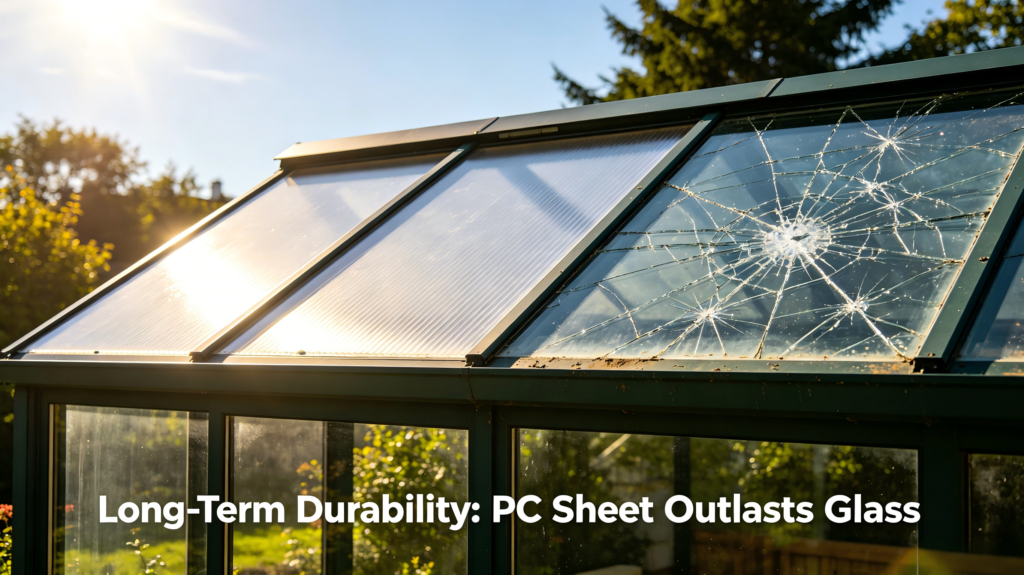
When tempered glass breaks, it’s done. The entire panel shatters, and you have a big mess to clean up. If it’s a roof or skylight, the broken pieces can fall on people or property below. You also have to replace the whole panel right away — there’s no temporary fix.
PC Sheet
If PC sheet ever gets damaged (like a deep scratch or a small crack from extreme force), it won’t shatter. The damage stays local, and you can often repair small scratches with polish. If you do need to replace it, the panel is light and easy to remove, with no risk of broken glass falling.
3. Durability & Longevity
3.1 UV Resistance & Yellowing
Tempered Glass
Glass doesn’t yellow with age. It stays clear and transparent forever, no matter how much sunlight hits it. That’s a big plus for appearance.
PC Sheet
PC sheet can yellow and become brittle over time if it doesn’t have proper UV protection. But high-quality PC sheets with co-extruded UV layers can last 10–15 years outdoors with minimal yellowing. Cheaper PC sheets without UV protection will start to yellow and fog in 2–3 years.
3.2 Scratch Resistance
Tempered Glass
Glass is very scratch-resistant. You can clean it with most tools without worrying about scratches.
PC Sheet
PC sheet is softer than glass, so it can scratch more easily. That’s why many high-quality PC sheets come with a scratch-resistant coating, and we recommend using soft cloths and mild cleaners for maintenance.
3.3 Insulation & Temperature Control
Tempered Glass
Glass conducts heat easily, so it doesn’t provide much insulation. In summer, it lets in heat, making spaces hot. In winter, it lets heat escape, which can increase heating costs.
PC Sheet
PC sheet has better thermal insulation than glass, especially multiwall (hollow) sheets. It keeps spaces cooler in summer and warmer in winter, which can reduce energy costs for heating and cooling.
4. Installation & Structural Requirements
4.1 Weight
Tempered Glass
Glass is heavy. A 5mm thick glass sheet weighs about 12.5 kg per square meter. That means you need strong, heavy frames and supports to hold it up, which adds to material and labor costs.
PC Sheet
PC sheet is lightweight — a 5mm sheet weighs only about 6 kg per square meter, half the weight of glass. This means you can use lighter, cheaper frames, and installation is much easier and faster.
4.2 Installation Difficulty & Labor Cost
Tempered Glass
Installing glass is a two-person job at minimum, and often requires professional installers. The heavy panels are hard to handle, and if you drop one, it breaks instantly. Labor costs are higher, and you need to be very careful with measurements — glass can’t be cut on-site, so it has to be made to exact sizes beforehand.
PC Sheet
PC sheet is light and flexible, so one person can often handle it. It can be cut on-site with simple tools, which means adjustments are easy. Installation time is shorter, and labor costs are lower.
4.3 Structural Load & Long-Term Risk
Tempered Glass
The weight of glass puts constant stress on frames and supports. Over time, this can cause the structure to sag or weaken, especially in large installations like skylights or carports.
PC Sheet
The light weight of PC sheet means less stress on frames, so the structure stays stronger for longer.
5. Cost Comparison: Initial vs. Long-Term
This is where many people make the biggest mistake — only looking at the upfront price. Let’s break down the full cost picture.
5.1 Initial Material Cost
At first glance, glass can look cheaper than high-quality PC sheet. But when you factor in the thicker glass often needed for strength, the price gap narrows. Low-quality PC sheets are cheaper, but they don’t last long.
- Tempered glass: Prices vary by thickness, but 5–10mm glass is common.
- PC sheet: Prices depend on quality, thickness, and UV protection. High-quality UV-protected PC sheet costs a bit more upfront, but lasts much longer.
5.2 Installation Cost
Glass installation costs more because of the weight, labor, and structural requirements. PC sheet installation is faster and requires less heavy equipment, so labor costs are lower.
5.3 Maintenance Cost
- Glass: Low maintenance — just clean it. But if it breaks, you have to replace the whole panel, which is expensive.
- PC sheet: Simple maintenance with soft cloth and mild cleaner. If you choose high-quality PC sheet, there’s almost no maintenance cost for years.
5.4 Long-Term Replacement Cost
- Tempered glass: If it breaks, you have to replace the entire panel, which can be costly, especially for custom sizes.
- PC sheet: High-quality PC sheet lasts 10–15 years outdoors, so you won’t need to replace it often. Even if you do, replacement panels are lighter and cheaper to install.
6. Best Use Cases: When to Choose Which?
Choose Tempered Glass If:
- You want a classic, premium look for your home or building
- Scratch resistance is your top priority (like for table tops or high-traffic areas)
- You don’t have hail or strong wind issues in your area
- The project is small and indoors, where weight isn’t a concern
Choose PC Sheet If:
- Safety is your top priority (hail, impact, public areas, children)
- You need lightweight material for large spans (carports, skylights)
- You want better insulation to reduce energy costs
- You need a material that’s easy to install and repair
- You want a material that won’t shatter, even if damaged
- You’re on a budget and want to save on installation and long-term costs
7. About Our PC Sheet Supply & Custom Service
If you decide PC sheet is the right choice for your project, we are here to help. We are a professional PC sheet manufacturer with over 13 years of experience, specializing in 100% virgin polycarbonate sheets for all kinds of applications.
Our Core Advantages:
✅ 100% virgin PC resin — no recycled material, so you get consistent quality and long life.
✅ Co-extruded UV protection on both sides, with 10-year warranty against yellowing.
✅ Full range of products: clear, frosted, colored, fire-retardant, and multiwall PC sheets.
✅ Custom sizes & processing: cut-to-size, drilling, bending, polishing, printing, and more.
✅ Fast delivery: standard sizes in stock, custom orders in 7–15 days.
✅ Free samples available for quality and color confirmation.
Whether you need a small panel for a safety guard or a large carport roof, we can provide the right PC sheet solution at factory prices. Contact us today for a free quote and sample!
Conclusion
PC sheet and tempered glass are both great materials, but they serve different purposes. If you prioritize safety, light weight, easy installation, and long-term cost savings, PC sheet is almost always the better choice. If you want a classic, scratch-resistant look for a small, low-risk project, tempered glass works well.
At the end of the day, the best material is the one that fits your project’s needs, budget, and safety requirements. If you have questions about PC sheets or need help choosing the right type for your project, contact our team — we’re here to help.